

Mike Figgis’ 1995 film “Leaving Las Vegas”, which was recently released in selected South Korean theaters, is still superlative for many good reasons. At first, its two lead characters seem to be more or less than familiar archetypes, but the movie elevates them as depicting their love story with a lot of human qualities to engage and then move us. In the end, you will not forget them at all after they eventually reach the inevitable ending of their love story.
At the beginning, the movie shows us how serious the alcoholic condition of its hero really is. Ben Sanderson (Nicholas Cage) once had a fairly successful screenplay writer working in Hollywood, but both of his life and career have crumbled a lot as he tumbles down toward the bottom of his alcoholism. In the end, he gets fired, and he soon goes to Las Vegas simply for drinking to death as quickly as possible.
The movie does not explain much about what has actually made him driven to alcoholism and those frequent self-destructive behaviors associated with it, but that does not matter much to us as we observe more of his worsening alcoholism. As he recognizes in a self-deprecating manner at one point early in the film, he has been so deeply mired in his alcoholism that he does not seem to know or remember whether his alcoholism came before losing his dear family or vice versa.
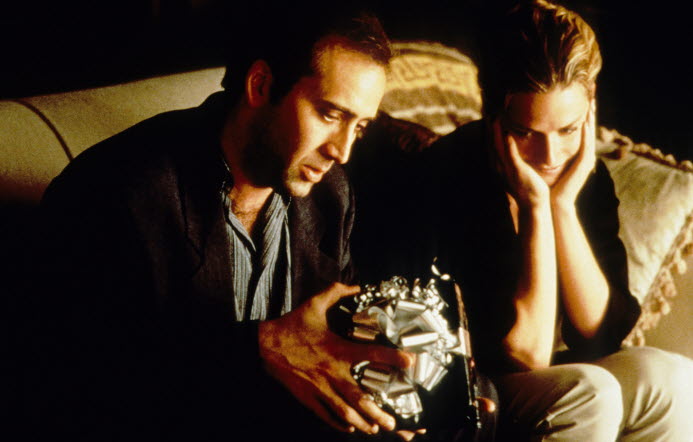
Around the point where Ben arrives in Las Vegas, the movie shifts its focus toward Sera (Elisabeth Shue), a young female prostitute who has worked in Las Vegas for years. Not long after she and Ben come across each other, they happen to meet each other again, and Ben manages to convince her to spend some night with him besides having a sexual encounter in his motel room.
While Ben looks like a creep to her at first, Sera does not say no when they are in his motel room. Although she has sometimes been pretty miserable as working under a Latvian pimp who is thankfully gone later in the story, she is a seasoned professional expert who knows what and how she will do before getting paid. There is a scene where she talks about how deftly she handles those seedy clients of hers as a well-experienced sex worker. She is willing to be whatever her clients desire in exchange for money, but she is not so eager to get emotionally involved with them more.
However, Ben surprises Sera, because she comes to care more about him than expected. She senses something sad about Ben, and then she lets him stay inside her residence. While not being persuaded to stop his suicidal plan at all, Ben asks her to let him stuck with bottles as before, and Sera does not mind this despairing request of his.
Not so surprisingly, both Ben and Sera come to love and care about each other a lot more than they can admit. Getting more and more frustrated with Ben’s worsening alcoholism, Sera cannot help but try to persuade him to get any good chance for recovery, but Ben does not listen to her at all while always thinking about another glass of drink – and what should be done for her before he eventually becomes too burdensome for her.
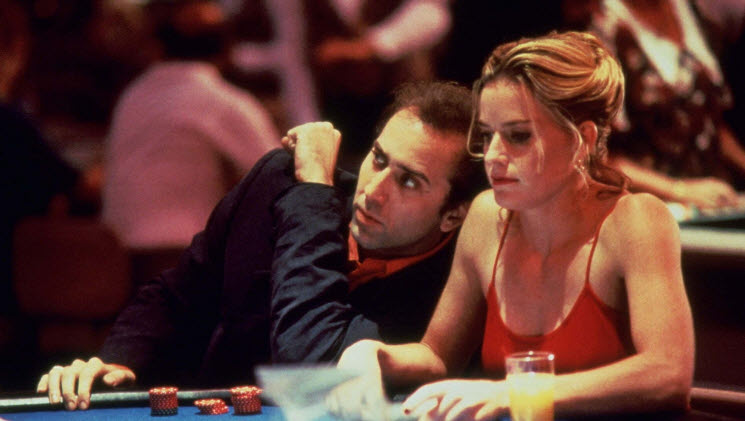
Although often being well-aware of his incorrigible alcoholic condition, Ben cannot help but follow his alcoholic impulses just like many other alcoholics out there. As many people say, one cannot love others without loving oneself first, and Ben cannot possibly be liberated from deep self-loathing, which comes with the territory in case of alcoholism. In the end, he comes to hurt Sera’s feelings a lot, and that accordingly leads him to another bottom to hit.
As the harrowing soul of the film, Nicholas Cage, who deservedly received a Best Actor Oscar for this movie, gives one of the best performances in his rather bumpy career. While he can be pretty bad if he is seriously miscast, Cage has usually showed considerable professional commitment during last several decades, and that is why he is often fantastic in demanding roles requiring a lot of efforts. As a part of his preparation, he studied Albert Finney’s Oscar-nominated alcoholic performance in John Huston’s “Under the Volcano” (1984), and, just like Finney, he gives a compelling performance both subtle and intense. While there are several striking moments emphasizing Ben’s worsening alcoholism, Cage aptly handles these scenes with human nuances to notice and observe, and we come to have more understanding of what Sera sees from Ben as they genuinely fall in love with each other.
On the opposite, Elizabeth Shue, who was also Oscar-nominated, functions as the precious heart of the movie. As the story advances, we get to know more about Sera’s feelings and thoughts during several personal scenes of hers where she reflects on her relationship with Ben. As Sera struggles to process her experience with Ben along the story, she comes to us as an engaging human figure to care about as much as Ben, and Shue, whose career has not sadly been boosted as much as Cage’s after this movie, is simply unforgettable when her character says something quite simple but very poignant at the end of the story.
On the whole, “Leaving Las Vegas”, which is based on the semi-autobiographical novel of John O’Brien (He killed himself shortly before the shooting of the movie began, by the way), is a powerful human drama about not only alcoholism but also love and compassion. This is surely one of the best works in Figgis’ filmmaking career, and I am glad that South Korean audiences can get a chance to see this little masterwork again in movie theaters.



 Seongyong's Private Place