
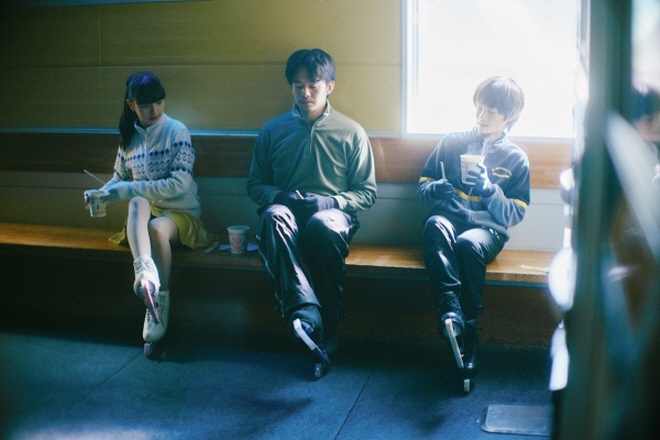
Japanese filmmaker Hiroshi Okuyama’s latest film “My Sunshine” is a modest but engaging coming-of-age drama to be appreciated for several good reasons. While the story and characters are quite familiar to say the least, the movie patiently builds up its mood and story as doling out little human moments to observe, and the overall result is another interesting work from its talented director.
The movie mainly revolves around three main characters, and the opening scene introduces us to one of them, who is a young boy named Takuya (Keitatsu Koshiyama). Besides stuttering at times, Takuya does not get along that well with his schoolmates, and that is more evident to us when he plays ice hockey along with them during one cold winter day. He merely participates in the game as the goalkeeper without much enthusiasm, and, not so surprisingly, many of his schoolmates complain about his lack of effort after the game is over.
Anyway, Takuya continues to practice hockey along with them during next several days, and then something begins to draw his attention on one day. He and his schoolmates happen to practice on the same rink where several female figure skaters around his age are also doing some practice together, and, what do you know, he cannot help but become mesmerized by all the graceful movements of figure skating. Soon, he begins his own practicing alone on the rink, and that happens to draw the attention of Arakawa (Sosuke Ikematsu), a figure skating coach who has been teaching several young female figure skaters after he returned to his hometown.
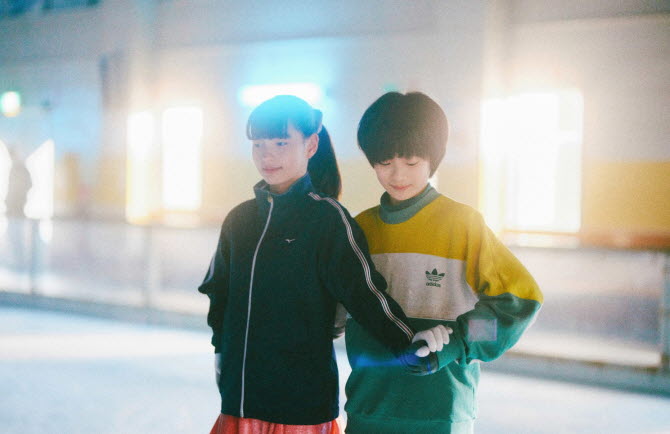
Probably because he saw his younger self from Takuya, Arakawa eventually starts to help and then teach Takuya. Although it takes some time for getting himself more accustomed to figure skating at first, Takuya comes to show more potential along with more enthusiasm, and Arakawa later decides to pair Takuya with Sakura (Kiara Nakanishi), who is one of those young female figure skaters under his coaching.
Now the story looks more like an icy winter version of Stephen Daldry’s Oscar-nominated coming-of-age drama film “Bilie Elliot” (2000), but the movie sticks to its dry and restrained attitude as leisurely rolling its story and character from one narrative point to another. Yes, Sakura, who is evidently interested in getting closer to her handsome male coach, is certainly not so pleased at all when she has to train along with Takuya, but she goes along with Arakawa’s decision anyway, and she turns out to be a fairly good partner for Takuya. Yes, Takuya surely shows more improvement in response, and that brings extra joy and excitement to his mundane middle-class daily life. Neither his parents nor his older brother is particularly supportive, but they do not mind him practicing figure skating instead of ice hockey at all, and he comes to dedicate himself more to that under Arakawa’s steady guidance.
Meanwhile, the screenplay written by Okuyama, who also served as the editor and cinematographer of the movie, gradually reveals a bit about Arakawa’s inner life. As reflected by a bunch of old stuffs belonging to him, he was once a very famous figure skater, and he cannot help but become a bit wistful even though knowing well that his days of glory were way behind him now. In addition, it is revealed that he has something he has mostly kept to himself, and, not so surprisingly, that leads to a little conflict when Sakura happens to discover that later in the story.
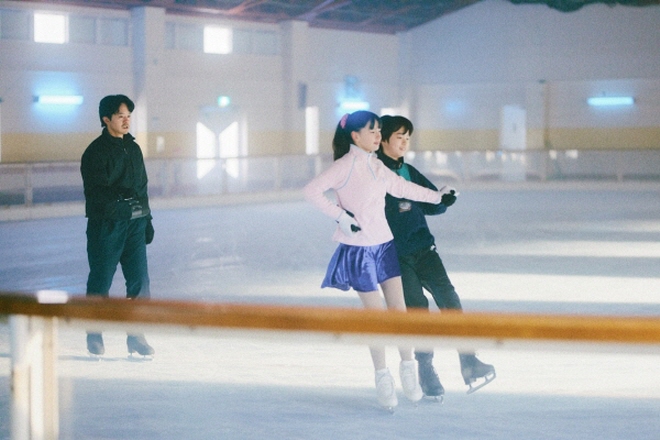
It goes without saying that the story eventually arrives at what is supposed to be a big moment for its three main characters. However, the movie sidesteps expected genre clichés a bit to our little surprise, and there comes a somber moment of personal self-reflection for Arakawa, who comes to muse more on what he really wants from the rest of his life. The following finale is a bit too restrained in my humble opinion, but you may appreciate how the movie pulls out small signs of optimism from each of its three characters at least.
The movie relies a lot on the effortless interactions between its three main cast members, who all give good performances under Okuyama’s competent direction. While Keitatsu Koshiyama humbly holds the center with his unadorned earnest acting, Kiara Nakanishi ably fills her role with enough presence and personality, and Sosuke Ikematsu has his own moments to stand out while diligently supporting his two younger co-stars as required. In case of several figure skating scenes in the film, these scenes are skillfully handled with enough realism, and both Koshiyama and Nakanishi look convincing on the rink while occasionally brightening up the mood.
In conclusion, “My Sunshine”, which belatedly came to South Korean theaters in this week although it was premiered at the Un Certain Regard section of the 2024 Cannes Films Festival and then was shown in the Busan International Film Festival in the same year, is relatively drier than “Billie Elliot” and many other similar coming-of-age drama films out there, but it distinguishes itself enough mainly thanks to its sensitive mood and storytelling. Although it is one or two steps down from his impressive first feature film “Jesus” (2018), Okuyama confirms to us again that he is another promising Japanese filmmaker to watch, and I will certainly keep watching on his advancing filmmaking career.


 Seongyong's Private Place