
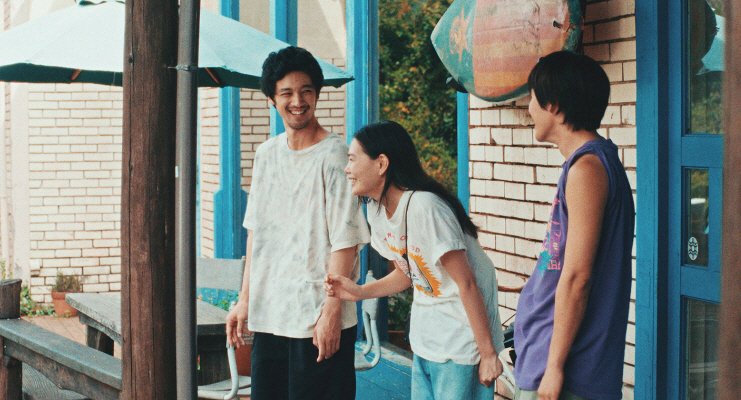
Self-pity can be one of the most tedious things to observe. As watching the first half of “Super Happy Forever”, I kept wondering why I should pay attention to the drab and superficial presentation of its rather uninteresting hero’s self-pity, and this impression of mine unfortunately remained to the end even though the movie later shifts its focus to the other main characters in the story and becomes a bit more engaging to my little relief.
The main background of the story is a resort hotel located in a seaside town named Atami. Although it is about to be shut down within a few days, Sano (Hiroki Sano) and his nurse friend Miyata (Yoshinori Miyata) came to spend several days at the resort mainly for some group activity involved with Miyata, and we come to sense that there is something wrong about Sano as observing how passive and quiet he usually is compared to his friend.
Although he does not tell much, we gradually gather what recently happened to Sano. Around 5 years ago, he came across a woman named Nagi (Nairu Yamamoto) at the same resort, and their accidental encounter led to their romance and then their marriage. Alas, Nagi suddenly died not so long ago, and Sano has felt a lot of grief as well as guilt, while regretting how he was not a very good husband to his wife.
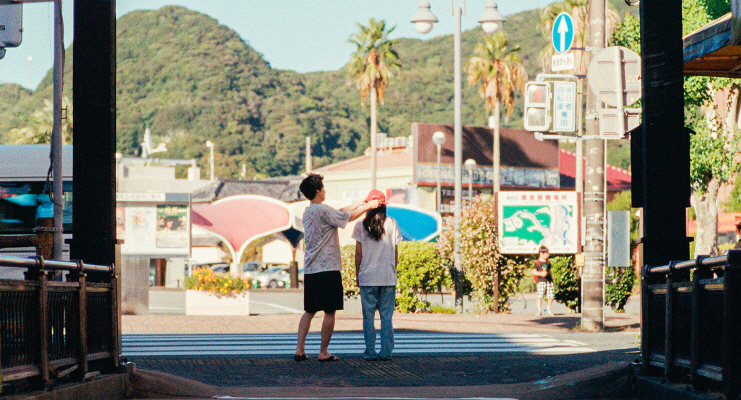
However, the movie merely observes its hero’s self-pity and guilt from the distance without adding much insight or understanding on his ongoing melancholy. As a result, Sano often looks like your average pathetic jerk who does not seem to care much about how he often makes others around him including his friend very uncomfortable to say the least. Yes, we all can be quite pathetic and annoying as struggling with our personal pain and grief, but the movie fails to bring more human details to observe from its hero. Despite the earnest efforts from Hiroki Sano, his character ends up becoming a tepidly one-note character instead of becoming a human figure to engage us more along the story, and Yoshinori Miyata does not have much to do except looking patient or frustrated as required by the story.
Thankfully, the story subsequently moves onto its second act, which is more interesting as looking into how Sano and Nagi met 5 years ago mainly via Nagi’s viewpoint. She was supposed to come down to the resort along with a female friend of hers, but her friend suddenly could not come due to a serious family matter of hers, so Nagi had no choice but to spend next several days alone in Atami.
As wondering here and there without any particular plan, Nagi happens to have a little encounter with Sano via a rather amusing incident at the lobby of the resort. Although this encounter of theirs is quite brief, Nagi and Sano recognize each other when she comes across him again later, and what follows next is the slow but gradual relationship development between them. Although they are certainly total strangers to each other, something seems to click between them as they interact with each other more and more, and they even come to spend some time with Sano’s nurse friend.
Meanwhile, several notable story elements appearing in the first half pop up here and there during this part. For example, we come to learn why Sano becomes quite fixated on one particular red cap after Nagi’s death, and we also get to know why a certain famous classic pop song by Bobby Darin means so much to him and Nagi. In addition, there is also a young Vietnamese woman working in the resort, and it goes without saying that she will play a small but substantial part later in the story.
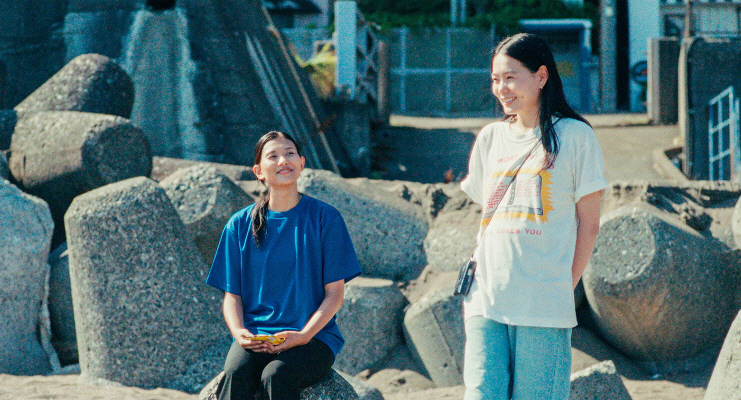
Nevertheless, I still did not care much about the story and characters as becoming more aware of the narrative design of the movie. Even during the second half, Sano remains a rather under-developed character, and Nagi sometimes feels a little too elusive while mainly defined by her frequent forgetfulness besides her natural charm. At least, Sano and his co-star Nairu Yamamoto generate enough chemistry during several key scenes of theirs in the film, and it is a shame that the screenplay by director/co-editor Kohei Igarashi and his co-writer Koichi Kubodera does not provide them more human elements for fleshing out their respective roles more.
In case of its technical aspects, the movie is mostly solid on the whole thanks to Igarashi’s competent direction. He and cinematographer Wataru Takahashi did a commendable job of filling the screen with a subtle sense of melancholy during the first half, and that is contrasted well with the relatively more relaxing tone of the second half. Although I have never been to Atami, this little town looks like a nice place for vacation as far as I can observe from the movie, and you may come to have the same thought after watching it.
Overall, “Super Happy Forever”, which comes from a phrase used in that group activity associated with Sano’s nurse friend in the story, does not satisfy me enough for recommendation even though it bored me less than I expected at first. Fortunately, Juzo Itami’s 1985 film “Tampopo” was the next movie to be shown at the same screening room right after I watched “Super Happy Forever”, and I gladly grabbed the chance without any hesitation. As a matter of fact, you will have a much better time with that film instead of watching “Super Happy Forever”, and you will surely thank me for my inconsequential recommendation.



 Seongyong's Private Place