
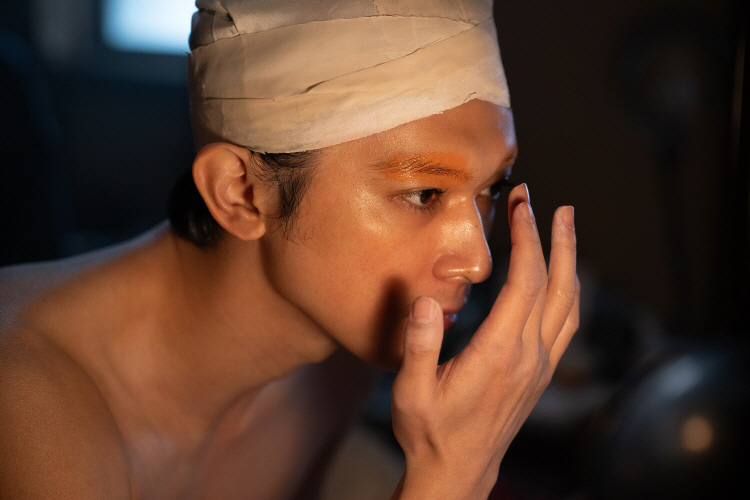
Japanese film “Kokuho”, which was selected as the Japanese entry to Best International Film Oscar at the 2026 Academy Awards, is an ambitious backstage drama to behold. Yes, this is another typical story about that hectic price of artistic achievement and success, but I admire its confident handling of mood and detail, even though I often found myself observing the story and characters from the distance during my viewing.
The main center of the story is a kabuki actor named Kikuo Tachibana (Ryo Yoshizawa), and the opening part of the movie, which is set in Nagasaki, 1964, shows us how young Kikuo, played by Sōya Kurokawa, came to draw the attention of Hanai Hanjiro (Ken Watanabe), a highly respectable kabuki actor from Osaka. When Hanjiro happens to drop by a New Year gathering held by Kikuo’s yakuza boss father, Kikuo presents a little kabuki performance of his in front of them and many others, and his “onnagata” performance (This is a kabuki term for male actors playing female characters, by the way) impresses Hanjiro a lot for his raw acting talent right from the beginning.
However, Kikuo’s father later gets killed due to an ambush from his opposing criminal organization, and Kikuo is eventually sent to Osaka for training and studying under Hanjiro. Once he is introduced to his teacher’s wife and their son Shunsuke (Keitatsu Koshiyama), Kikuo goes through a series of rigorous training sessions along with Shunsuke, and he and Shunsuke gradually become more like brothers despite the constant rivalry between them.
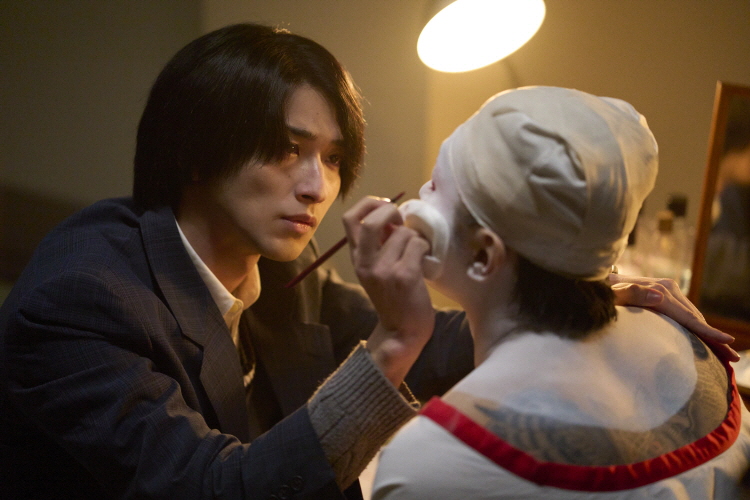
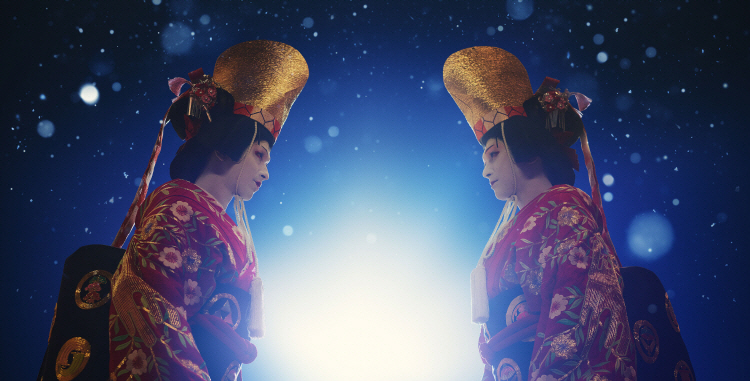
Several years later, both Kikuo and Shunsuke, who is now played by Ryusei Yokohama, are certainly ready to take the first step for their respective kabuki careers, and, of course, there soon comes a golden opportunity they cannot possibly refuse. Mainly thanks to Hanjiro’s considerable reputation and influence, they are asked to perform “The Maiden at Dojoji Temple” together, and, of course, they supremely dazzle and entertain their audiences together with sheer talent and confidence.
However, as enjoying their first career success, Kikuo and Shunsuke are also reminded of the considerable gap between them. While Shunsuke is surely expected to inherit the honorable title of his father someday, Kikuo does not have anyone particularly willing to support and admire his talent except his teacher and Shunsuke, and that makes him all the more serious and competitive than before. Not so surprisingly, he soon aims to get that honorable title of his teacher instead of Shunsuke, and this certainly leads to a growing conflict between him and several others around him including Shunsuke.
The screenplay by Satoko Okudera, which is based on the novel of the same name by Shuichi Yoshida, does not exceed our expectation much as hopping from one point to another along its sprawling narrative spanning no less than 50 years. Yes, there is a big moment of clash between Kikuo and Shunsuke not long after Hanjiro makes the final decision on who will inherit his honorable title. Yes, Kikuo and Shunsuke respectively go through a series of ups and downs after that point, and the movie surely generates some bitter irony from that. Yes, the movie certainly asks some important questions about the price of artistic achievement and success around the end of the story, and it expectedly delivers a dramatic answer with some ambivalent feelings.
The main flaw of the story lies on how the movie remains rather distant to its hero without delving a lot into whatever he feels or thinks behind his mostly detached façade. As far as I observe from the film, he is more or less than a blank canvass to whatever several other characters happen to suffer in one way or another because of him, and this makes us all the more distant to him without really getting to know or caring about him even at the end of the story.

I guess the movie simply wants to observe Kikuo’s relentless dedication to his art and ambition, and it surely does not disappoint us at all in case of its several kabuki performance scenes. I must confess that I do not know that much about kabuki, but I can tell you instead that the kabuki performances scenes in the film are simply superlative for their top-notch production qualities, and Ryo Yoshizawa and several main cast members look quite believable in every physical movement of theirs on the stage (Please do not ask me whether they actually had to depend on body doubles to some degree).
Behind his character’s aloof attitude, Yoshizawa did a good job of embodying his character’s ambition and commitment, and he is also supported by several good performers to notice. Ryusei Yokohama is particularly poignant during one key kabuki performance scene between him and Yoshizawa later in the film, and they are also flawlessly connected with Sōya Kurokawa and Keitatsu Koshiyama. Ken Watanabe, who is surely the most recognizable cast member to many of us, fills his archetype role with a palpable sense of honor and dignity, and Min Tanaka steals the show as an aging kabuki actor who has been appointed as a Living National Treasure (The title of movie means “National Treasure”, by the way). Another main flaw of the movie is its rather flat depiction of several substantial female characters in the story, but Mitsuki Takahata and Shinobu Terajima manage to fill their respective roles with enough presence at least.
On the whole, despite my reservation on a number of notable shortcomings, I enjoyed “National Treasure” enough for recommendation in addition admiring the skillful direction of director Lee Sang-il, a Zainichi (Korean Japanese) director who previously made several other major films including “Hula Girls” (2006). I personally prefer the cheerful spirit of “Hula Girls”, but “National Treasure” has its own strong aspects to appreciate, so I think you should give it a chance someday.


 Seongyong's Private Place
Pingback: 10 movies of 2025 – and more: Part 2 | Seongyong's Private Place
Pingback: My Prediction on the 98th Academy Awards | Seongyong's Private Place