
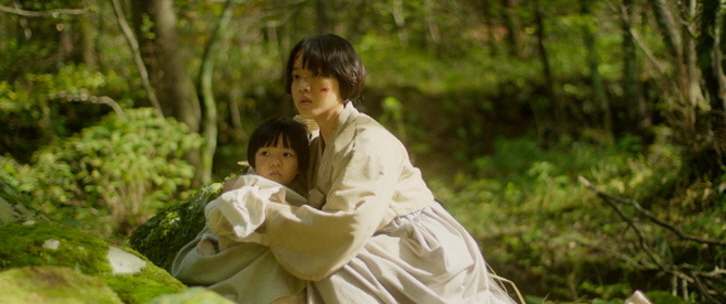
South Korean film “Hallan” turns out to be a lot more haunting than I expected at first. Closely following the harrowing survival drama of a young mother and her little daughter in the middle of the Jeju Uprising (1948 ~ 1949), the movie humbly but powerfully conveys to us the enormous human horror and tragedy behind that incident, and you will come to reflect more on how that painful past never goes away even at this point.
After giving us some background information on the Jeju Uprising, the movie introduces us to Ah-jin (Kim Hyang-gi) and her daughter Hae-saeng (Kim Min-chae). Before the Jeju Uprising was started, they happily lived with Ah-jin’ schoolteacher husband in one small village in Jeju Island, but he came to join those left-wing insurrectionists in the mountain region of the island not long after the beginning of the uprising. As getting threatened more and more by many policemen and soldiers out there, most of the villagers eventually decide to hide away into the mountain area just like those left-wing insurrectionists, and Ah-jin also joins them, but she has her daughter stay with her mother-in-law even though that is the last thing her daughter wants.
At first, things look all right for Hae-saeng and the remaining villagers including her grandmother, but, of course, there eventually come a group of soldiers accompanied with several American military officers on one day. Although they have no definite proof against the villagers, Sergeant Park (Hwang Jung-nam) and his soldiers have no problem at all with labeling all of the villagers as the sympathizers to their enemies, and that leads to one of the most heartbreaking moments in the film.

Meanwhile, Ah-jin becomes more concerned about her daughter’s safety, even after a close friend of hers, who is incidentally a village shaman, tells her that Hae-saeng is still all right. In the end, she decides to go down to the village alone by herself, but, not so surprisingly, she soon comes upon a series of perils, and she also comes to learn that the left-wing insurrectionists can be pretty heartless for their cause just like their opponents.
The movie also pays some attention to the little struggle of Hae-sang, who managed to survive unlike many others in the village including her grandmother. Although she does not know at all where her mother and some other villagers are hiding now, she wanders around here and there in the mountain region without realizing anything about what is happening in the world surrounding her, and the movie gives us a number of achingly innocent moments as this little girl continues her aimless journey across the mountain area.
In addition, we get to know a bit about a few other main characters in the story. Ah-jin’s shaman friend provides some calmly mystic quality to the story, and there are a few interesting scenes showing her some soothsaying. In case of one of the soldiers under Sergeant Park, he becomes more conflicted about whether he and his comrades are really doing the right thing, and he surely functions as a little voice of conscience in the story. However, of course, he is reminded again of how helpless he is in front the bullying influence of Sergeant Park, who does not even hesitate to kill a couple of unfortunate soldiers just because they show a bit of care to those people they are supposed to eliminate at once.
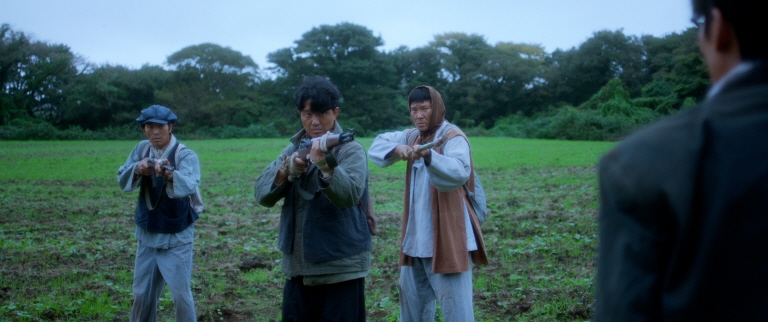
Although the screenplay by director/writer Ha Myeong-mi, who previously made a feature debut with “Her Hobby” (2023), trudges a bit during its second half, the movie keeps us engaged under Ha’s competent direction, and the result is as impressive as O Meul’s “Jiseul” (2012), which is also about the human tragedy behind the Jeju Uprising. Its main characters are rather broad and simple in my humble opinion, but the drama generated among them is often emotionally striking, and we come to care more about Ah-jin and her daughter, though we are not so surprised by what will happen to them in the end. I will not go into detail here, but I can tell you instead that the movie thankfully does not resort to any kind of cheap sentimentalism or catharsis, and the very last scene of the film makes a very clear point on how Jeju Island and its people remain haunted by that darkly sad past which still needs to be revealed and then illuminated more.
Ha draws solid performances from the two lead performers at the center of the movie. While Kim Hyang-gi, who has appeared in a number of notable South Korean films including “Innocent Witness” (2019), gives her best performance here in this film, young performer Kim Min-chae’s effortless natural performance functions well as the other half of the story, and they are surely the soul and heart of the film. In case of several other main cast members, Kim Da-hwin and Kang Chae-young are suitable in their respective supporting roles, but Hwang Jung-nam is unfortunately demanded to chew every scene of his as the main villain of the story.
In conclusion, “Hallan”, whose title incidentally comes from the name of a wild local plant inhabiting in the mountain area of Jeju Island, may feel rather plain on the surface, but it will linger on your mind for a while mainly thanks to its earnest storytelling as well as several fine performances to remember. In short, this is another interesting movie to be added to the list of those numerous films and documentaries about the Jeju Uprising during last several years, and it will certainly make you want to learn more about the Jeju Uprising after it is over.


 Seongyong's Private Place
Pingback: 10 movies of 2025 – and more: Part 3 | Seongyong's Private Place