
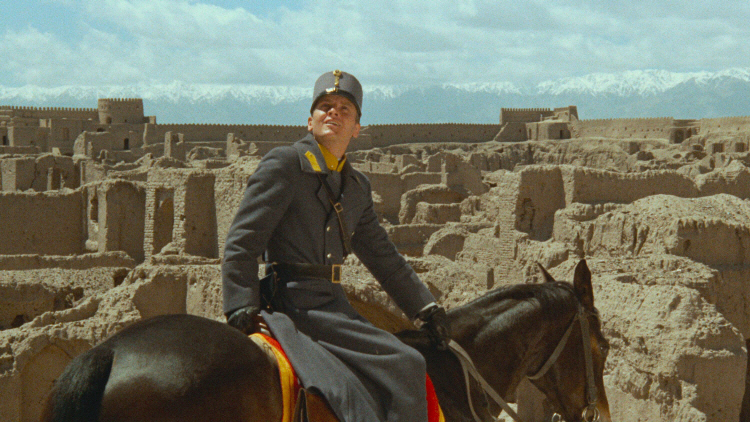
Valerio Zurlini’s 1976 film “The Desert of the Tartars”, which happens to be released in selected arthouse movie theaters in South Korea in this week, is interesting for its odd mix of bleak beauty and dark absurdity. While dryly and slowly illustrating its hero’s increasingly absurd plight, the movie doles out a series of awesome moments of stark beauty unfolded across the screen, and we are often mesmerized by its striking visual qualities, even while observing its hero’s plight from the distance.
The story begins with the seemingly promising status of Lieutenant Drogo (Jacques Perrin), a young officer who is about to take the first step of his military career. He has recently been assigned to an old fortress located in the middle of some remote border area of his country, and we soon see him leaving his hometown after saying goodbye to a close friend of his.
However, things do not look that optimistic to him as he enters that border area in question. When he eventually arrives in the fortress, he is welcomed by the commander of the fortress and several other officers, and then he befriends some of these officers, but it does not take much time for him to see that many of these officers have been stuck there for a long time without much hope or prospect. While they are supposed to be constantly ready for the possible attack from those barbaric Tartar folks beyond the border, there has not been any attack for years, so there is not much possibility for transfer or promotion for the officers in the fortress.

The movie phlegmatically observes how the officers of the fortress have coped with their frustrating state. While the commander simply occupies himself with maintaining the status quo of the fortress, some officers merely wait for any possible way out, and others including Major Matis (Giuliano Gemma) and Captain Ortiz (Max von Sydow) adamantly stick to their codes and rules. At one point, Major Matis coldly orders the killing of an unfortunate soldier who cannot give a password before going inside the fortress, and he is not so pleased at all when the comrades of that dead soldier do a defiant act of protest together.
While he tries his best for finding any possible way out, Lieutenant Drogo only ends up being mired in ennui and despair just like many other officers and soldiers around him. With some generous help from Surgeon Major Rovine (Jean-Louis Trintignant), he gets a chance for transfer later in the story, but then his precious chance is dashed in one way or another, and this makes him all the more despaired and frustrated than before.
Meanwhile, he and the other officers in the fortress notice a series of disturbing signs from the distance. While the commander and many of his officers are not particularly alarmed as casually going through their another uneventful day, Lieutenant Drogo becomes gradually obsessed about one particular sign which may be the prelude for a major attack, but nobody pays much attention to him as the fortress remains in stalemate as usual.
The movie, which was mostly filmed in Arg-e Bam, Iran, frequently looks around the bleakly vast landscapes surrounding the fortress. Cinematographer Luciano Tovoli did a splendid job of filling the screen with a haunting sense of existential emptiness, which is further accentuated by the terse but effective score by Ennio Morricone. While occasionally providing some lyrical touches, Morricone’s score remains as detached as the movie itself, and we become all the more distant to the story and characters as a result.
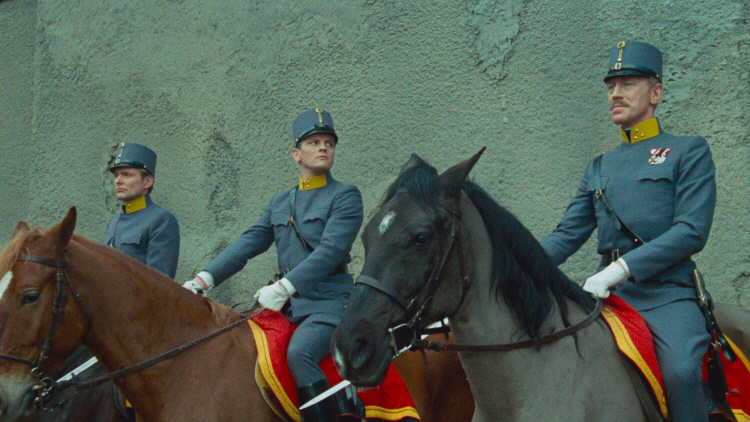
Nevertheless, we also somehow remain engaged as often amused by the sheer absurdity surrounding Lieutenant Drogo and several other main characters. When one of the officers finally gets an opportunity to leave the fortress, it turns out that he does not know what to do next after spending so many years in the fortress, and we are not so surprised by what eventually occurs next. Around the end of the story, there comes a real good chance for its hero at last, but then the movie throws a morbid irony upon him to our little dark amusement.
As watching the film, I could not help but think of J.M. Coetzee’s 1980 novel “Waiting for the Barbarians”, which is also about a hero trapped by utter absurdity in a remote border region and was incidentally inspired by Greek poet Constantine P. Cavafy’s 1898 poem “Waiting for the Barbarians”. The movie is based on Dino Buzzati’s 1940 novel “The Tartar Steppe”, and I was not so surprised to learn later that Buzzati’s novel was also inspired by Cavafy’s poem. Because I have not read Buzzati’s novel yet, I cannot tell you about how much his novel is actually overlapped with Coetzee’s novel in terms of idea and theme, but I can tell you instead that the mood and texture of the movie is not so far from what I felt as reading Coetzee’s novel a few years ago.
In conclusion, “The Desert of the Tartars”, which was Zurlini’s last film before his death in 1982, may require some patience from you mainly due to its dryly slow storytelling, but it is still a rewarding cinematic experience on the whole. To be frank with you, I did not know anything about the movie or its director at all, so I am glad to get a chance to watch this fascinating work at a local arthouse movie theater today, and now I am willing to explore more of Zurlini’s rather obscure filmmaking career.


 Seongyong's Private Place