
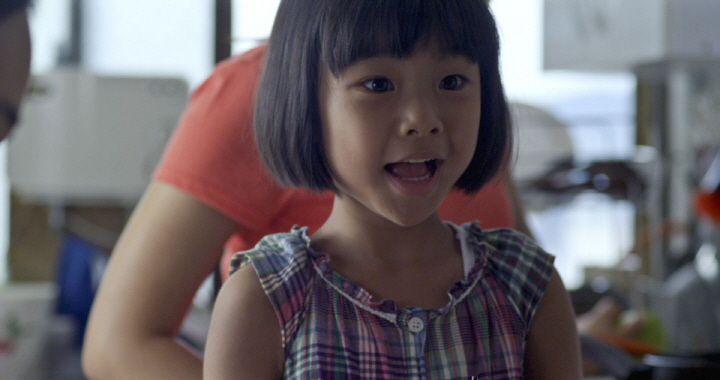
Yoon Ga-eun’s 2013 short film “Sprout”, which happens to be released in selected theaters in South Korean on this Wednesday, is still remarkable in many aspects. This simple but precious piece of work shows that Yoon was already quite a talented filmmaker even before drawing our attention with her excellent first feature film “The World of Us” (2016), and I was impressed again by how deftly she handles the story and characters for generating a considerable amount of emotional impact within less than 20 minutes.
The story mainly revolves around the viewpoint of a little young girl named Bo-ri (Kim Su-an), and the opening scene shows her watching her adult family members including her mother busily preparing for the ancestral offering ceremony for Bo-ri’s deceased Grandfather in the house belonging to one of the adult family members. When it turns out that they forgot to buy bean sprouts, they consider having Bo-ri go outside for buying bean sprouts from a nearby market, but then they decide not to do that because Bo-ri seems too young for the task.
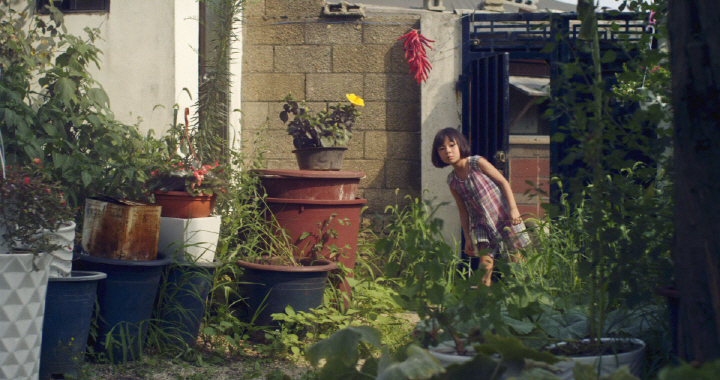
Nevertheless, Bo-ri soon becomes quite serious about buying bean sprouts. She quickly gathers some pocket money, and then she goes outside the house while nobody is looking. Not so surprisingly, she soon finds herself getting lost in the surrounding area, and then she comes to have a series of small and big happenings as wandering from one spot to another.
While watching her rather aimless wandering, we naturally become concerned about this little young girl’s safety, but the overall mood of the film is sweet and tender with a lightweight sense of humor. When she comes across a dog at one point, Bo-ri is understandably afraid of that dog even though it does not look that threatening, and this reminds me of how I was sometimes afraid of dogs when I was very young. I instantly empathized with her little fear again, and I was amused by when she managed to find a way to pass by that dog.
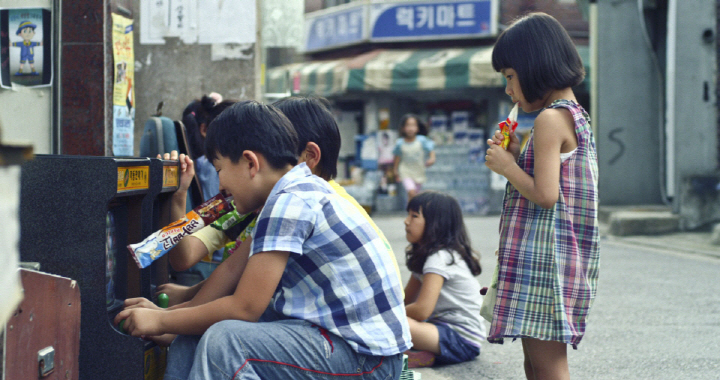
In the middle of the story, Bo-ri gets involved with a bunch of kids around her age, and that is when the story becomes more cheerful. As hanging around with these kids more and more, Bo-ri comes to forget her task for a while, and the film vividly conveys to us her joy and excitement before something happens to make her cry a lot.
Another funny moment comes from her accidental encounter with several middle-aged people having a little afternoon drinking time together. Not long after she has some drink by mistake, Bo-ri willingly entertains herself as well as them, and I was reminded of what my parents still remember well. When I was just a little toddler in the early 1980s, one of my uncles gave me a bit of drink just for a little amusement in the middle of a family meeting, and, according to my parents, everyone enjoyed my little drunken dancing even though my drinking was not so wholesome to say the least.
During its second half, the movie becomes a bit more serious when Bo-ri follows after one old man after noticing something from him. She eventually goes to his house, and the old man shows her some generosity even though he is a total stranger to her. Just like many other small moments in the film, this looks merely accidental, but then there comes an unexpected moment during the very last scene. The movie does not wisely explain too much as simply sticking to its heroine’s viewpoint as usual, and her little but eventful quest along the story comes to feel all the meaningful than before.

Everything in the movie depends a lot on the direct and unpretentious acting of its young lead actress. While she is now an adult actress who has appeared in a number of notable South Korean films, Kim Su-an has never surpassed what she achieved so well under Yoon’s skillful direction here in this film, and her terrific acting reminds us again of how deft Yoon has been in case of handling child performers. Like Abbas Kiarostami or Hirokazu Kore-eda, she really knows how to draw natural performances from her young performers, and her latest film “The World of Love” (2025) shows that to us again via several key scenes involved with the little younger brother of its young heroine.
In conclusion, “Sprout” remains as an important early point in Yoon’s career, which has steadily advanced since “The World of Us”. When I watched it in 2016, I chose “The World of Us” as the best film of that year without any hesitation, and I was certainly delighted when Yoon impressed me and others more with “The House of Us” (2019), which was one of many wonderful works from South Korean cinema in that year besides, yes, Bong Joon-ho’s “Parasite” (2019). In case of “The World of Love”, Yoon excels herself again to our excitement, and she certainly deserves to be regarded as one of talented new local filmmakers to carry South Korean cinema after Bong and several other master South Korean directors of our time.
By the way, I have observed how many of those emerging South Korean filmmakers including Yoon are female. Considering how male-dominant South Korean cinema has been for many years, these wonderful female artists will certainly bring some fresh air to their field, and I truly believe that the future of South Korean cinema lies on their undeniable talent. Although the current situation is not so bright for them mainly due to the frequent lack of support inside their field, we must show them more support and encouragement in my humble opinion, and then they may keep South Korean cinema alive and exciting during next several decades at least. After all, girls can do anything, can’t they?


 Seongyong's Private Place