
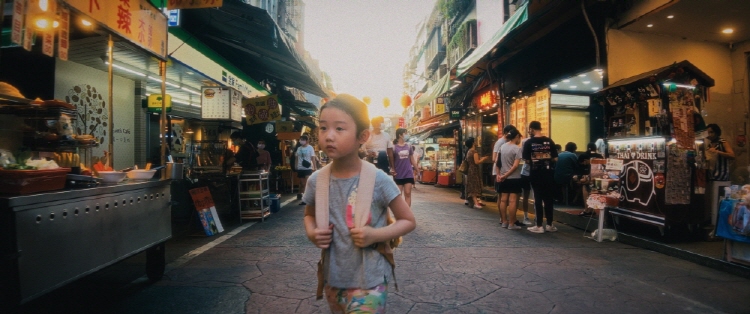
“Left-Handed Girl” is a little but superlative coming-of-drama to admire and cherish. Mostly sticking to the innocent viewpoint of its young heroine, the movie gradually immerses us into her small world along its free-flowing narrative, and it alternatively amuses and touches us as we get to know more about her and several figures around her.
The movie, which is set in Taipei, Taiwan, opens with the arrival of a young girl named I-Jing (Nina Ye) and her two close family members in the city. Her single mother Shu-fen (Janei Tsai) wants to have a new start for not only her but also I-Jing and her older sister I-Ann (Shih-Yuan Ma), but things do not look that optimistic for them to say the least. For example, their residence in the city looks quite stuffy and shabby, and it later turns out that Shu-fen borrows a considerable amount of money from her mother for moving into this residence. She tries to run a small restaurant in a nearby marketplace, but her and her family’s economic situation is not improved a lot despite her hard efforts.
Meanwhile, I-Ann gets a part-time job at a place where she handles an illegal drug business under some seedy dude. While her mother does not ask her too much because they need any kind of income right now, I-Ann does not tell her mother at all about having an affair with her boss behind her back, and we sense a trouble when he later hires some other young woman to assist I-Ann
Understandably, I-Jing does not know well how much her mother and older sister struggle to earn their living day by day, and the movie often observes her doing her little exploration around the marketplace. As the camera of cinematographers Ko-Chin Chen and Tzu-Hao Kao closely follows her, the movie fills the screen with a considerable amount of verisimilitude, and we often feel like a fellow explorer of our little heroine.
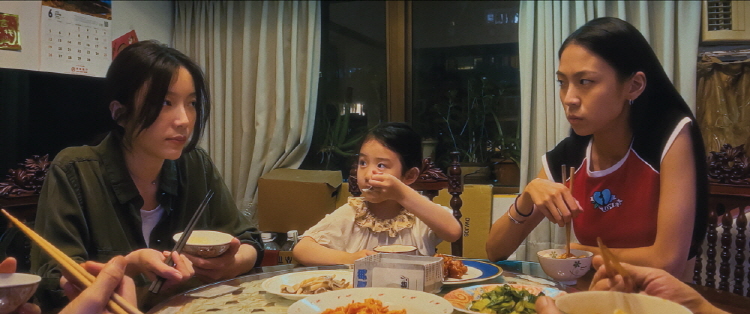
And then there comes a little internal conflict for I-Jing. When she is notified that her ex-husband is dying, Shu-Fen decides to see him again regardless of however she feels about him now, so I-Jing comes to spend a few days with Shu-Fen’s parents. The grandmother is fairly nice to I-Jing, but the grandfather is not so interested in befriending her, and, just because of an old superstition, he does not approve that much of her being left-handed.
When he subsequently tells her about that superstition, I-Jing comes to regard her left hand as something evil, and that prompts her to commit a little transgression. As trying to use her left hand as little as possible, she also begins to steal small stuffs with her left hand here and there in the marketplace, and she comes to believe more of what her grandfather told her.
And we see more of how her mother and older sister are often too occupied with their respective issues to cope with. After her ex-husband eventually dies, Shu-Fen chooses to pay for his funeral just because he has been penniless, even though this choice of hers is going to bring another financial burden upon her. She asks for more financial help from her family members, but her mother and sisters are not so willing to do that just because of a petty reason associated with patriarchy.
In case of I-Ann, she later comes to realize how unreliable her boss is, and that is followed by several intense moments including a brief but painful scene where she makes a hard choice for herself. Again, she does not tell anything to her mother, and they become more distant to each other without noticing I-Jing’s growing problem.
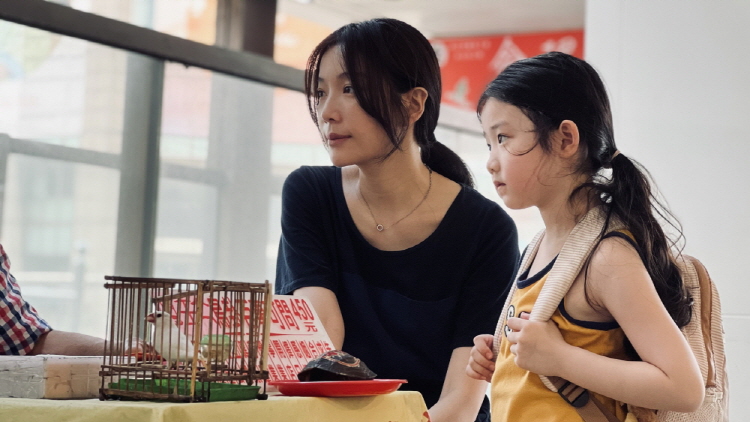
While never overlooking the harsh reality surrounding its main characters, the movie also shows some sense of humor at times. In case of one particular scene involved with a pet animal given to I-Jing, some of you may wince a lot, but then you will also probably be tickled a bit by what follows next. When I-Jing decides to steal something very important later in the story, the mood becomes a little more tense, but then there comes a humorous plot turn to amuse you.
After carefully establishing and then developing its main characters along the story, the movie throws an unexpected dramatic moment of surprise and revelation during its last act, but this does not feel jarring at all, while also making us look back more on what has been shown to us up to that point. In the end, we come to discern more of the complicated relationships among its three main characters, and that makes the very last scent of the film quite poignant.
Director/co-writer/co-producer Shih-Ching Tsou draws stellar performances from her main cast members. While young actress Nina Ye’s unadorned natural performance holds the center, Janel Tsai and Shih-Yuan Ma have each own moment to shine around Ye, and Brando Huang provides extra warmth and humor as a vivacious shop owner who genuinely cares a lot about Shu-Fen’s economic struggle.
On the whole, “Left-Handed Girl” is a commendable solo work from Tsou, who has been mainly known for her close collaborations with her co-writer/co-producer/editor Sean Baker in several acclaimed works including “Take Out” (2004). She demonstrates here that she is a talented filmmaker to watch just like Baker, and it will be interesting to see how much she will advance further from this impressive starting point.


 Seongyong's Private Place
Pingback: 10 movies of 2025 – and more: Part 2 | Seongyong's Private Place