
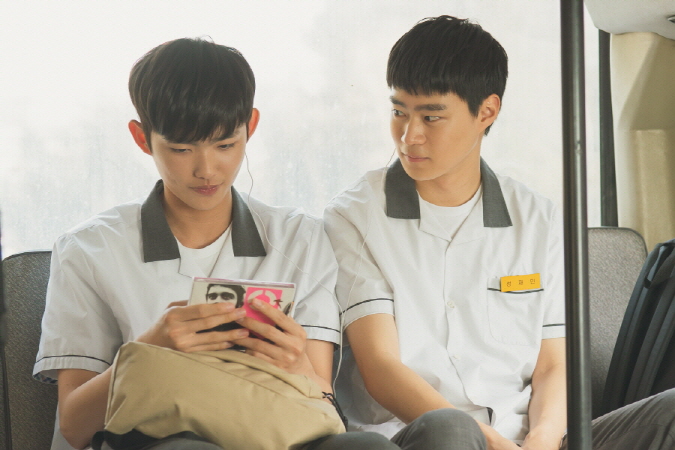
South Korean independent film “404 Still Remain” made me feel a bit nostalgic for good reasons. Set in early 2000s, this little coming-of-age drama movie is filled with the period details to notice here and there, and I can tell you that it did a fairly good job on the whole. In addition, the emotional struggles of its two main characters resonated a lot with me because I was a repressed gay boy just like them around that time, and I must tell you that there are several moments which came particularly close to me.
The movie opens with the arrival of a high school student named Kyeong-hwan (Sim Hyun-seo) and his parents in Daegu, one of the big local cities in South Korea. He and his parents moved from some rural town just because of some better business opportunity for both of his parents, and we soon see him starting his first day at his new school.
Needless to say, Kyeong-hwan feels quite awkward among his new classmates, but then he receives some help and support from Jae-min (Hyeon Woo-seok), the popular class president who happens to sit right next to him. Mainly thanks to their enthusiasm on Japanese pop songs, they instantly befriend each other, and they come to spend more time with each other as sharing a lot of Japanese pop songs between them via Kyeong-hwan’s MP3 player (Are you old enough to remember what it is, by the way?).

Meanwhile, they and many other classmates of theirs have to prepare a lot for the college entrance examination as usual, and Kyeong-hwan soon comes to distinguish himself a lot as becoming the No.1 student of the class. As a result, he becomes a little more popular in his class than before, and Jae-min does not seem to mind this at all even though he has been frequently pressured by his mother to excel himself.
As getting closer to Jae-min more and more, Kyeong-hwan finds himself quite attracted to Jae-min. It later turns out that he had a little trouble due to his homosexuality before moving to Daegu, and that makes him very hesitant about revealing himself more to Jae-min, but it seems that Jae-min likes Kyeong-hwan more than he can admit on the surface. For example, he often touches Kyeong-hwan a lot, and this looks like a merely friendly gesture, but Kyeong-hwan comes to wonder more about whether Jae-min has actually repressed himself just like he has for years.
While Kyeong-tae remains conflicted about his relationship with Jae-min, the screenplay by director/writer Uhm Ha-neul, who incidentally made a feature film debut here in this film, doles out one episodic moment after another for more plot and character development. We get to know a bit about some of Kyeong-hwan’s classmates, and then we also observe how his parents’ marriage crumbles for some unspecified reason. In the end, his father leaves after the divorce, and his mother has to support her and her son alone by herself, but then there comes a big trouble for her and her fellow merchants in the neighborhood.
It is not much of a spoiler to tell you that Kyeong-hwan eventually shows Jae-min his romantic feelings toward him later in the story, and you will not be surprised that much by the following consequence Kyeong-hwan has to deal with. Jae-min suddenly becomes quite distant to him, and Kyeong-hwan also finds himself frequently bullied and ostracized by many of his classmates once the gossip about his homosexuality is spread around his class.
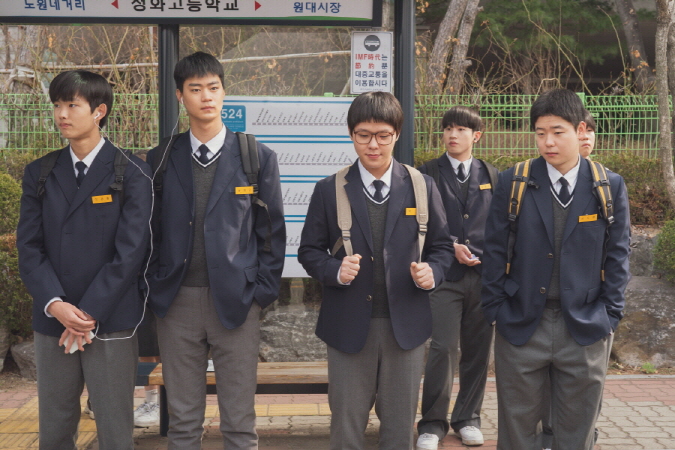
While there are several heavy-handed moments involved with your typical homophobia, the movie handles Kyeong-hwan’s emotional struggle with enough care and sensitivity at least. There is a little touching scene after Kyeong-hwan finally reveals his homosexuality to his mother, and then there is also a powerful moment as Kyeong-hwan listens to Jae-min’s favorite Japanese pop song and then comes to sense and understand more of whatever Jae-min is holding behind his back. In case of the epilogue part, it feels rather redundant at first, but then there comes an unexpected moment of poignancy which will linger on your mind for a while after the movie is over.
The movie certainly depends a lot on the good chemistry between its two lead performers. Besides looking young enough on the screen, Sim Hyun-seo and Hyeon Woo-seok are believable in their characters’ relationship development along the story, and Shim is particularly harrowing when his character must endure a lot just because of being honest to himself. On the opposite, Hyeon effectively complements his co-star via his more subdued acting, which often speaks volumes even though his character does not seem to signify much on the surface. In case of several substantial supporting performers, Gong Min-jung has a few good scenes to notice as Kyeong-hwan’s struggling mother, and On Joo-wan makes a brief appearance around the end of the story.
In conclusion, “404 Still Remain”, whose title is derived from a certain Internet message with which many of you are quite familiar, is an engaging high school drama to be appreciated for mood, storytelling, and performance. Along with two recent South Korean films “3670” (2025) and “Homeward Bound” (2025), this is another notable South Korean queer film of this year, and I sincerely hope that it will bring some comfort and support to many sexual minority adolescent kids out there in the South Korean society.


 Seongyong's Private Place