
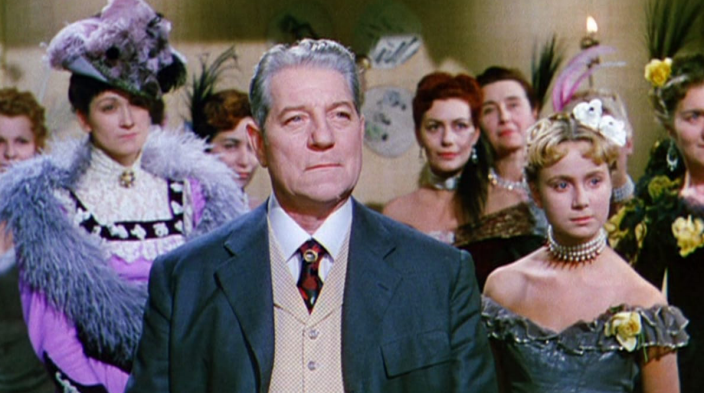
Jean Renoir’s 1955 film “French Cancan” is often exuberant for its colorful mood and spirit. As a fictional story about the foundation of the Moulin Rouge in Montmartre of Paris, the movie cheerfully goes up and down along with its almost unflappable hero and many various characters, and the result is one of the best works from one of the great filmmakers in the 20th century.
The hero of the film is Henri “Zizi” Danglard (Jean Gabin), a middle-aged impresario who has run a little Parisian nightclub called “Le Paravent Chinois”. Although his nightclub has been known for his beautiful belly dancer Lola de Castro (María Félix), it is not exactly profitable enough for him at present, and it later turns out that his financial situation is not very good to say the least.
Nevertheless, as a seasoned but passionate show business guy, Danglard cannot help but drawn to another possibly good idea for his show business. When he later comes to a simple dance hall in Montmartre along with Lola and several admirers of hers, he observes how joyfully people doing an old-fashioned dance called, yes, cancan, and then the idea for presenting a cancan show soon comes to his mind. In addition, he also notices one particular young lady dancing with considerable spirit and charm, and he subsequently approaches to her with an offer she cannot refuse.
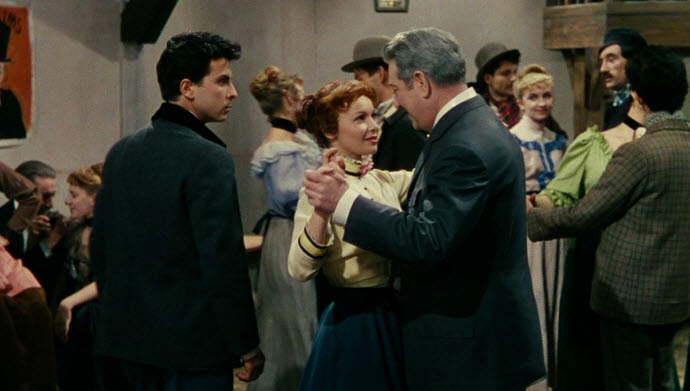
Danglard’s idea is simple but bold. He is going to buy the dance hall and then turn it into a big cabaret, and he is willing to take a big chance even though his financial status is still not so positive. Fortunately, one of Lola’s admirers, who is incidentally quite rich, soon becomes willing to finance Danglard’s new project thanks to a little persuasion from Lola, and we soon see Danglard working on the project along with a bunch of figures including Nini (Françoise Arnoul), the aforementioned young girl who comes to show more passion toward show business under Danglard’s guidance.
Of course, just like many other show business stories, there comes one setback after another. For example, Lola, who still has some feelings toward Danglard, is not amused as Danglard and Nini get attracted to each other, even though she knows well what a womanizer Danglard is. This eventually leads to a hilarious group fight scene, which consequently jeopardizes the construction of Danglard’s cabaret.
The movie has some fun with how Danglard remains phlegmatic and practical as steadily pushing his project in one way or another despite those setbacks. Even when he has to leave an expensive hotel due to another financial problem of his, he keeps his appearance as usual, and, above all, he continues to prepare for the cancan show as before.
Meanwhile, the story also focuses on a little romantic complication of Nini, who already finds herself surrounded by more than one admirer besides Danglard. There is a young baker who was quite close to her before she met Danglard, but he wants her to give up her aspiration toward show business. There is also a young foreign princess who has been madly in love with her right from when he saw her for the first time, but she does not love him much even though she is touched by how sincerely he promises her a lot of things including jewelry.

It is not much of a spoiler to tell you that Danglard’s cabaret is eventually completed and then opened for many audiences to come, and the movie does not disappoint us at all once the show begins. Besides the cancan show, Danglard also presents several different shows to entertain and excite his audiences, and Renoir and his crew members including cinematographer Michel Kelber skillfully present the growing excitement among the audiences as one good show after another is presented on the stage.
When the moment for the cancan show eventually arrives, the movie brings more spirit and energy to the screen as those lovely dancers including Nini joyfully present their dancing skills in front of their enthusiastic audiences, and Renoir also did a nice job of delivering a feel-good ending for everyone in the story. Regardless of all those conflicts among them, they are all swept by the joy and excitement around them, and they all feel really happy and spirited for a while at least.
Like any good show business movie, the movie is packed with many colorful characters to remember, and the main cast members effortlessly embody their respective roles. While Jean Gabin, who is often regarded as one of the best actors in the French cinema during the 20th century and also previously collaborated with Renoir in several films including “Grand Illusion” (1937), steadily holds the ground with his gently graceful acting, a number of different performers including Françoise Arnoul and María Félix have each own moment to shine, and you will be also delighted by the brief appearance of several notable French singers including Édith Piaf, who does not need any introduction or explanation at all because of her own distinctive singing voice.
On the whole, “French Cancan” is quite charming and entertaining for not only its vibrant mood and style but also its witty handling of story and characters. I must confess that I was rather tired and sleepy when I watched it at a local arthouse movie theater during last evening, but my interest and spirit soon got perked up within 30 minutes, and I really felt like watching an excellent show in the end. Folks, that is what a good show business movie can do in my trivial opinion.


 Seongyong's Private Place