
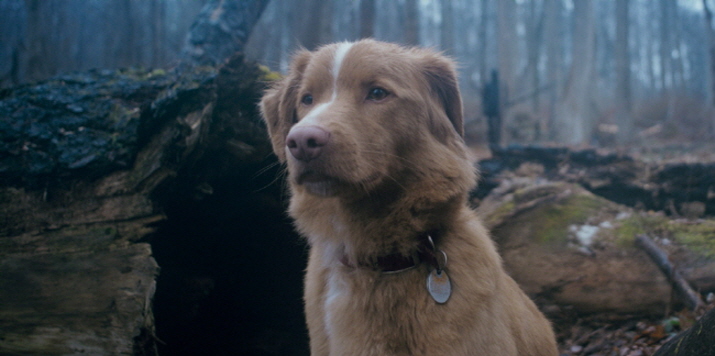
“Good Boy” is a little genre film which tries something different, and I like that. Mainly driven by the viewpoint of one good dog, the movie unfolds its rather simple horror story step by step, and the growing sense of fear and dread along the story is more palpable to us as it adamantly sticks to the limited viewpoint of its lead animal character.
At first, the movie establishes how things are not good for the male owner of a dog named Indy. For some unspecified reason, his health has been seriously deteriorated for a while, and he is eventually sent to a hospital after his sister belatedly finds his unconscious body, but he decides to get out of the hospital and then go to his grandfather’s house, which is incidentally located in the middle of some remote forest area.
Through Indy’s viewpoint, we already see some bad signs unnoticed by the owner. During the opening scene, the dog senses something quite insidious, which seems to have some toxic influence on the owner’s increasingly bad health. When the owner goes to the his grandfather’s house in the middle of one dark and rainy night along with his dog, the dog senses that insidious entity again, but, again, the owner does not notice anything even though it is apparent to us from the beginning that his grandfather’s house is not a good place to stay to say the least.
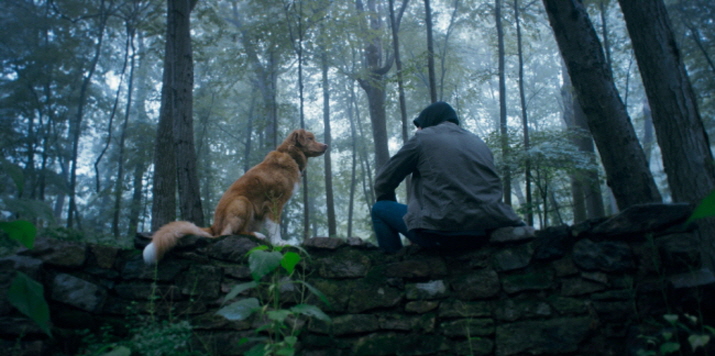
Anyway, Indy keeps trying to stand by its owner as your average good dog, and the owner, whose face is seldom shown on the screen mainly because the camera usually follows the dog’s viewpoint, looks a bit more relaxed than before. At one point, he goes for a walk outside his house, and he seems soothed a bit by his trusted dog, regardless of how sick he really is at present.
However, there soon come more ominous signs to disturb Indy in one way or another whenever its owner is not looking. It often hears some strange sounds heard from somewhere inside the house, and there are also several typical moments including a door suddenly being moved a bit for no apparent reason. Needless to say, the dog becomes all the more disturbed and terrified, but the owner remains occupied with his worsening condition as before. His concerned sister often calls, but he gets only annoyed by that, and he even becomes rather harsh to his dog later in the story.
Director/co-producer/cinematographer/editor Ben Leonberg, who also wrote the screenplay along with Alex Cannon, trusts his audiences enough. There are a number of wordless key scenes depending a lot on the dog’s responses and behaviors, and they are fairly effective despite some clichéd elements including an old neighbor living not so far from the house. Although we can usually see as much as Indy within its limited viewpoint, we become more aware of whatever is approaching to its owner, and we come to empathize more with its emotional disturbance, especially when Sam Boase-Miller’s unsettling score is played on the soundtrack.
As a result, the movie so completely immerses us into the dog’s viewpoint around the middle point of the story that we do not mind at all even when it goes a bit deeper into Indy’s unconsciousness more than once. That is rather conventional, but it gives us some more understanding on how much Indy is scared about whatever is happening around it and its owner. After all, the owner is virtually the center of Indy’s small world, and we can only imagine how terrible it will be for Indy to lose its owner.
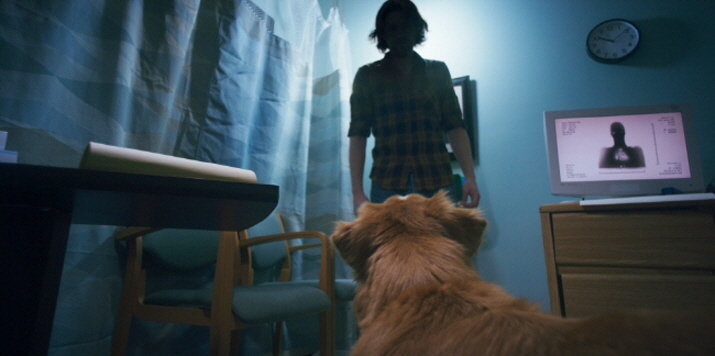
When the story arrives at its expected finale, the mood becomes all the more tense and ominous than before. Sensing more of how much its owner is menaced by something inside the house, Indy becomes more determined to take some action for saving its owner, and you will certainly root for it more as it goes through a bit of action. What eventually happens may not surprise you much, but there is some little poignancy as we are reminded again of how loyal a dog can be.
It surely helps that the animal performer of the film is actually quite convincing from the beginning to the end. Not so surprisingly, Leonberg, who is incidentally the owner of Indy, spent around 300 days for drawing the right reactions and behaviors from Indy in front of the camera, but the result looks quite seamless on the screen. Regardless of whatever it felt or thought about whatever its owner was doing behind his camera at that time, Indy did a good job of functioning as the center of the story, and it is also quite likable just like any good dog. While there are also a handful of human performers in the movie, the main focus of their acting how to serve or enhance Indy’s “performance” more, and we easily accept Indy as the main star of the film.
Overall, “Good Boy” occasionally feels rather slight in terms of narrative, but it is taut and efficient during its relatively short running time (72 minutes). I must confess that I am mostly a cat person, but the movie appealed to me more than expected, and I admire the considerable efforts shown from the screen. In short, Leonberg, who previously made several short films before making a feature film debut here, deserves all the praise for his modest but commendable achievement, and it will be interesting to see how he will advance further after this promising beginning for his filmmaking career.


 Seongyong's Private Place
Pingback: 10 movies of 2025 – and more: Part 2 | Seongyong's Private Place