
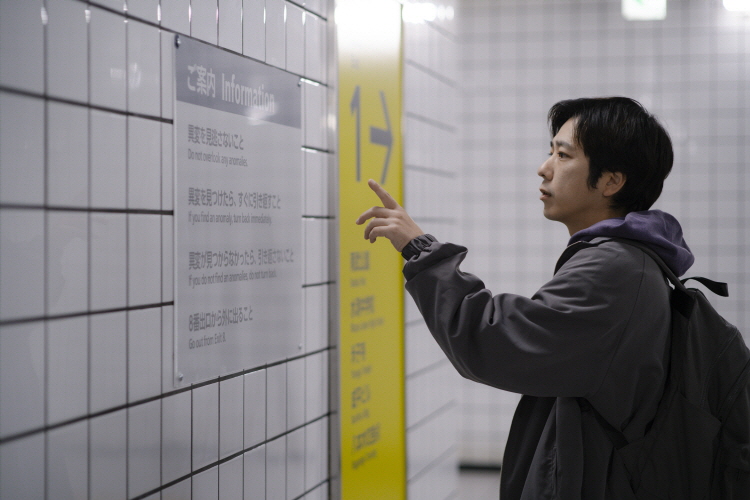
Japanese film “Exit 8” is simple but effective in its rather limited setting. Based on the 2023 Japanese video game of the same name, the movie follows the desperate struggles of a few figures helplessly trapped in a seemingly endless loop of subway hallways, and it is often fun to watch how it ably balances itself between repetition and variation before eventually reaching to its expected final stage.
The movie opens with an anonymous man riding a subway along with many others. While he is merely spending some time on his smartphone, there comes an unexpected phone call from his ex-girlfriend, who notifies him that she has just found that she is pregnant. Needless to say, he becomes quite confused and conflicted to say the least, while also being quite indecisive about what to do about this circumstance.
Anyway, as he tries to talk more with his ex-girlfriend after getting off from the subway later, something really perplexing happens to him. He goes through a series of stairs and hallways while looking for an exit, but then he suddenly finds himself walking along an almost empty hallway. At first, this does not surprise him much, but then he comes to realize that he is actually walking the same hallway again and again.
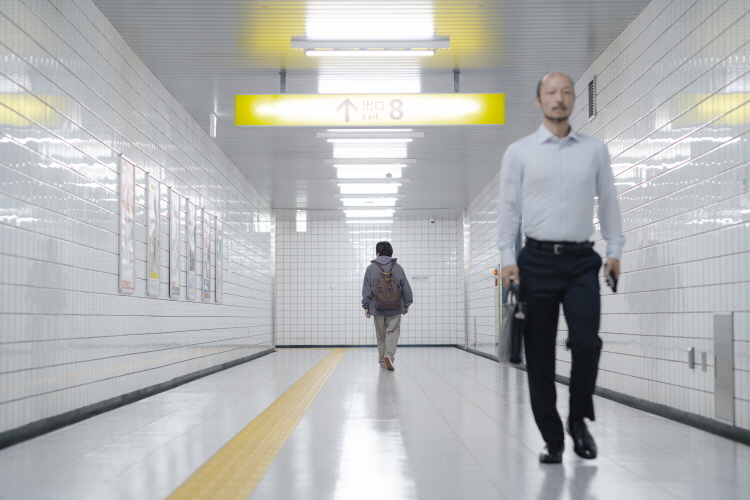
The movie takes some time for us to get accustomed more to this strange setting. Along this very odd hallway, there are several advertisements on the left wall while there are three steal doors on the right, all of which are incidentally locked. In addition, our hero always comes across some guy walking from the opposite end of the hallway, and it is evident that this figure is nothing more than one of the mere details of this weird hallway.
Our hero soon comes to learn the simple golden rule of the hallway. Whenever he walks along the hallway, he must confirm whether there is any kind of anomaly in the hallway. If there is really any anomaly to notice, he must turn back and walk in the opposite direction. If there is not anything different at all, he must walk along the hallway as before. If he is correct in his observation, he can move up to the next level before eventually arriving at “Exit 8”. If he is not correct, he will be back to the first level.
Now, this seems pretty easy at first, but, of course, things gradually become tricky for our hero as he struggles to advance stage by stage. At first, it is not so difficult to notice an anomaly along the hallway, but, just like many other video games, the hallway becomes more challenging at the higher levels. For example, our hero is stopped by something quite unexpected at one point, but he is not so sure about whether this is actually an anomaly or not, and that naturally generates some suspension on the screen.
As steadily rolling its story and characters in one direction or another, the movie tries a number of interesting variations on its limited setting. As the camera of cinematographer Keisuke Imamura smoothly and fluidly follows the actions of our hero, we become more engaged and watchful as the movie pulls out small and big surprises along the hallway, and you may have some fun if you notice any anomaly before our hero does. The score by Yasutaka Nakata and Shohei Amimori is effective in generating more tension and dread on the screen, and the movie also shows some twisted sense of humor via a certain famous classic piece by Maurice Ravel, whose repetitive rhythm certainly resonates with the narrative structure of the movie.
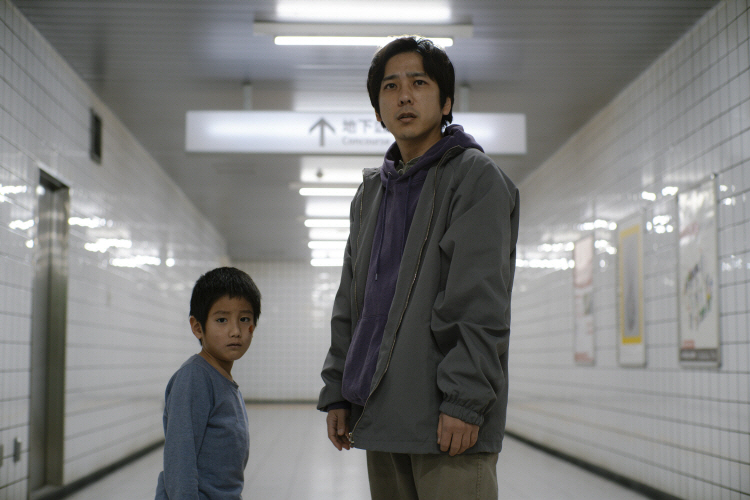
Although the characters in the film are more or less than the figures to be moved here and there as required, we come to care a bit about some of them later in the story, and the movie adds a bit of extra drama to the main story via that walking dude and a few other figures appearing in the hallway. For example, one of these figures becomes an unexpected ally for our hero later in the story, and our hero’s relationship with this particular figure makes him reflect more on his life – and what he really should do about that situation involved with his ex-girlfriend.
Under the competent direction of director/co-writer/co-director Genki Kawamura, who previously made a feature film debut in “A Hundred Flowers” (2022), the small main cast member of the film are all believable in their respective parts. As the main center of the film, Kazunari Ninomiya is particularly good when his character comes to face more of his human flaws along the story, and he is also supported well by Yamato Kochi, Naru Asanuma, Kotone Hanase, and Nana Komatsu.
On the whole, “Exit 8”, which incidentally received the Best Poster Design award when it was premiered at the Midnight Screenings of the Canne Film Festival early in this year, is a fairly enjoyable case of video game adaptation which actually made me interested in playing its original video game someday. While certainly reminiscent of several other similar genre films such as “Cube” (1997), the movie has its own style and mood to distinguish itself, and it also may make you reflect a bit more on how mindlessly we often go through our daily life. After all, repetition is always bound to bore and then numb you, isn’t it?


 Seongyong's Private Place
Pingback: 10 movies of 2025 – and more: Part 2 | Seongyong's Private Place