
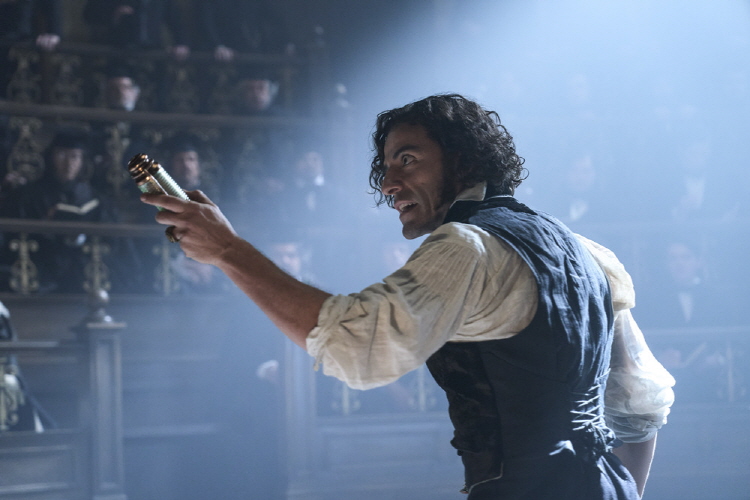
Guillermo del Toro’s latest film “Frankenstein”, which happens to be released in South Korean theaters before getting released on Netflix a few weeks later, is certainly something he is born to make. After all, he is an undeniably talented filmmaker of darkly vivid and fantastic imagination, and his utterly impressive adaptation of Mary Shelley’s classic horror novel will solidify his status more just like many of his other excellent works in the past.
As many of you know well, the story is about an ambitious medical doctor named Victor Frankenstein (Oscar Isaac) and his monstrous creation. As shown from the early part of the film, Dr. Frankenstein has been quite obsessed with conquering death since he lost his dear mother during his childhood years, and we later get a grotesque scene where he proudly presents the latest result of his obsessive medical study in front of many scholars and doctors in London.
While his presentation is not welcomed much on the whole, the doctor is approached by Henrich Harlander (Christoph Waltz), a wealthy arms manufacturer who is incidentally the uncle of the fiancée of the doctor’s younger brother. He is willing to finance the doctor’s ongoing experiment on exchange for doing some favor for him later, and the doctor cannot possibly say no because he really needs more money and support for reaching to the breakthrough point of his experiment someday.
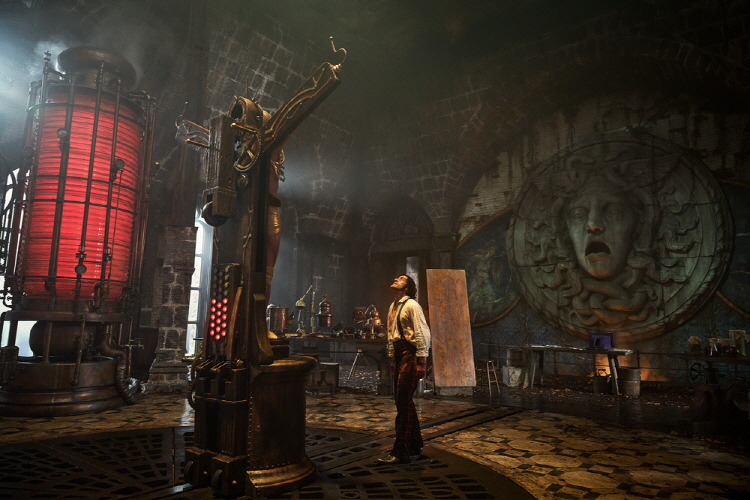
Harlander happens to have a right place for the doctor’s experiment, which is a big abandoned castle located somewhere in Scotland. As the doctor and his benefactor furnish this moody place step by step, del Toro and his production designer Tamara Deverell, who previously collaborated with him in “Nightmare Alley” (2021), have a lot of fun with filling the screen with a bunch of darkly fascinating stuffs to observe, and the movie also has some gory fun with how the doctor collects his “materials” for his experiment thanks to Harlander, who surely knows well where he can get them as a merchant of death.
Meanwhile, the doctor also finds himself gradually attracted to Lady Elizabeth Harlander (Mia Goth) once he meets her in Harlander’s house. While she is soon going to marry his younger brother, he cannot help but be impressed by her intelligence and independent spirit, and she also seems to be interested in getting closer to him even though she still finds him too arrogant and egoistic. She does not flinch at all about whatever he is studying, but she instantly senses the possible trouble from that, and that always holds her back from him.
Anyway, everything in the doctor’s experiment eventually culminates to its finishing point in the middle of one dark and stormy night (What do you expect, folks?), and the movie naturally pulls all the stops for this expected highlight moment. As the score by Alexandre Desplat, who won his second Oscar for del Toro’s previous film “The Shape of Water” (2017), becomes quite tense and bombastic as required, cinematographer Dan Lausten, who also worked in “The Shape of Water”, unleashes a series of overwhelming visual moments on the screen, and then we soon see the eventual result of the doctor’s experiment.
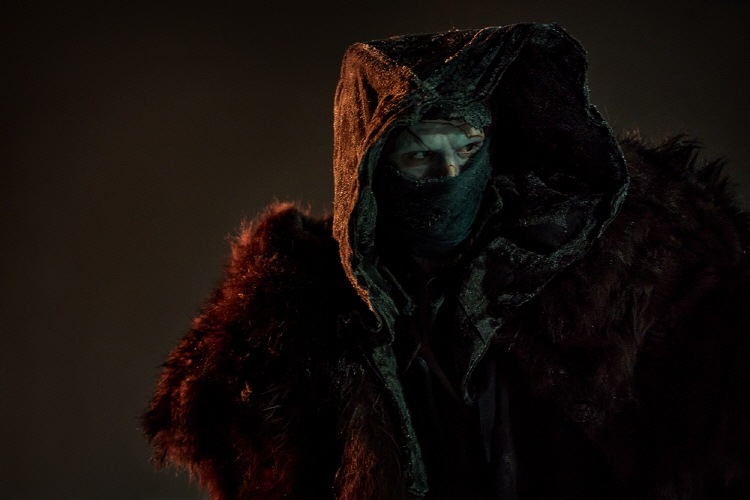
Of course, what the doctor creates in the end horrifies and disgusts him a lot, and that is when the movie shifts itself more toward his creation. While this creature looks quite hideous on the surface, it gradually shows a lot more intelligence and sensitivity than expected. As a matter of fact, there is a brief but poignant moment of communication between him and Elizabeth at one point later in the story, and this will certainly remind you of that oddly touching romance between the heroine of “The Shape of Water” and that mysterious creature in that film.
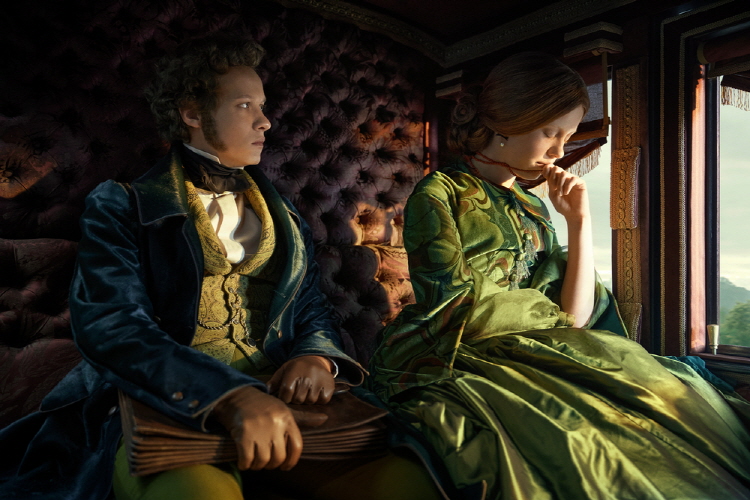
While the story steadily heads toward its predetermined finale, the movie constantly mesmerizes us with its superb visual qualities. I still remember its many grand touches including the striking crimson dress of the doctor’s mother and the huge library belonging to the doctor’s father, and these and many other interesting details certainly contribute a lot to the overall Gothic atmosphere of the film.
Above all, the complicated conflict between the doctor and his creation continues to hold our attention to the end. While Oscar Isaac, who is no stranger to playing a mad scientist considering his memorable performance in Alex Garland’s Oscar-winning film “Ex Machina” (2014), fills his role with a lot of fierce arrogance, Jacob Elordi brings enough pathos and sensibility to the doctor’s creation while also looking fearful and intimidating as required. Several notable cast members including Lars Mikkelsen, David Bradley, Felix Kammerer, Christoph Waltz, and Charles Dance are well-cast in their respective supporting parts, and Mia Goth, who also plays the doctor’s mother besides Elizabeth, brightens up the film a bit with her interestingly uncanny presence.
On the whole, “Frankenstein” is a first-rate horror film which is also as good as you can expect from del Toro, who has never disappointed me and many other audiences throughout his long and illustrious career packed with a number of distinctive achievements to enjoy and cherish. I think it is too good and epic to watch at home, and I strongly urge you to grab a chance to watch it at movie theater as soon as possible – especially if you admire del Toro’s works as much as I do.


 Seongyong's Private Place
Pingback: 10 movies of 2025 – and more: Part 1 | Seongyong's Private Place
Pingback: My Prediction on the 98th Academy Awards | Seongyong's Private Place