
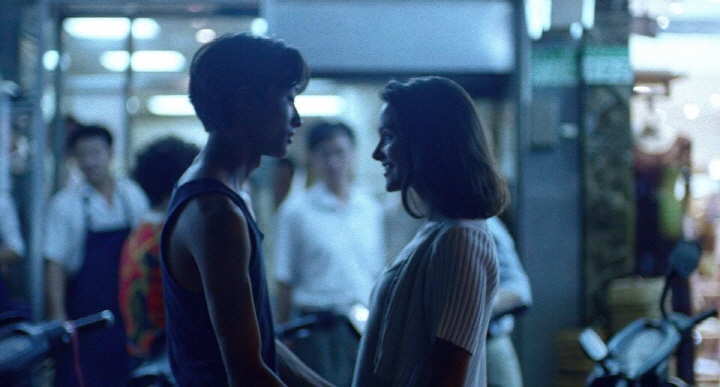
Taiwanese filmmaker Edward Yang’s 1996 film “Mahjong”, whose recent 4K restoration version happens to be released in South Korean theaters in this week, is a bleak comedy about a bunch of rather unpleasant lads in Taipei. As phlegmatically but starkly illustrating their materialistic lifestyle in the city, the movie is sometimes uncomfortable to watch, but it continues to hold our attention with its vividly realistic presentation of the urban mood of Taipei during the late 1990s, and it ultimately comes to us as an engaging time capsule to observe.
During its opening part, the movie introduces its four male main characters one by one. Red Fish (Tang Tsung-sheng), Hong Kong (Chang Chen), Lun-lun (Lawrence Ko), and Little Buddha (Chi-tsan Wang) have been living together in one shabby apartment in Taipei, and we get to know about how they have earned their living. Little Buddha mainly works as a soothsayer who seems to be very accurate on the surface, but his three friends actually make his predictions look quite precise in one way or another, and this fraud scheme of theirs has been fairly successful enough to provide them some extra income.
At a local nightclub, we also meet a couple of foreign figures associated with them, and one of them is a British dude named Markus (Nick Erickson), who has had a fairly substantial financial success as working as an interior designer. He is currently in the relationship with a local young woman named Angela (Carrie Ng), but then there suddenly comes a French girl named Marthe (Virginie Ledoyen), who was once quite close to him in the past. Needless to say, Markus is not so amused at all, and Marthe’s presence certainly disrupts his relationship with Angela, who eventually decides to dump him and then get involved with Hong Kong instead.

However, though he seems pretty nice on the surface, Hong Kong turns out to be much crummier than Markus. He frequently works as a male escort thanks to his very dashing appearance, and he is not willing to stop that even after he and Angela become closer to each other. Furthermore, he is also quite ready to share Angela with all of his three roommates, who are not so bothered by the shamelessly amoral aspects of this situation. It goes without saying that Angela becomes all the more furious, but then, probably because of her low self-esteem, she eventually allows herself to be regarded as a shared thing among Hong Kong and his roommates.
Meanwhile, there comes a big trouble to Red Fish as already shown to us at the beginning of the film. His supposedly wealthy father was recently driven to bankruptcy with a lot of debt, so he ran away along with his mistress, and this certainly angers his devastated wife more. Red Fish does not show much care or concern as having been estranged from his parents for a while, but there are a couple of thugs looking for him for getting any money from his father, and we see them getting closer to Red Fish and his roommates later.
Nevertheless, the movie patiently rolls its story and characters as before, while subtly establishing its realistic urban atmosphere with small details to observe and appreciate. As the camera of cinematographer Longyu Li and Li Yixu often leisurely follows or focuses on whatever is happening among its main characters, we get to know more about them even though we often observe them from the distance without much care, and there is some unexpected little poignancy from the surprisingly tender relationship development between Lun-lun and one of the substantial female characters in the story.
After the main characters are fully established during the first half of the film, its mood becomes a bit more intense as Red Fish and his roommates let themselves thrown further into the harsh reality surrounding them. Hong Kong continues to show more of his coldly uncaring sides to Angela’s frustration and exasperation, and then there comes a comically ironic moment of poetic justice for him, which painfully reminds him of how weak and inconsequential he really is. In case of Red Fish, he turns out to be a lot more vulnerable than expected behind his occasionally cocky attitude when he finds himself overwhelmed by more disillusionment toward the older generation represented by his parents, and we are not surprised when he suddenly commits a devastating act of violence around the end of the story.

The movie surely feels quite bleak and despairing at times, but it also shows some humor and warmth. While we get some good laughs from the clumsiness of the two aforementioned thugs, several brief scenes between Lun-lun and his accidental lover are illustrated with sensitive tenderness, and that is the main reason why the movie really earns the genuine emotions of its very last scene.
Yang also draws solid performances from his main cast members. While Chang Chen, who was incidentally several years after his unforgettable performance in Yang’s great film “A Brighter Summer Day” (1991) at that time, is certainly the most prominent cast member in the group, Tang Tsung-sheng, Lawrence Ko, and Chi-tsan Wang are well-cast in their respective parts, and Virginie Ledoyen, Carrie Ng, and Nick Erickson have each own small moments around the fringe of the story.
Overall, “Mahjong” is relatively less impressive compared to Yang’s other films such as “A Confucian Confusion” (1994) and “Yi Yi” (2000), but it is still worthwhile to watch for its mood, storytelling, and performance. During last several years, I and my fellow South Korean audiences have had a fortunate chance to watch all of Yang’s seven feature films, and now our journey is over with “Mahjong”, but I am already willing to revisit them all. That says a lot about what a great filmmaker Yang is, right?


 Seongyong's Private Place