

South Korean Netflix film “Good News”, which was released two days ago, is a disaster black comedy film loosely inspired by a real-life hijacking incident in March 1970. While it is clear from the beginning that most of its story and characters are fictional, the movie holds our attention with its cheerfully sardonic mix of absurd comedy and intense thriller, and the result is one of more entertaining products from Netflix during this year.
The first act of the film quickly establishes its period background. In 1970, the Japanese society was often disturbed by a radical communist terror group called the Red Army Faction, and we see how several members of the Red Army Faction could get on a Japanese passenger airplane with their hidden guns and knives on that day. Not long after the airplane left the Haneda Airport in Tokyo, they swiftly took it over as planned, and then they demanded to be flown to Pyeongyang in North Korea as soon as possible.
However, things did not go that well for them right from the start, and the movie gives us a series of absurd comic moments as a bunch of Japanese government officials struggle to handle this urgent situation. Thanks to the resourceful tactic of its pilot, the airplane subsequently lands on some other airport in Japan, but the hijackers remain adamant about their demand, and the airplane eventually leaves for Pyeongyang after a small group of hostages are fortunately released after some negotiation.

Now the ball is handled to the South Korean government as the airplane will soon fly over South Korea before entering North Korea, and the director of the Korean Central Intelligence Agency (KCIA) sees a good chance to impress the president more. The director happens to have a shadowy fixer figure known only as “Nobody” (Sul Kyung-gu), and Nobody proposes a rather risky plan to his boss, who understandably balks at the proposed plan at first but approves it anyway.
One of the crucial parts of Nobody’s plan is Seo Go-myung (Hong Kyung), a young South Korean Air Force lieutenant who is incidentally one of a very few certified South Korean Air Force officers who can handle a top-notch US military radar system. Although he is not so willing to break some rules for his sudden mission, Go-myung soon comes to see that he has no choice from the start. After all, he cannot possibly say no the direct order from the KCIA director, who can easily and instantly ruin his life and career as one of the most powerful figures in the South Korean government.
The task given to Go-myung is pretty challenging to say the least. He must pretend that he is an air controller in Pyeongyang, but he has to locate the airplane and then hijack the radio communication for contacting with its pilots first without drawing any suspicions from the hijackers, and that is not easy to do at all, especially considering that somebody on the North Korean side is already ready to outmatch him.
While Go-myung must tiptoe well among numerous risks, the movie steadily develops an immediate sense of urgency, but it also provides an ample amount of absurd humor as Nobody frequently pulls some strings here and there for the success of his risky plan. For example, he must turn the big airport in Seoul into the one in Pyeongyang within a few hours before the airplane is eventually led to there, and there is a hilarious scene showing how he can get things done within a short time thanks to a filmmaker in the middle of making his latest anti-communist propaganda.
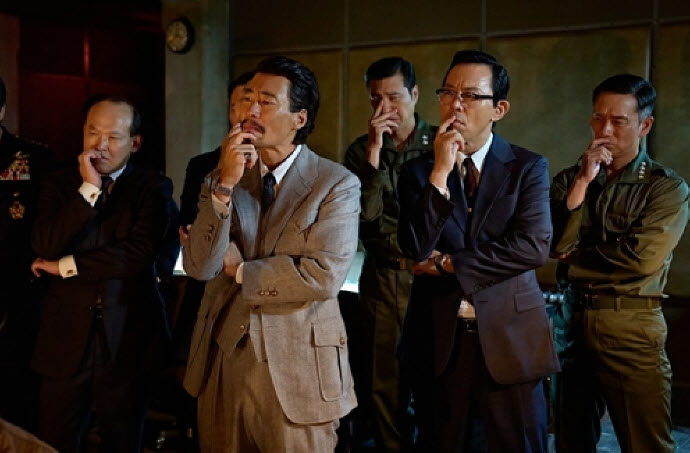
Needless to say, the circumstance becomes more complicated due to a series of unexpected setbacks, and the movie does not pull any punch in its cynically broad depiction of many government official characters in the story. While the KCIA director is your average opportunistic bully, many of South Korean officials and military generals are no better than him as mostly caring more about saving their positions, and they are certainly willing to put all the blames on Go-myung and Nobody if the situation goes horribly wrong in the end.
While the movie continues to maintain the distance between itself and many of its main characters in the story for more absurdity and irony, we come to care a bit more about its two main characters. While his ultimate goal is boosting his military career more, Go-myung comes to care about the safety of those hostages much more than expected, and that makes him all the more frustrated with the incompetence and cowardice of those petty South Korean government officials. Although he is casually sardonic and indifferent on the surface, Nobody gradually comes to show little but genuine care and compassion along the story, and we are not so surprised when we get to know a bit more about how he ended up doing all those dirty works behind his powerful boss. As the contrasting duo of the movie, Sul Kyung-gu and Hong Kyung complement each other well throughout the film, and they are also supported well by a bunch of notable performers including Ryoo Seung-bum, who gleefully chews every scene of his in the movie as required.
In conclusion, “Good News”, directed by Byun Sung-hyun (He previously made Netflix film “Kill Boksoon” (2023), by the way), balances itself well between humor and gravitas without being too serious about itself, and a number of good elements in the film are enough to compensate for its several weak aspects including its rather long running time (136 minutes). It feels a bit too irreverent about its historical background, and I enjoyed its lightweight concoction of humor and suspense nonetheless, and that is enough for me for now.


 Seongyong's Private Place
Pingback: 10 movies of 2025 – and more: Part 3 | Seongyong's Private Place