
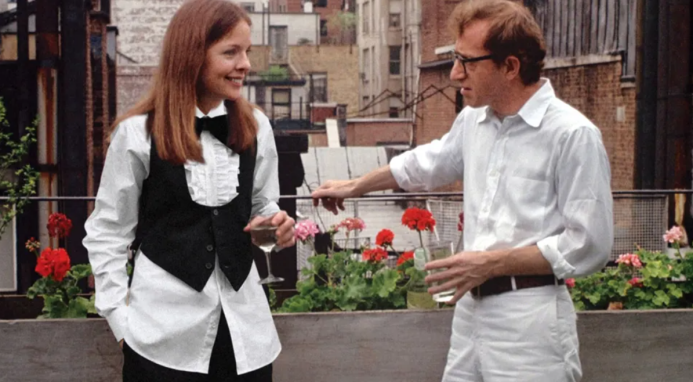
Several years ago, one South Korean critic said that it is a shame that we cannot enjoy Woody Allen’s 1977 film “Annie Hall” like we did for many years. Sure, the movie itself is still very witty, funny, and touching in addition to being one of the definite New Yorker comedy films from Allen, but now his iconic public image is not welcomed much in these days because we come to pay more attention to what has always been there in many of his notable works. After the #MeToo movement, I and many others became much more aware of what he allegedly committed behind his back in the past, and most of us consequently have stayed away from his works as much as possible while noticing their indubitable sexual aspects.
However, it is undeniable that Allen gave many of his actresses some of the best moments in their acting career. Yes, regardless of whether she likes it or not, it is really difficult to talk about Mia Farrow’s career without mentioning a number of Allen’s films she appeared, and one of the main pleasures of his films is how a bunch of many different talented actresses ranging from Diane Wiest to Cate Blanchett excel themselves in one way or another.
Some of these wonderful actresses deservedly won an Oscar for their significant contribution to Allen’s films, and one of such cases is Diane Keaton in “Annie Hall” (The movie also won Best Picture, Best Director, and Best Screenplay, by the way). Right from her very first scene in the film, Keaton, who sadly passed away a few days ago, instantly draws our attention with her natural charm and spirited presence, and her iconic performance remains as the best thing in the film even at present.

As cheerfully bouncing along its non-linear narrative, the movie follows how Alvy Singer, played by Allen, struggles to process his thoughts and feelings on his relationship with his former girlfriend Annie Hall, played by Keaton. As wondering how their relationship was ended, Alvy’s mind naturally goes here and there among the memories of his past as well as his relationship, and it is still amusing to watch several absurd moments from Alvy’s childhood.
Throughout the film, Allen frequently talks directly to us in front of the camera, and I cannot help but observe how that becomes less funny than before. We were once amused a lot by how humorously he wields his neurotic comic persona on the screen, but now he often reminds more of all those allegations against him, and his character’s confusion and anxiety about those colorful young women in the film understandably look rather creepy at times.
However, Keaton constantly brings a lot of life and personality to her character besides that famously quirky attire of hers in the film, and her character comes to us a smart and independent young lady who knows a bit better about the matters of heart compared to her boyfriend. As revisiting the movie at last night, I noticed how much Keaton’s character was depicted through the viewpoint of Allen’s character, but Keaton’s charming performance easily jumps over that inherent storytelling limit, and her character eventually becomes the other half of the story.
Above all, she and Allen effortlessly click well with each other during their several comic key scenes to be savored and appreciated. During one certain scene, the movie suddenly uses subtitles to show what Alvy and Annie respectively think as talking with each other more and more. This may look like a mere attempt for a bit more laugh, but it is enhanced to a considerable degree by the good comic timing between Allen and Keaton, and that is why it is one of the most memorable moments in the film.
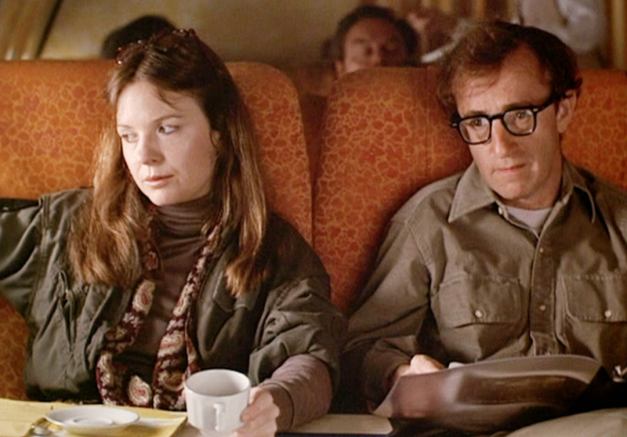
I must point out that several other comic moments in the movie including one particular animation scene are rather dated compared to what is wonderfully transpired between Keaton and Allen. These moments belong more to those early comedy films of Allen such as “Take the Money and Run” (1969) and “Bananas” (1971), which are fairly amusing but often feel a bit too thin as mainly driven by gags and jokes instead of story and character. After getting more recognition and praise thanks to “Annie Hall”, Allen wisely moved onto more sophisticated areas, and that led to not only a series of solid comedy films but also several surprisingly serious drama films such as “Interiors” (1978) and “Another Woman” (1986).
Around Allen and Keaton, several notable performers including Tony Roberts, Carol Kane, Shelley Duvall, and Collen Dewhurst come and go as providing some extra amusement to the movie. Christopher Walken, who would advance further with his Oscar-winning supporting turn in Michael Cimino’s “Dear Hunter” (1978), gives a brief but hilariously uncanny moment as Annie’s rather disturbed brother, and you may also notice Jeff Goldblum and Sigourney Weaver when they respectively appeared for a few seconds later in the film.
In conclusion, “Annie Hall” is still a definite career high point for both Allen and Keaton even though its reputation has been irreversibly tarnished to some degree by the allegations against Allen during last several years. Although she sided with Allen even after the #MeToo movement, it is inarguable that Keaton was one of the greatest American actresses of our time, and I am glad to see that she still shines in “Annie Hall” as before.


 Seongyong's Private Place