

I still remember when I visited the contemporary art section in the Art Institute of Chicago during one day of April 2010. I must confess that most of those exhibited artworks were a bit too plain and simple to my eyes, and I wondered whether they were profoundly simple or simply profound, though it goes without saying that they were all valued pieces of art.
That interesting experience of mine always comes to my mind whenever I watch any good film about the creation or evaluation of art, and Japanese comedy film “Maru” is one of the recent cases. As leisurely rolling its absurd story promise, the movie has some dry fun with its artist hero’s quirky creative struggles along the story, and I enjoyed that enough even though I struggled to grasp what and how it is about at first.
At first, we are introduced to a young struggling artist named Sawada (Tsuyoshi Domoto), who has been virtually exploited by some prominent male artist along with several other young artists. Without teaching or helping them at all, that artist dude simply uses the labor of Sawada and the other employees for the production of more artworks from his studio, and, not so surprisingly, he takes all the credits for these manufactured artworks.
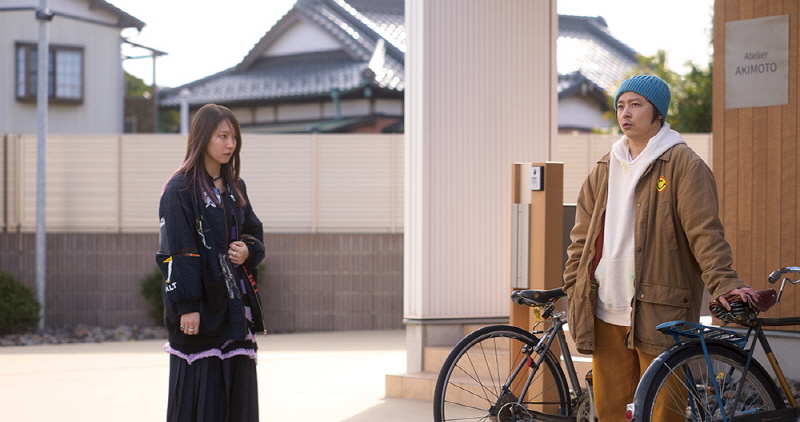
While some of his colleagues naturally express some discontent and exasperation about this impertinent labor exploitation, Sawada does not seem to mind at all. When he happens to get his right arm injured due to a little bicycle accident, he is promptly fired, but he is not so angry or miserable about that, and then he gets employed as a part-time worker in a local convenience store because, well, he needs to earn his meager living as usual.
Sawada lives alone in a small shabby apartment, and we observe how he languidly goes through one day after another when he is not working. Paying attention to his little pet animal from time to time, he mumbles several supposedly meaningful excerpts from some Buddhist books, and that is sometimes disrupted by the sudden loud noises caused by whoever is living right next to his little apartment.
Because his financial status is still difficult despite working at that convenient store, Sawada often sells a number of trivial stuffs inside his apartment, but then he comes to try something different. On one day, he happens to have sort of artistic inspiration via a very tiny happening, and, what do you know, he soon begins to draw a number of very simple paintings, all of which just have only one big black circle drawn on white paper (The title of the movie means “circle” in Japanese, by the way). When he sells these paintings under his name, he does not expect a lot, but, surprise, they are regarded as the profound pieces of (don’t laugh) minimalist Buddhist art once they draw the attention of some prominent art dealer.
As the value of him and his paintings is subsequently skyrocketing in both Japan and the whole global world, Sawada is naturally perplexed. While he does not mind doing whatever his dealer suggests, he still does not know what is exactly happening to him and his life, let alone what really motivated him to draw those very simple paintings.
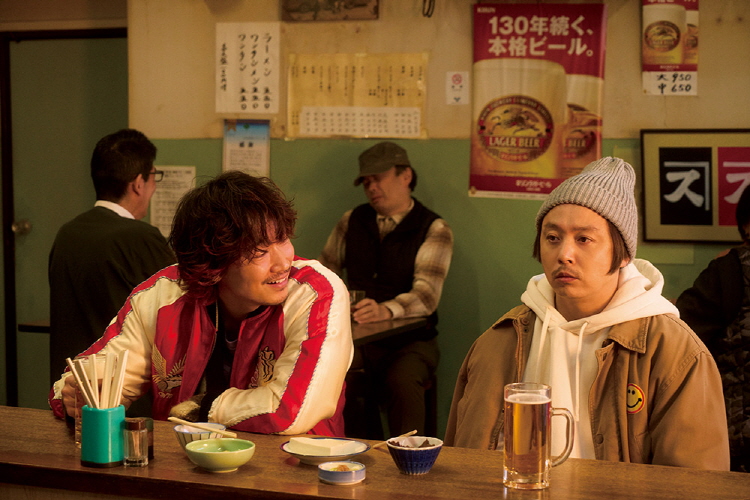
While its hero wanders with more doubt and confusion, the movie provides a series of amusing moments to tickle you in one way or another. At one point, Sawada finally befriends his noisy neighbor who is also a struggling artist just like he once was, and his neighbor certainly envies how Sawada attains his ongoing success so easily and quickly. At one point, they have a lunch together in a local restaurant, and it is rather hilarious to see how Sawada’s new friend cannot help but express his petty envy and inferiority complex as Sawada simply listens to him without saying that much.
In his rather passively docile attitude, Sawada usually looks rather distant to us, but we gradually understand and then empathize with his growing artistic struggle, even when we cannot help but amused by his constant bafflement. However, when he finally comes to realize why those simple drawings of his feel so special to many others, the movie becomes a bit more serious along with its hero than before, and what follows next, which incidentally evokes the action painting of Jackson Pollock, makes me realize one really important thing about art. Regardless of whether it is simple or complex or whatever, art is always based on human emotion and spirit, and that is the main reason why those numerous instant artworks by artificial intelligence feel instantly phony and vulgar to many of us. In my humble opinion, there always should be the human agony and ecstasy of creation to be communicated between creators and us (Is this the ultimate purpose of art, isn’t it?), and artificial intelligence will probably never be able to reach to that point unless it truly understands and then experiences our everlasting matters of heart.
On the whole, “Maru”, which is directed/written by Naoko Ogigami, requires a bit of patient at first, but it will gradually intrigue and amuse you while also leading you to some musing on art and creation. In short, this is another solid work from Ogigami after “Riverside Mukolitta” (2021) and “Ripples” (2023), and I will certainly look forward to whatever will come next from this interesting Japanese filmmaker.


 Seongyong's Private Place