
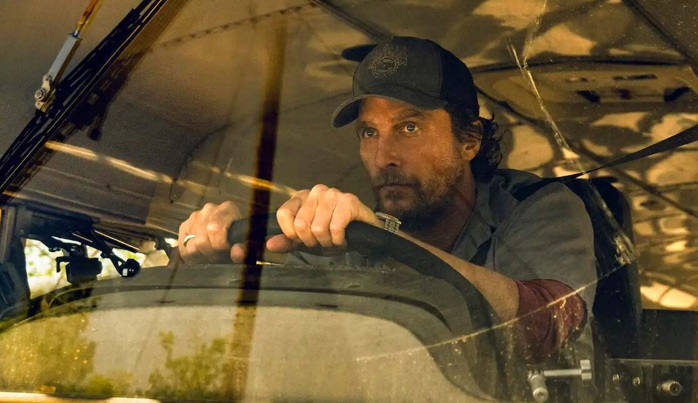
Paul Greengrass’ latest film “The Lost Bus”, which was released on Apple TV+ on last Friday, works whenever it is on fire. Based on one real-life story associated with the 2018 Camp Fire in California, the movie is as clichéd as you can expect from your average disaster survival drama film, but many scenes of fire in the film are filled with considerable intensity and verisimilitude, and that is more than enough for compensating for its several weak points.
At first, the movie mainly revolves around Kevin McKay (Matthew McConaughey), a school bus driver working in Paradise, California. The early part of the film establishes how messy McKay’s life has been, and things seem to be getting only worse for him on that particular day of November 2018. While he becomes more distant from the only child from his failed marriage, he cannot earn enough money for him to support his child and his ailing mother, and his school bus also needs to be repaired as soon as possible.
Meanwhile, the movie shows how the fire was started and then developed at a spot not far from Paradise early in the morning. Although it is spotted and then reported during its early stage, the fire is quickly spread around the surrounding regions due to the extremely dry weather and the strong wind at that time, and those firemen of California Department of Forestry and Fire Protection (CAL FIRE), led by Ray Martinez (Yul Vazquez), soon begin to realize that they are facing what will be one of the biggest wildfire disasters in the Californian history.
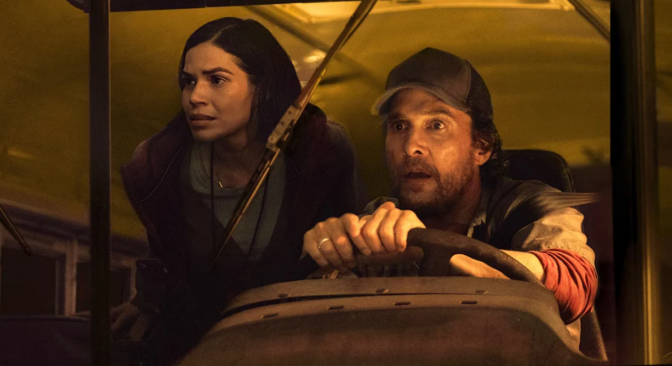
As the fire is being spread toward Paradise, the evacuation is ordered upon the citizens of Paradise, and the whole city is consequently thrown into a lot of chaos and panic. Although he certainly worries about the safety of his family, McKay cannot say no when his dispatcher hurriedly requests him to take a bunch of elementary school students to a safer place right now, and he soon arrives at that elementary school. Under the calm guidance of a teacher named Mary Ludwig (America Ferrera), all the remaining kids in that elementary school quickly get on the bus, and it seems that they are safe at least for now.
However, of course, it does not take much time for both McKay and Ludwig to realize how dangerous the situation is for them and those kids in the bus as well as many others out there. As the fire keeps getting spread over the surrounding regions of the city, the sky becomes quite dark and fiery to say the least, but many of the roads in the city are already saturated with vehicles, while time keeps running out no matter how much McKay tries here and there for getting his job done as soon as possible.
Alternating between McKay and Ludwig’s increasingly desperate situation and the strenuous efforts of the firemen of CAL FIRE against the Camp Fire, the movie, which is based on Lizzie Johnson’s nonfiction book “Paradise: One Town’s Struggle to Survive an American Wildfire”, keeps things rolling even though its road is strewn with one cliché after another. As they stick together more for themselves as well as those school kids in the bus, McKay and Ludwig come to show a bit of themselves to each other, and we naturally get an expected scene where they come to talk about their respective lives when all seems to be lost for them and the school kids at one point later in the story. In case of the scenes involved with Martinez and his people of CAL FIRE, we surely get a series of typical moments as they get frustrated again and again along the story, and the movie does not pull much punch on a certain big local energy company which could have responded more quickly to the disaster from the very beginning.
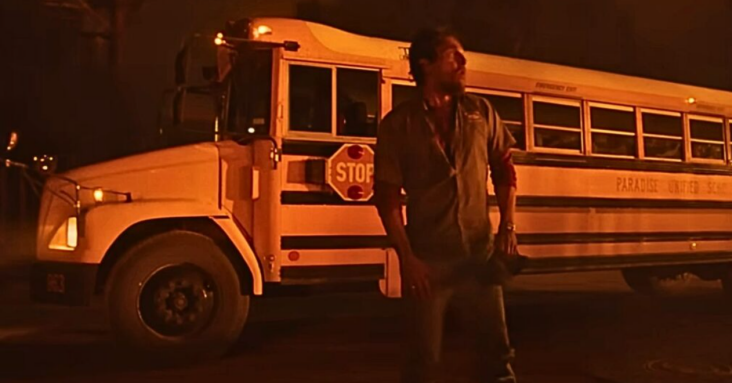
In the end, everything eventually culminates to the point where McKay and everyone else in the bus must face the grave and immense possibility of danger and death, and Greengrass, who wrote the screenplay with co-producer Brad Ingelsby, and his crew members including cinematographer Pål Ulvik Rokseth did a heck of job of putting us right into the middle of the peril experienced by McKay and the others in the bus. Although I am sure that those fire scenes in the film depend on a considerable amount of CGI, they look quite vivid and scary on the screen, and it is a shame that I and many others can only see the movie via the streaming service at present (The movie was briefly released in American theaters in last month, by the way).
In case of the two notable performers of the film, they ably handle the clichéd aspects of their characters as diligently carrying the movie to the end. Matthew McConaughey, who has curiously been less active during last several years, demonstrates that he has not lost any of his talent and charisma yet, and America Ferrera has several moments to shine as steadily holding her spot beside McConaughey. Yul Vazquez and Ashlie Atkinson are effective in their small but crucial supporting parts, and those child performers in the film are also convincing in their natural acting.
In conclusion, “The Lost Bus” may burn a bit too much of clichés and conventions for starting its engine, but it ably drives along its fiery plot course under the skillful direction of Greengrass, who previously directed several very intense drama films such as “United 93” (2006) and “Captain Phillips” (2013). I still think it could be improved more with less clichés, but it engaged me enough during viewing, so I will not complain for now.


 Seongyong's Private Place
Pingback: My Prediction on the 98th Academy Awards | Seongyong's Private Place