

Francis Ford Coppola’s 1972 film “The Godfather”, which happened to be re-released in selected South Korean theaters several weeks ago, is a masterpiece you cannot possibly refuse. As compellingly illustrating the transfer of a criminal power from one generation to the other generation, the movie immerses us into the world of various criminal figures, and it somehow makes us sympathize with some of these dangerous figures even we are well aware of what they have done for their “business”.
The opening part of the film, which is set on one day of 1945, is a masterful case of how to introduce and then establish numerous characters within a short time. As many of his guests are enjoying the wedding party of his daughter outside during one sunny afternoon, Vito Corleone (Marlon Brando), the aging boss and patriarch of the Corleone family in New York City, is meeting some of his guests in the dark private room of his big house, and the first scene shows him quietly listening to the request to a father who wants the revenge for his unfortunate daughter. While sharply pointing out how this man has distanced himself from his family, Vito benevolently accepts his request as having this man accept his “friendship”, and the movie pulls out a bit of surprise when Vito requests something very important to this man later in the story.
Meanwhile, many different characters are introduced to us one by one at the party outside, but we are not so confused at all mainly because they are broad but colorful archetypes played by various performers with distinctive presence. Just look at Salvatore Tessio (Abe Vigoda), Peter Clemenza (Richard Castellano), and Luca Brasi (Lenny Montana), three key figures in the Corleone family. The movie does not show or tell a lot about who they are, but their appearances instantly draw our attention right from the start, and that certainly helps as the plot subsequently thickens with more characters and incidents to come along the way.

And we are also introduced to Vito’s three sons: Sonny (James Caan), Fredo (John Cazale), and Michael (Al Pacino). While Sonny is your average hot-tempered gangster who is usually held in check by Vito and Vito’s adopted son/consigliere Tom Hagen (Robert Duvall), Fredo does not have much right stuff for their family business, and Michael, who is incidentally their father’s favorite, prefers to stay out of their family business as much as possible, though he comes to the weeding party with his girlfriend Kay (Diane Keaton) as required.
Ironically, Michael only ends up getting involved with the family business much more than he probably ever imagined, because, after all, he also follows the one important code among his family members – the family comes first above all else. When his father as well the family are seriously threatened, he actively comes forward for providing the solution, and that fatefully leads to the beginning of his descent into crime.
While also juggling many other crucial plot elements, the screenplay by Coppola and his co-writer Mario Puzo, which is based on the novel of the same name by Puzo, takes time for us to observe how Michael eventually succeeds his father as Vito is ready to walk away from his powerful position. When everything is set for Michael to start a series of events to catapult him onto the top of his criminal world, the movie deftly delivers a climatic sequence to remember, and it is still electrifying to observe how the movie swiftly and smoothly resolves everything in the story before its haunting last shot comes.
Furthermore, the movie also works as a rich character drama as focusing more on the relationship between Vito and Michael. When they have a private conversation at one point around the last act, Vito shows a bit of sorrow and sympathy as showing his concern on the future of Michael and their family (“I never wanted this for you.”), but he also shrewdly predicts what will happen next once he is gone, and Michael simply listens, while never revealing anything except his deep affection and loyalty toward his father.
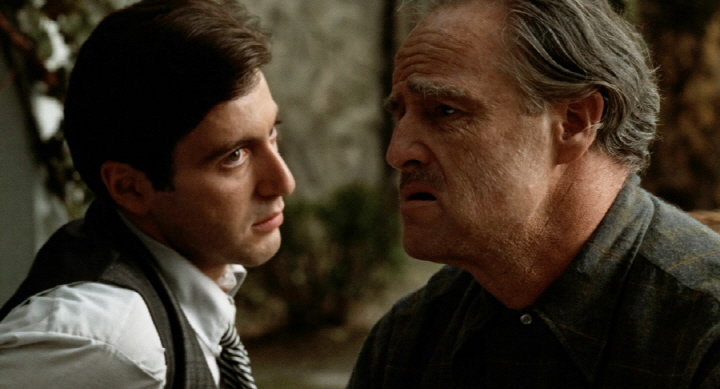
Although the movie is actually more about Michael than Vito, Marlon Brando, who won his second Oscar for the movie, delivers an iconic performance to be remembered. As my late mentor Roger Ebert pointed out in his 1972 review, Brando’s performance is basically a “skillful throwaway”, but Brando also brings interesting nuances and details to his character besides a subtle sense of authority and sensibility and that cute little cat, and we somehow come to have some respect for the power and influence of this old but shrewd criminal who has probably done a lot of evil throughout his life. On the opposite, Al Pacino, who just started his movie acting career as showing considerable promise in “The Panic in Needle Park” (1971) at that time, gradually takes the center with his equally indelible low-key performance, and he is particularly effective when his character has a brief moment of conflict and hesitation right before his first act of killing.
The movie is filled with many wonderful performers to behold. Besides Abe Vigoda, Richard Castellano, and Lenny Montana, a bunch of other character actors ranging from Sterling Hayden to John Marley ably fill their respective spots as required, and John Cazale, James Caan, and Robert Duvall have each own moment to shine. Although the movie is prominently male-dominant, Talia Shire and Diane Keaton hold their small spots as the small but substantial female characters of the film, and Keaton is particularly heartbreaking when her character comes to see what Michael has become around the end of the story.
In conclusion, “The Godfather” is a great film which is also a definite high point for Coppola and many of his cast and crew members including cinematographer Gordon Willis, whose moody cinematographer here in this film surely shows here why he has been often called “the Prince of Darkness”. Although it has been more than 50 years since it came out, the movie can still captivate and mesmerize us from the beginning to the end, and you will admire more of how it confidently and effortlessly takes us into the world of its criminal characters without much objection from us.


 Seongyong's Private Place