
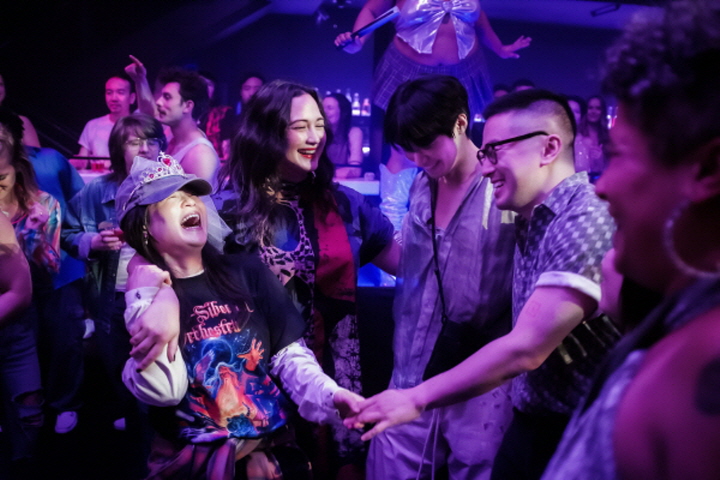
“The Wedding Banquet”, the remake of Ang Lee’s 1993 film of the same name, is an exemplary remake to enjoy. While it understandably adds some big changes to the story and characters, the movie also has a fair share of humor and poignancy just like the original version, and the overall result is actually less redundant than expected.
The story, which is set in Seattle, Washington, mainly revolves around two very different homosexual couples. Angela (Kelly Marie Tran) and Lee (Lily Gladstone) have lived together for years, and they have tried to have a baby via in vitro fertilization (IVF), but Lee recently fails to get pregnant again after her second trial. Unfortunately, they do not have enough money for the third trial at present, and they naturally begin to wonder whether both of them really wanted to have a baby from the beginning.
The other couple in the story is Min (Han Gi-chan) and Chris (Bowen Yang), who have incidentally lived in the garage of Lee’s house and have also been Angela and Lee’s best friends for a long time. The opening scene of the film shows these two couples attending a ceremony for many sexual minority people in Seatle, and Angela’s mother May (Joan Chen) gladly attends this ceremony even though, as revealed later in the story, it took some time for her to accept that Angela is lesbian.
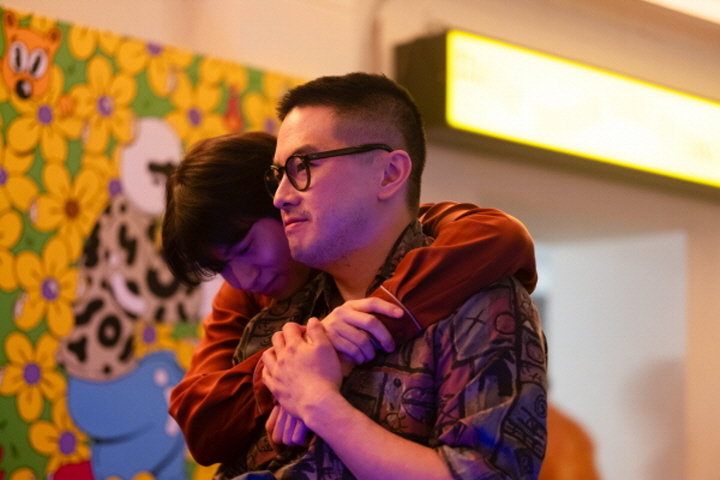
Some time later, Min suddenly faces a serious family problem. As a young South Korean studying in US, he needs to get his student visa extended at present, but his wealthy grandmother Ja-young (Youn Yuh-jung) begins to stop supporting his stay in US, mainly because she and her husband have expected Min to return to South Korea and then join their family business for years. Although he has not revealed yet to his grandmother that he is gay, Min seriously considers marrying Chris, but then Chris hesitates to go further with their relationship.
And then there comes a seemingly good idea to Min not long after he and Chris come to learn about Angela and Lee’s ongoing problem. When Min suggests to Angela that she should marry him and then help him get a green card in exchange for the money for the third IVF trial for her and Lee, Chris as well as Angela and Lee instantly reject this rather outrageous idea, but then Angela and Lee start to wonder whether this can actually a nice solution for not only them but also their two best friends.
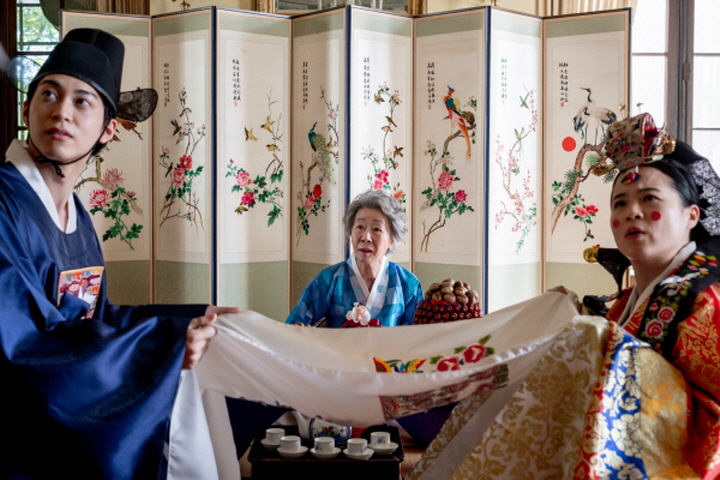
It initially seems that all Angela and Min will have to do is simply registering themselves as a legally married couple at the city hall without a wedding ceremony or anything else, but then things soon get quite complicated after Min notifies to his grandmother that he is going to marry Angela. Ja-young unexpectedly decides to come to Seattle for paying a visit to Min and Angela, and Min and Angela as well as Chris and Lee must try to hide their homosexuality as much as possible in front of Min’s grandmother.
Around this narrative point, the screenplay by director Andrew Ahn and his co-writer/co-producer James Schamus, who wrote the screenplay for the 1993 film along with Ang Lee and Neil Peng, takes a little different route compared to the 1993 film. Because homosexuality has become a lot more acceptable at present, the movie does not have the same dramatic/comic tension in the 1993 film, so it focuses more on the internal issues of its four main characters. Although they are quite open about their homosexuality, Angela, Lee, Chris, and Min find themselves and their relationships getting tested more than expected at first, and this alternatively exasperates and frustrates them as Angela and Min’s fake wedding is approaching.
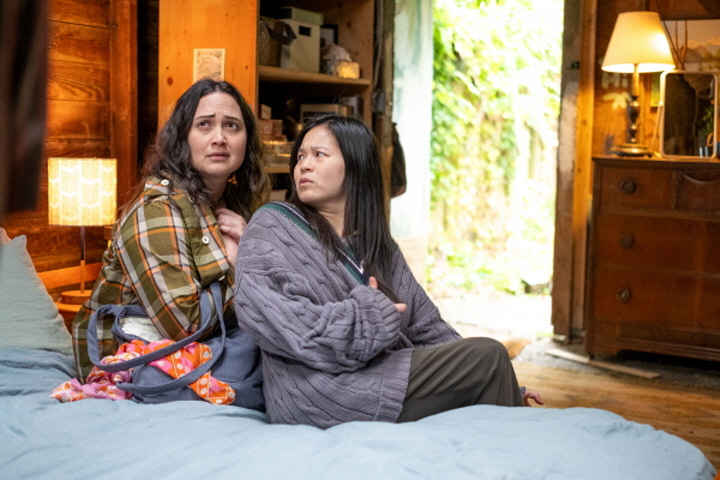
Nevertheless, the movie steadily maintains its lightweight mood as balancing itself well between humor and poignancy. There is an amusing moment involved with how Chris and Min try to make Lee’s house and their place look as straight as possible along with Lee and Angela, and then we get all the more amused when Ja-young, who is your typical no-nonsense old lady, begins to sense something fishy about her grandson’s sudden decision to marry. When Angela’s mother later gets involved with their situation, Angela is not so amused to say the least due to an old personal wound of hers, and that eventually leads to a brief but aching moment between her and her mother.
Although the story trudges a bit as the circumstance becomes all the more serious and complicated for everyone in the story, the movie remains supported well by the well-rounded ensemble performance from its main cast members. Bowen Yang, who has been mainly known for his Emmy-nominated works in “Saturday Night Live” and also appeared in Ahn’s previous film “Fire Island” (2022), demonstrates the more serious side of his acting talent here in this film, and he and South Korean actor Han Gi-chan are believable during several key scenes between them in the movie. On the opposite, Kelly Marie Tran, who has been mainly known for her unjustly maligned supporting turn in Rian Johnson’s “Star Wars: The Last Jedi” (2017), and Lily Gladstone, who has advanced further since her recent Oscar-nominated turn in Martin Scorsese’s “Killers of the Flower Moon” (2023), are also equally wonderful as the other half of the story, and the special mention goes to Joan Chen and Youn Yuh-jung, the two legendary grand dames of Asian Cinema who surely bring a lot of class and grace to their characters as well as the film.
Since I watched “Spa Night” (2016) and then met Ahn at the Jeonju International Film Festival in 2016, I was impressed by how he went further with “Driveways” (2019) and “Fire Island” during next several years, and I think “The Wedding Banquet” will be another substantial stepping stone in his promising filmmaker career just like the 1993 film was in Lee’s career. The movie delighted me for many reasons in addition to entertaining me enough for recommendation, and I hope that I may be able to show it to my parents someday for helping them accept more of my homosexuality. Yes, they still want to marry some nice girl soon even after I came out of my closet in late 2016, and my mother tried another heterosexual matchmaking again a few days ago. Will they really change their mind if they ever watch this film, I wonder?


 Seongyong's Private Place
Pingback: 10 movies of 2025 – and more: Part 2 | Seongyong's Private Place