
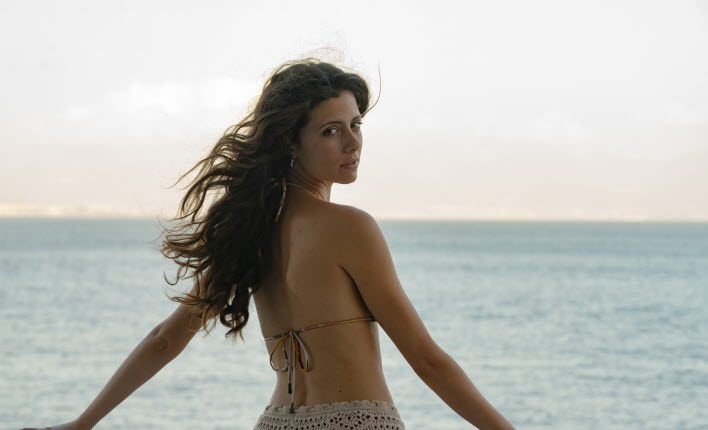
Paolo Sorrentino’s 2024 film “Parthenope”, which belatedly came to South Korean theaters a few weeks ago, tries something different compared to many of his previous works, and that made me interested to some degree. As shown from “Il Divo” (2008) or “The Great Beauty” (2013), many of Sorrentino’s movies are about aging heroes, but “Parthenope” places a young beautiful lady at its center, and that is sort of refreshing even though the overall result is not satisfying enough in my inconsequential opinion.
The titular character of the film is played by newcomer Celeste Dalla Porta, who instantly grabs our attention with her natural charm and spirit. The opening part of the film shows us when her character, Parthenope Di Sangro, was born to a fairly affluent family in Naples, Italy in 1950, and then the movie instantly moves forward to 1968, when Parthenope is entering adulthood while looking like being quite ready for her upcoming college education.
As your typical natural beauty, Parthenope has certainly attracted the interest of many young guys around her age. While it is apparent that Sandrino (Dario Aita), a close friend of her and her older brother Raimondo (Daniele Rienzo), has been carrying a torch for her for years, she often pays more attention to how she is going to live, and she never responds much to Sandrino’s courtship while merely remaining as a friend to him as before.
Meanwhile, a few older figures come and then go in her life. At a local college, Parthenope impresses an old professor a lot with her intellectual passion, and he willingly becomes a mentor to guide her along the following academic course toward her doctoral degree, though she is also interested in any other possibility in her life besides that.

Several years later, Parthenope goes to Capri along with her older brother and Sandrino, and she is quite excited when she comes across John Cheever (Gary Oldman), a famous American writer who wrote several works admired by her. Although Cheever is your average bitter old drunken man, he and Parthenope come to form a sort of friendship, and he surely has some wisdom to impart to her whenever his inebriated mind becomes a bit more lucid.
And there is a rich old man who is not only the boss of Parthenope’s father but also the godfather of both Parthenope and her older brother. As shown from his extravagant gift in the opening part of the film, he has always loved and cared a lot about his goddaughter, and he and Parthenope get along pretty well with each other as he often cherishes her youthful charm and spirit.
And then something quite devastating happens to Parthenope, and that leads her to a lot of wandering during next several years. As becoming less interested in her academic career, she tries a bit on becoming an actress, but she is only reminded that this is not exactly what she wants for her life, especially when she encounters an old aging star actress who reveals to Parthenope a lot of bitter personal feelings behind her brash appearance.
While leisurely rolling along with its heroine from one point to another, the movie sometimes intrigues us with a series of oddly striking visual moments to remember. When Parthenope lets herself get involved with a handsome but rather shady lad at one point, we get a brief but dazzling moment filled with a lot of lighted blue baskets descending over a seedy alley, and then we are served with an unnerving sequence where a forced heterosexual copulation is presented in front of a group of older men and women just for an important criminal family business deal.
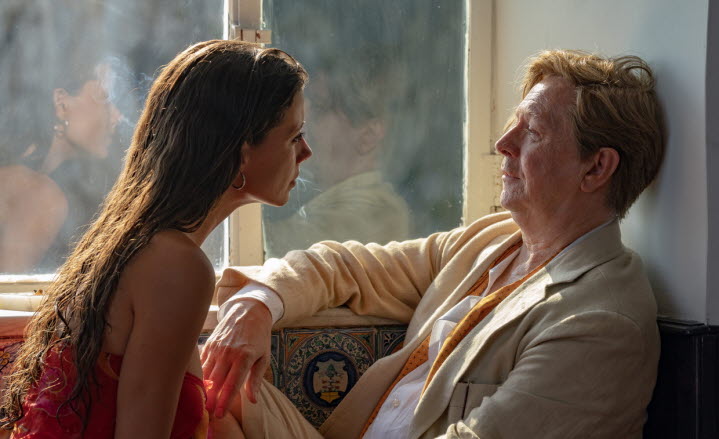
However, the movie does not delve that much into its heroine’s personality and humanity as simply following her formative period without much emotional impact. Around the ending, it shows a bit of poignancy as Parthenope and her mentor come to show more affection and respect to each other, but that comes too late to compensate for the rather languid narrative pacing of the story, and the movie feels all the more disjointed with a really bizarre moment involved with her mentor’s private life.
Anyway, Dalla Porta did an admirable job of carrying the movie to end, though the movie does not provide her much to do from the beginning. Thanks to her diligent acting, we sense a bit of how her character gets gradually matured during her wandering period, even though her character is often required to look distant and elusive throughout the film.
In case of a bunch of substantial main cast members, they are mostly limited by their underwritten parts. As the two young main figures in Parthenope’s life, Daniele Rienzo and Dario Aita bring some extra youthful energy to the story, but they are stuck with their thankless supporting roles from the start. Several older performers including Silvio Orlando, Luisa Ranieri, Peppe Lanzetta, Stefania Sandrelli, and Gary Oldman have some nice juicy moments, and Oldman certainly has a bit of fun with his deliberately hammy performance.
In conclusion, “Parthenope” is another disappointment after Sorrentino’s previous film “The Hand of God” (2021), which I was less enthusiastic than many other reviewers and critics. At least, Sorrentino already moved onto “La grazia” (2025) in this year, and I can only hope that this next film of his will impress me more than this disappointing work.


 Seongyong's Private Place