

During last 10 years, I have admired the strenuously defiant artistic efforts of Iranian filmmaker Jafar Panahi. I must confess that I was not so familiar with his filmography when I heard about his ongoing political conflict with the Iranian government around the early 2010s, but his subsequent works such as “Taxi” (2015) and “No Bears” (2022) showed me that he is indeed one of the best filmmakers working in Iran at present, and I was often impressed by how he has managed to keep making interesting movies to watch despite all those limits and obstacles surrounding him and his collaborators.
In case of his latest film “It Was Just an Accident”, which won the Palme d’Or award at the Cannes Film Festival early in this year, it is quite apparent that he will not step back at all in his critical stance against the Iranian government. While looking like a typical revenge drama at first, the movie engages us more than expected as dexterously balancing itself among drama and comedy along the story, and it is certainly another impressive achievement to be added to Panahi’s admirable career.
At the beginning, we are introduced to a guy driving to his home in the middle of one night along with his pregnant wife and their little daughter. As the camera steadily focuses on their interactions, we get to know these three people bit by bit, and then the quiet mood surrounding them is suddenly interrupted by an unexpected accident involved with some unfortunate dog. As watching this scene, I could not help but amused a little because I happened to watch Christian Petzold’s “Miroirs No.3” (2025) right before watching the movie in the same screening room. That movie also begins the story with a sudden car accident, which leads to the accidental encounter between its two main characters.

That unexpected car accident at the beginning of “It Was Just an Accident” also leads to an accidental encounter, though this encounter is more disturbing in comparison. When it later turns out that his car needs to be repaired, the guy takes his car to a local garage, and then his voice happens to be noticed by a mechanic named Vahid (Vahid Mobasseri), who was once arrested and then tortured for some political protest against the Iranian government. During that grim and horrible time, Vahid was severely brutalized by one particular interrogator, and we come to gather that he has suffered a serious kidney problem in addition to still reeling from the trauma caused by those barbaric tortures and abuses inflicted upon him.
Although he did not see the interrogator’s face in question during that time, the interrogator’s voice and the squeaking sound of his right prosthetic leg remain quite vividly in Vahid’s mind, and that is why Vahid becomes quite certain that he found the interrogator. Once the guy leaves, Vahid follows after him for getting to know more about him, and then he kidnaps the guy for getting his revenge on the interrogator at last.
At first, it seems that all he has to do is taking the guy to some remote spot outside their city and then killing the guy, but then Vahid comes to have some reasonable doubt as the guy, who gets tied up and blindfolded just in case, keeps insisting that he is not the man responsible for Vahid’s misery and torment. Becoming more aware of the possibility of capturing the wrong man, Vahid eventually decides to get some help from several others who may support or confirm his initial conviction, while his captive is locked in a big wooden box in the back of his shabby van.
We subsequently see several other characters getting involved with Vahid’s increasingly tricky situation, and they turn out to have each own pain and anger as being tortured by the same interrogator during that time. Like Vahid, they never saw the interrogator’s face at that time, but they remember a few recognizable things from him as vividly as Vahid, and their traumatized minds are instantly triggered by what they respectively notice from Vahid’s captive, though both they and Vahid are still not absolutely certain about the identity of Vahid’s captive.
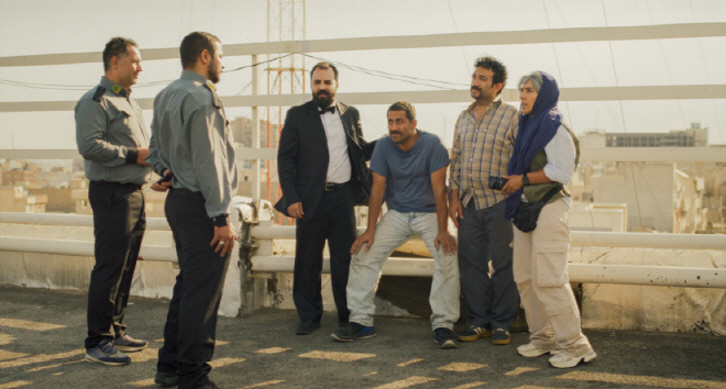
Now this situation is surely reminiscent of Ariel Dorfman‘s famous play “Death and the Maiden”, and the movie, which gradually feels universal as much as Dorfman’s play, certainly becomes more intense as things get all the more complicated for Vahid and several other characters around him, but it also shows some sense of humor via several moments of sheer absurdity. In case of one particular scene, the movie deftly swings back and forth between absurdity and gravitas in one steady unbroken shot, and it even evokes Samuel Beckett’s classic play “Waiting for Godot” to some degree.
The story eventually culminates to the inevitable resolution of Vahid and several others’ impossible circumstance, but the movie does not lose any of its narrative momentum under Panahi’s confident direction. The setting of the following climactic part may look pretty simple and plain at first, but the resulting emotional intensity on the screen is overwhelming at times, and then there comes the sublime final shot whose effective sound design you absolutely need to experience at movie theater for good reasons. Panahi also draws excellent performances from Vahid Mobasseri and several other main cast members, and the special mention goes to Ebrahim Azizi, who splendidly handles his crucial moment around the end of the film as we keep oscillating between certainty and doubt along with Vahid.
In conclusion, “It Was Just an Accident”, which was recently selected as the French submission to Best International Film Oscar, is a seemingly modest but undeniably powerful human drama to remember. In short, this is one of the most compelling movie experiences of this year in my inconsequential opinion, and I am glad that I and many other South Korean audiences can watch this terrific film much earlier than expected.


 Seongyong's Private Place
Pingback: 10 movies of 2025 – and more: Part 1 | Seongyong's Private Place
Pingback: My Prediction on the 98th Academy Awards | Seongyong's Private Place