

Argentine filmmaker Matías Piñeiro’s latest film “You Burn Me” often baffled and confounded me for good reasons. Probably because I do not have much background knowledge on the main subjects of this experimental film, I simply observed the repeated images and quotes without enough interest, and it was a rather challenging experience on the whole despite its rather short running time (64 minutes).
At least, I knew a bit about what and how the movie is about, because I happened to watch its trailer right before the screening I attended during this afternoon. As the trailer presents a series of seemingly random images, Piñeiro tells us a bit about how the movie will shuffle between the works of two different poets, and we are also introduced to his two lead actresses who will play the central figures of the film.
One of these two central figures is Sappho, a famous ancient Greek poet whose body of work deserves attention as much as her well-known homosexuality (I am sure that you all know well where that well-known word for female homosexuality came from, right?). Unfortunately, as often reflected throughout the film, many of her works have been preserved only in fragmented state, and the movie tells us later that only one of her works remains intact just because of being wholly quoted in the certain famous book of a contemporary male Greek poet.
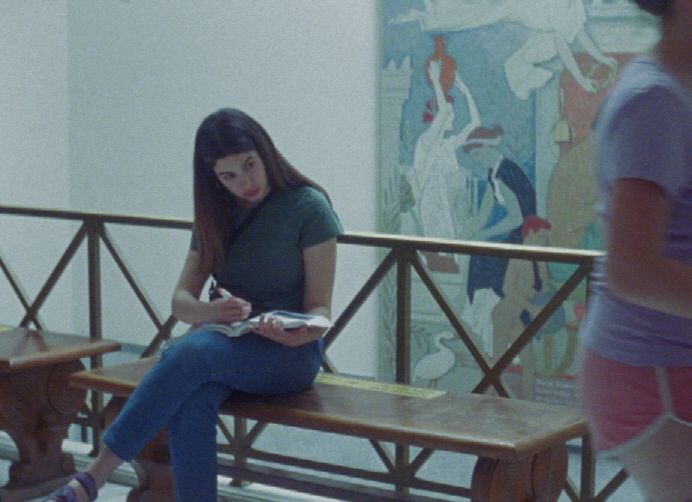
The main ground for the narrative of the film is actually a chapter from the book of Italian poet Cesare Pavese (1908 ~ 1950), whose tragic death by suicide often resonates with how Sappho killed herself due to a matter of heart. In that part of Pavese’s book, Sappho has a private conversation with a nymph named Britomartis, and their following conversation on life and desire gradually takes the center as the film steadily juxtaposes their words with a number of various images shot in various locations around the world.
Piñeiro and his co-cinematographer Tomás Paula Marques shot these images on 16mm films in the screen ratio of 1.33:1, and they deliberately made them look older and shabbier, probably for evoking the ancient aspects of the conversation between Sappho and Britomartis. As their conversation flows from one ancient Greek tale after another, the movie comes to reflect more on how desire has been a constant fact of human life just like it was a key factor in numerous ancient Greek tales such as “The Iliad” and “The Odyssey” by Homer, and both Sappho and Britomartis also mull a bit on how they were destroyed by desire in one way or another. While Sappho killed herself because of a big heartbreak involved with one certain young lady, Britomartis leapt into the sea for escaping from a man who desired her a lot, and there is a little amusing scene involved with a sketch showing how a certain body part of that dude was absurdly cursed due to his fierce desire toward Britomartis.
Piñeiro’s two lead actresses simply play a bit as Sappho and Britomartis in front of the camera or duly read the quotes from the works Sappho and Pavese. Sometimes these quotes are repeated more than once, and the accompanying images are also repeated along with that. Although this feels a bit frustrating at times, it is apparent that the movie expects us to reflect more on this direct juxtaposition between text and image, and you may also come to mull more on the feministic viewpoint on those ancient Greek tales. For example, how much Calypso felt betrayed and devastated when Ulysses eventually decided to return to his faithful wife after living with her for no less than 7 years? And how did Helen of Troy actually feel about all those epic conflicts surrounding her?

However, because I may not be emotionally matured yet despite being over 40, the words in the film feel rather abstract to me instead of genuinely resonating with my heart. Besides, I usually prefer prose to poetry as a guy inclined to being more direct and straightforward, so I must confess that I struggled over understanding the emotional aspects of whatever implied by those fragmented works of Sappho or the conversation between her and Britomartis in Pavese’s book.
Nevertheless, the movie succeeds to some degree in case of igniting more interest toward Sappho and Pavese from me. Although the movie just explains a bit about the circumstance surrounding his last days, Pavese looks like another interesting artist to explore for me, and I will certainly look for any way to get more access to his works. In case of Sappho, well, I come to learn from the film that she was really much more than a historical woman who originated the aforementioned word for female homosexuality, and I can only hope that more of her works will be discovered in the future, though that may be less possible as more time goes by.
In conclusion, “You Burn Me” did not exactly engage me enough, but it enlightened me a bit at least, and I became more aware of the career of Piñeiro, who has steadily made one film after another since his feature debut film “El hombre robado” (2007). Although “You Burn Me” is an acquired taste to me, I recognize that he is another interesting filmmaker with his own artistic style to notice, and I will probably appreciate more of his talent as watching more of his works in the past and the future. Yes, I am still hesitating to recommend the film to you, but I also want to tell you that it is still worthwhile to try – especially if you are willing to go for something different and challenging.


 Seongyong's Private Place