
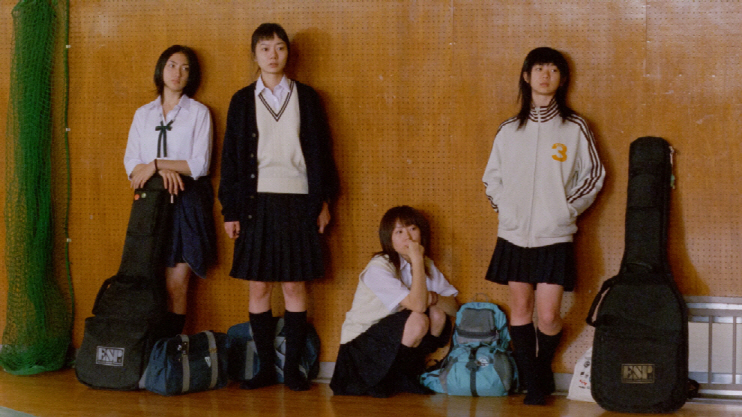
2005 Japanese film “Linda Linda Linda”, which was re-released in South Korean theaters a few days ago, is a conventional but undeniably likable mix of drama, comedy, and music. Right from the beginning, we get a pretty good idea about how it will eventually end, and the movie does not exceed our expectation much on the whole, but it keeps holding our attention via its solid storytelling as well as the spirited efforts from its main cast. In the end, you will root and then cheer for its main characters more than before, and the movie surely delivers its expected feel-good moments as delightfully as possible.
During the first act, the movie gradually establishes its four main characters one by one. For their upcoming school festival, Kei (Yuu Kashii), Kyoko (Aki Maeda), and Nozomi (Shiori Sekine), who are the students of some high school located in some local city outside Tokyo, are supposed to perform as the members of their little band, but there is one big problem. Not long after their guitarist Moe (Shione Yukawa) happened to get seriously injured in her left hand, Kei clashed with their vocalist Rinko (Takayo Mimura), and this eventually made Rinko quit the band.
While Kei, who has incidentally been the keyboardist of the band, could play a guitar instead, she and the remaining band members still need someone to perform as their vocalist, and they happen to come across an unlikely figure for that role. That figure in question is none other than Son (Bae Doona), a South Korean exchange student who has been pretty much like your average loner in the school due to her rather clumsiness in speaking Japanese. Although Son is not so sure about whether she can sing well in Japanese, Kei and her two fellow band members impulsively decide to have Son join their band, and Son begins to practice singing in Japanese while her new friends also start to prepare for the upcoming performance of theirs.

The screenplay by director Nobuhiro Yamashita and his co-writers Kōsuke Mukai and Wakako Miyashita takes its time as leisurely rolling its main characters from one intimate episodic moment to another. Because they do not have much time for practice from the start, they even sneak into the practice room in their school at night, and, to our little amusement, they naturally come to suffer a lot of sleep deficiency later.
And we get to know more about them bit by bit. While she can be frigid at times, Kei is the one steadily holding the center, and Kyoko and Nozomi willingly stand by Kei via their shared passion on music. We often cannot help but notice more of the language gap between these three girls and Son, but they sincerely support and encourage Son as much as possible, and Son comes to show more dedication as befriending them more along the story.
In addition, the movie pays some extra attention to a number of supporting characters in the story. There is an amusing subplot between Kyoko and a male schoolmate eager to be her boyfriend someday, and then we get a humorously awkward moment between Son and some boy who has clearly been having a crush on her (His clumsy speaking in Korean is certainly extra amusement for me and my fellow South Korean audiences, by the way). As the high school festival begins later in the story, the school is filled with more spirit and excitement as its students actively participate in a number of various stuffs ranging from cooking to running a fun house, and there is a little funny moment involved with the teacher supervising the festival, who turns out to be more understanding than he seemed at first.

During the last act, there naturally comes some suspense on whether its main characters will arrive in time for performing on the stage, but the movie does not hurry itself at all as slowly doling out several good moments. Certain two supporting characters boldly come forward at the last minute for buying some time for Kei and the other band members and, what do you know, their impromptu performances turn out to be more effective than expected. Although the dream sequence right before the finale is rather distracting to me, I enjoyed its absurd touches at least, and I also like a brief but crucial moment between Kei and Rinko, who comes to show a bit of support despite the remaining resentment between them.
The movie depends a lot on the good ensemble performance from its main cast members. Besides effortlessly interacting with her fellow cast members, Bae Doona, a South Korean actress who has steadily advanced as appearing in a diverse array of films ranging from Hirokazu Kore-eda’s “Air Doll” (2009) to the Wachowski films “Cloud Atlas” (2012) and “Jupiter Ascending” (2015) has a couple of showstopper moments to remember, and she also did a commendable job in case of the musical performance scenes including the climactic moment when her character must sing well “Linda Linda”, a hit song from the Japanese punk rock band the Blue Hearts. In case of Aki Maea, Yu Kashii, and Shiori Sekine, they have each own moment to shine just like their Korean co-star, and several substantial supporting performers including Takayo Mimura, Shione Yukawa, and Yuko Yamazaki are also well-cast in their respective roles.
Overall, “Linda Linda Linda” remains as a solid crowd-pleaser with a lot of energy and charm although 20 years have passed since it came out. It may look rather plain and modest compared to the more prominent achievements in Japanese Cinema during the 2000s such as Hayao Miyazaki’s “Spirited Away” (2001) or Kiyoshi Kurosawa’s “Tokyo Sonata” (2008), and it still entertained me and the other audiences around me, and that is more than enough for recommendation in my trivial opinion.


 Seongyong's Private Place