
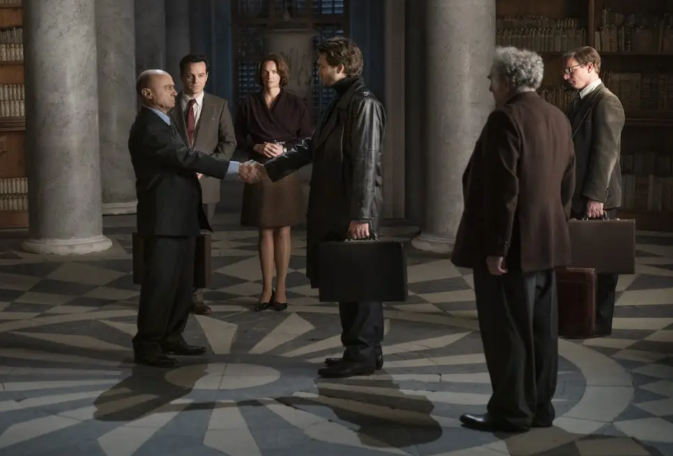
HBO TV movie “Oslo” cannot help but look rather naïve to me, considering how things have alarmingly gotten worse between Israel and Palestine since it came out four years ago. Yes, as dramatically presented in the film, there was a time when it seemed that both Israel and Palestine finally could recognize each other for real peace and co-existence, and the film looks into how hard and tricky it was for everyone associated with the behind-the-door negotiations leading up to the 1993 Oslo Peace Accords. However, even though I cared about the story and characters to some degree, I also often wondered what its main characters would think about the current political situation between Israel and Palestine, and that is what the movie cannot answer even at this point.
The story, which is based on the Tony-winning play by J.T. Rogers (He also adapted it for the film in addition to serving as one of the co-executive producers, by the way), is mainly told through a Norwegian diplomat named Mona Juul (Ruth Wilson) and her husband Terje Rød-Larsen (Andrew Scott), who is incidentally the director of the Fafo Foundation. They have been quite passionate about brokering a backdoor channel for negotiations between Israel and the Palestine Liberation Organization (PLO), but the circumstance does not look optimistic for them to say the least. For example, the Norwegian Ministry of Foreign Affairs is not so willing to assist their ambitious diplomatic plan, and, above all, the Israeli government and PLO happen to be going through another big political conflict between them.
However, Juul and Rød-Larsen are determined to try as much as possible, and then there comes a breakthrough around early 1993. Juul persuades Ahmed Qurei (Salim Daw), Minister of Finance of the PLO, to come to a little private negotiation meeting to be held at a rural manor in Norway, and Rød-Larsen convinces the Israeli Ministry of Foreign Affairs to send their unofficial representatives to that rural manor in Norway, though, not so surprisingly, nothing is guaranteed from the very beginning.
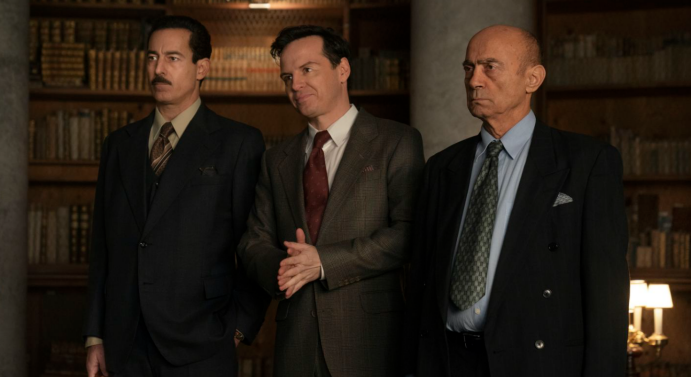
The movie generates some humorous moments when Qurei and his assistant Hassan Asfour (Waleed Zuaiter) meet Yair Hirschfeld (Dov Glickman) and Ron Pundak (Rotem Keinan), the two unofficial representatives of the Israeli government who are incidentally well-known university professors. Nevertheless, as these two contrasting groups push and pull each other over their negotiation under Juul and Rød-Larsen’s supposedly neutral support and guidance, they come to open themselves more to each other while also sticking to their respective beliefs and principles, and, what do you know, it gradually looks like they can actually initiate something quite meaningful for their countries.
However, not only they but also Juul and Rød-Larsen are also reminded more or more of how fragile their back-channel negotiation can be. While the Norwegian government remains reluctant to support this more despite some real progress from it, both the Israeli government and PLO continue to clash each other without much possibility for more compromise and negotiation. This surely generates more headache for Rød-Larsen and Juul, who come to realize that they also should accept some compromise for getting any chance for the eventual success of this ongoing negotiation process.
Rogers’ screenplay naturally provides a lot of talky moments as its main characters struggle to balance themselves between belief and compromise along the story, but the rather stagy ambiance of the movie may often distract you from time to time. In fact, several scenes in Israel are so jarringly tinged with warm orange tone that we cannot help but notice the apparent artificial qualities of these scenes, and I must tell you that this is probably one of the lowest points in the career of cinematographer Janusz Kamiński, who won two Oscars as frequently collaborating with Steven Spielberg for more than 30 years (Not so surprisingly, Spielberg is one of the co-executive producers of the film).

Director/co-executive producer Bartlett Sher, who also directed the 2017 Broadway production of Rogers’ play, simply lets the story and characters roll under his plainly unobtrusive direction, but there are several notable flaws in terms of storytelling. For instance, I do not think the flashback shots involved with Juul’s experience in Palestine are really necessary, and the movie could just trust our imagination when she reminisces about that in front of several other main characters later in the story.
At least, the main cast members hold our attention to the end. While never overshadowing their fellow main cast members, Ruth Wilson and Andrew Scott diligently hold the center as required, and they are particularly good whenever their characters come to show more of the strong personal/professional bond between them along the story. Around them, Itzik Cohen, Sasson Gabai, Dov Glickman, Rotem Keinan, Jeff Wilbusch, Igal Naor, and Waleed Zuaiter have each own moment to stand out, and the special mention goes to Salim Daw, a charismatic Palestinian Israeli actor who has been more notable thanks to his memorable supporting performance in the fifth season of Netflix drama series “The Crown”.
In conclusion, “Oslo” is surely a well-meaning movie, but it also undeniably feels like being out of touch as I reflect more on what happened during next several decades after the Oslo Peace Accords. Sure, we should not give up hope and optimism at all regardless of how the volatile historical narrative between Israel and Palestine will end, but the movie is not effective enough to suppress our growing doubt and skepticism at least for a while, and that is really a shame in my humble opinion.


 Seongyong's Private Place