

William Wyler’s 1953 film “Roman Holiday”, which is being shown in selected theaters in South Korea, is a witty and charming work absolutely tailor-made for its lead actress. Here is an exceptional actress whose charm and presence have never been surpassed by any other actress during last seven decades, and the movie has indubitably been immortalized by her breakthrough performance to remember.
Yes, that actress is none other than Audrey Hepburn, who was one of the greatest Hollywood actresses during the 1950-60s. Although her movie acting career was nearly over after “Wait Until Dark” (1967) and “Two for the Road” (1967), she left her own indelible image in the movie history in a number of notable films such “Sabrina” (1954) and “Charade” (1963), and “Roman Holiday” is one of the best examples in the bunch.
Hepburn plays Princess Ann, who is a very, very, very important royal figure of an unspecified European country. As the heiress to the throne, Princess Ann has certainly been burdened with a lot of royal duty, and the opening part of the movie shows how busy she is as visiting one European country after another for serving her country. Around the time when she visits Rome, she cannot help but feel quite tired and suffocated, and, to make matters worse, nobody around her seems to understand her mounting stress and fatigue.
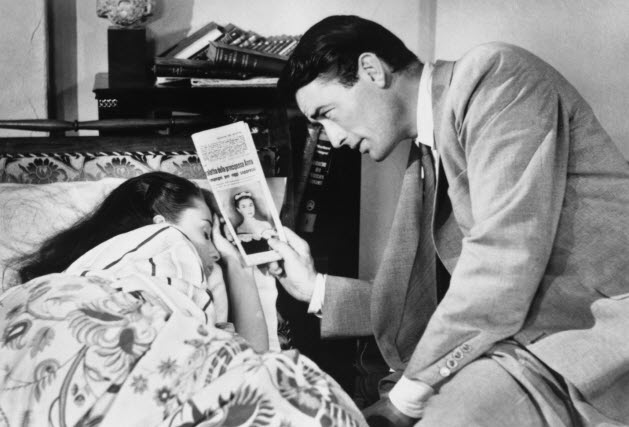
Eventually, Princess Ann impulsively decides to sneak out of the embassy of her country when no one is looking, but there is one small problem. Shortly before her elopement, she happened to be medically sedated, and she soon becomes quite groggy around the time when she is discovered by an American newspaper reporter named Joe Bradley (Gregory Peck). After seeing how helpless she is, Bradely decides to take her to his current staying place, while having no idea about her real identity.
Of course, around the next morning, Bradley belatedly comes to learn who she really is, and there soon comes a very good idea to benefit him and his career. When Princess Ann becomes interested in having some free time in the city, he gladly volunteers to be a generous guide for her, while also having his photographer friend Irving Radovich (Eddie Albert, who was deservedly Oscar-nominated for providing some extra humor to the film) photograph their private moments without being noticed by her at all.
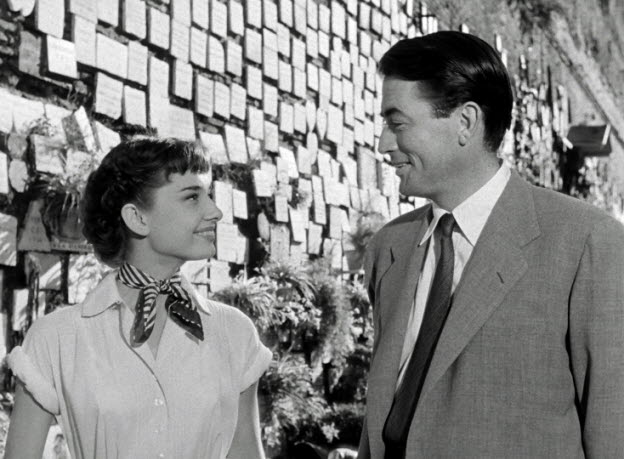
After establishing its two main characters during its first half, the screenplay by Dalton Trump, Ian McLellan Hunter, and John Dighton gives a series of lightweight moments during its second half (Its rather checked history caused by the blacklisting against Trump and many other left-wing Hollywood figures during that time is dramatized in “Trumbo” (2015), by the way). While freely wandering along with Bradley, Princess Ann feels much happier than before, and, not so surprisingly, Bradley comes to care more about her even though he still does not reveal to her that he knows her real identity.
Because of the inherent human decency in Gregory Peck’s rather plain but undeniably wholesome screen persona, there is not much suspense on Bradley’s eventual choice later in the story, but I must point out that Peck humbly supported his co-star in and out of the screen. Cary Grant, who was incidentally considered first for Peck’s role, might have been more believable in the wily sides of Bradley, but Peck’s unadorned acting lets his co-star shine more and more along the story. As a matter of fact, his earnest acting works better as things get more serious around the last act of the movie, and that is one of the main reasons why the expected finale is accompanied with genuine poignancy.

In addition, Peck also made Hepburn presented as his co-star in the main title, and that was quite generous to say the least considering that Hepburn was just a young unknown newcomer at that time. Hepburn, who won a Best Actress Oscar for the film, is indeed the real star of the movie, and we can only imagine how refreshing she looked to the audiences at that time. With her own charm and presence, she effortlessly radiates as a singular beauty to behold, and she also did a stellar job of conveying to us her character’s inner drama along the story. While surely having more fun and freedom than she can ever imagined thanks to her unexpected American friend, there eventually comes a point where Princess Ann must return to her royal duty and position, and Hepburn is terrific when her character must hold her aching personal feelings in front of others including Bradley around the end of the story.
The movie is certainly one of many highlights in the illustrious filmmaking career of Wyler, who made some of best works from the classic Hollywood era during the 1930-60s and also won no less than three Best Director Oscars for “Mrs. Miniver” (1942), “The Best Years of Our Lives” (1946), and “Ben-Hur” (1959). He and his crew including cinematographers Henri Alekan and Franz Planer did a stellar job of vividly capturing numerous real locations in Rome on the screen, and you can easily see how the city was destined to be brimming with more class and glamour as shown from “La Dolce Vita” (1960).
In conclusion, “Roman Holiday” is a classic Hollywood romantic comedy film mainly distinguished by Hepburn’s exceptionally luminous presence. During last several decades, many different young actresses were compared to her, but she remains irreplaceable even at this point, and she and her several good films including this lovely movie will probably remain forever in the history of cinema.


 Seongyong's Private Place