

Is there any divorce comedy film as dark, cynical, and vicious as Danny DeVito’s 1989 film “The War of the Roses”? The main pleasure of this particularly nasty classic comedy movie is how uncompromising it is with a number of hilariously extreme moments to make us both laugh and cringe, and you will be amused more to observe it firmly sticking to its edgy comic spirit to the end along with its two rather unlikable main characters.
After the inspired main title designed by Saul and Elaine Bass, the movie proceeds to a private meeting between a lawyer named Gavin D’Amato, played by DeVito himself, and one of his clients (He is played by Dan Castellaneta, who has provided the voice of Homer Simpson in the TV animation series “The Simpsons”). What Gavin is going to tell his client is a cautionary tale involved with his close colleague Oliver Rose (Michael Douglas) and Oliver’s wife Barbara (Kathleeen Turne), and it does not take much time for us to guess from the sardonic tone of Gavin’s storytelling that things did not end that well for Oliver and Barbara.
Their marriage story was started with your average Meet Cute moment. When Oliver and Barbara came across each other at a little auction held in some beach town, something instantly clicked between them as they competed with each other over a certain china figurine, and, what do you know, they married not long after having quite a passionate time between them (“If we end up together, then this is the most romantic evening of my life. And if we don’t, then I’m the world’s biggest slut.”). Although they struggled a bit during the first several years of their married life, Oliver subsequently began to advance more in his lawyer career, and Barbara mostly focused on taking care of those domestic matters including decorating a big house recently purchased by them.

However, around the time when their two kids are going to leave them for studying in Harvard University, Barbara becomes more aware of the distance and friction between her and her husband – especially after she becomes more financially independent as beginning her own catering business. When Oliver is suddenly sent to a hospital due to what turns out to be a rather minor medical problem, she comes to realize that she is not only sick of her husband but also not in love with him anymore, and she eventually tells him that she wants to divorce him right now.
While naturally quite confused and exasperated, Oliver eventually agrees on their divorce, but there is one big problem between them. Although she is willing to give up almost everything to her husband, Barbara demands that she should get the house because she thinks she deserves it for all the diligent efforts of hers in making the house look much better than before. In contrast, Oliver believes that the house should remain with him as the house was purchased with the money earned by him, and he is certainly willing to fight against his wife to the end.
What follows next is a series of truly mean and vicious clashes which can still raise your eyebrows even at present. Regardless of whether there is really any affection left between them, both Oliver and Barbara become quite determined to go for total war, and their house is consequently turned into a sort of battleground for their ongoing divorce war. Thanks to a bit of legal advice from Gavin, Oliver keeps staying in their house despite Barbara’s demand, and he soon embarks on trying to outmatch his wife by any means necessary, while ignoring the sincere words of caution from Gavin (“Oliver, my father used to say that a man can never outdo a woman when it comes to love and revenge.”).
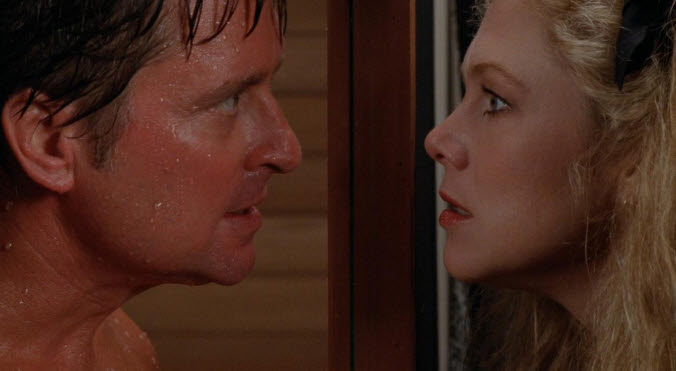
The screenplay by Michael J. Leeson, which is based on the novel of the same name by Warren Adler, often delights in the increasingly malicious behaviors of its two main characters. When Barbara holds a party for the clients of her catering business, Oliver deliberately sabotages the party in a certain definite way to make your eyes roll (“I would never humiliate you like this!” – “You’re not equipped to, honey.”), and then Barbara surely shows him that Hell hath no fury like a woman scorned. In case of another conflict of theirs involved with their respective pet animals, the movie steps back a bit to my little disappointment at the last minute, but we still get some dark laugh despite that.
The comic chemistry between the two lead performers of the film is flawless to say the least. As many of you know, Michael Douglas and Kathleen Turner were successfully paired together in Robert Zemeckis’ romantic comedy adventure film “Romancing the Stone” (1984) and its 1985 sequel, and that is why it is quite amazing to see how they effortlessly interact with each other in a totally different comic mode here in this film. Under DeVito’s confident direction, both Douglas and Turner are utterly fearless in their thoroughly uncompromising comic acting, which steadily keeps us engaged to the very end even though we wince more and more as watching the conflict between their spiteful characters from the distance.
In conclusion, “The War of the Roses” is still quite viciously funny due to its numerous biting comic moments including its starkly cynical ending true to its nasty black comic heart, and it is definitely one of the highlights in the respective careers of DeVito, Douglas, and Turner. Yes, this is surely not something you can casually watch on Sunday afternoon, but you will find yourself tickled more and more by its morbidly cutthroat sense of humor after watching it, and, like me, you may wholeheartedly agree to the advice given at the end of the story.


 Seongyong's Private Place