

Jonathan Demme’s 1984 concert film “Stop Making Sense”, whose recent 4K restoration version was released in South Korean theaters a few days ago, is quite an electrifying experience to say the least. While more than 40 years have passed since it came out, it still rocks in addition to being on the top of the field as before, and you will soon find yourself enthralled by its numerous superb musical moments to behold and then appreciate.
As many of you know, the film was shot over the four nights of December 1983 at Pantages Theater in Hollywood. During that time, Talking Heads performed there as a part of their ongoing promotional tour associated with their latest album, and the film closely and vividly shows us this famous band performing a number of popular songs of theirs such as “Burning Down the House” on the stage.
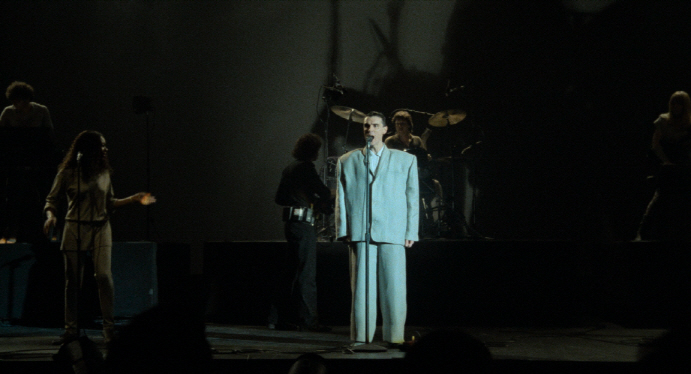
The early part of the film is interesting for how the members of Talking Heads build up the mood and momentum on the stage step by step. At the beginning, we see David Byrne, who was the lead singer of Talking Heads, appearing alone on the stage, and then he performs “Psycho Killer” alone by himself. With the vast empty space surrounding Byrne, this may look and feel modest at first, but his performance generates some excitement around the stage, and the mood gets more elevated as several other members of the band appear on the stage one by one. After Byrne and his fellow band members perform several following songs such as “Slippery People”, there eventually comes “Burning Down the House”, and the stage surely feels all the more galvanized than before.

And we cannot help but observe the considerable physical efforts shown from Byrne and his fellow band members. Besides singing or performing their instruments well in front of their audiences (We seldom see the audiences except around the end of the film, by the way), they also express a lot of their musical joy and excitement via their dynamic physical movements, and Byrne looks particularly sweaty on his face and body around the point when he and others are performing “Life During Wartime”. In fact, as noticing the sweaty back of his shirts, I wondered how many extra clean shirts were ready for him during every performance.
While Bryne often takes the center as expected, the cameras of cinematographer Jeff Cronenweth and his many assistant cinematographers wonderfully capture the styles and personalities of the members of Talking Heads. While Byrne’s fellow lead singer Tina Weymouth has her own moment to shine later as performing “Genius of Love” as a part of her and drummer Chris Frantz’s side project Tom Tom Club, Jerry Harrison and Alex Weir are also memorable for their enthusiastic guitar performance, and Lynn Mabry and Ednah Holt are always ready to provide some extra electricity beside performing as backup singers. In case of Bernie Worrell and Steven Scales, the film sometimes shows a lot of how confidently they perform behind Bryne and several other band members, and this will surely make you appreciate more of their considerable contribution.
Around the middle part of the concert, the mood becomes all the more heated with the two famous songs of Talking Heads: “This Must Be the Place (Naive Melody)” and “Once in a Lifetime”. Now I must confess that these two songs mean a lot to me even though I did not know much about Talking Heads before reviewing Spike’s Lee’s concert film “David Byrne’s American Utopia” (2020). When I came across the former via Oliver Stone’s Oscar-winning film “Wall Street” (1987), the song has lingered on my mind for a long time, and I came to like it all the more when it was memorably used in Paolo Sorrentino’s “This Must Be the Place” (2011). In case of the latter, I still remember how it was brilliantly (and hilariously) used in the trailer of Stone’s subsequent film “W.” (2008), and I was quite delighted to see it being humorously used in recent Pixar Animation Studios film “Elio” (2025).

Byrne and his fellow band members do not disappoint us at all as vigorously performing these two well-known songs, and I felt more of the lively spirit of the songs during my viewing. Like many of the songs performed in the film, they delve into our feelings and thoughts about life, and “This Must Be the Place (Naive Melody)” actually made me reflect more on my rather solitary status of life. Yes, as a nerdy single gay dude on autistic spectrum, I may never find a man who can both tolerate and love my quirky sides, but this song somehow made me feel comfortable and optimistic to some degree.
If the film ended after the exuberant performance of “Once in a Lifetime”, which will come close to anyone feeling quite disoriented about the current status of life, I would not complain at all. However, the members of Talking Heads keep throwing more enthusiasm and excitement across the screen, and you may be quite stupefied by a lot of spirit and energy when they perform “Take Me to the River” and then “Crosseyed and Painless”. Again, you may notice how they look all the sweatier, and you will absolutely agree with what my late mentor Roger Ebert observed in his 1984 review: “Starting with Mick Jagger, rock concerts have become, for the performers, as much sporting events as musical and theatrical performances.”
In conclusion, “Stop Making Sense” is a definite high point in the early filmmaking years of Demme, who would soon move onto several acclaimed mainstream films including Oscar-winning film “The Silence of the Lambs” (1991). I am glad to report to you that the film remains to be a spirited piece of timeless entertainment, and you may also be a bit amused to observe that it happened to come out not long after Rob Reiner’s great mockumentary comedy film “This Is Spinal Tap” (1984). As “This Is Spinal Tap” went all the way for mocking and parodying every conventional aspect of those run-of-the-mill rock concert films during the 1970s, “Stop Making Sense” came as something quite refreshing while simply focusing on the joy and exuberance of musical performance, and this still can excite and then elevate us even at present. That is what a good concert film can do, isn’t it?


 Seongyong's Private Place