
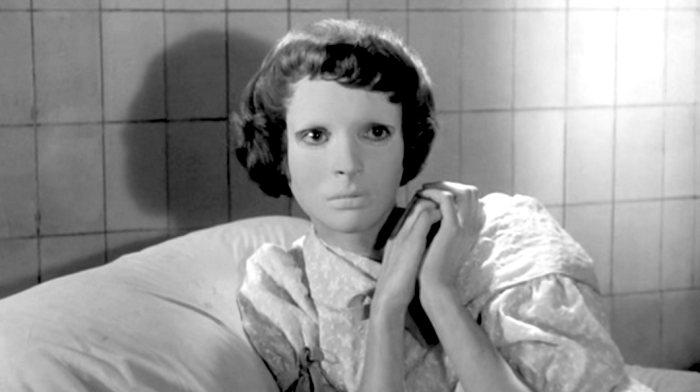
French filmmaker George Franju’s 1960 horror movie “Eyes Without a Face” is quite striking for its eerie qualities. While it initially feels merely bizarre and disturbing on the surface, the movie gradually draws us into the evil and madness at the center of the story, and it is interesting to observe how it goes further with its morbid story and characters before pulling out an oddly poetic moment to touch and mesmerize us in the end.
The movie is mainly about the private medical project of Dr. Génessier (Pierre Brasseur), a prominent doctor who has studied a lot on “heterograft” for years. After his daughter Christiane (Édith Scob) was severely disfigured in her face due to a recent car accident, the doctor becomes more obsessed about succeeding in his skin transplant experiment, and we come to gather later that he has already experimented on many dogs inside his private residence right next to a hospital located somewhere outside Paris.
However, Dr. Génessier has not made much, shall we say, progress in case of the final stage of the project. He and his loyal assistant Louise (Alida Valli, who was also quite memorable in Carol Reed’s “The Third Man” (1949)), who are very devoted to him and the project because he did a very successful facial restoration surgery on her some time ago, have kidnapped several young women for taking away their face skin and then grafting it onto Christiane, but they have failed during last several attempts. The opening part of the film chillingly shows Louise taking care of the aftermath of their latest failure, and its horrific aspects are further accentuated by the jaunty score of Maurice Jarre (It was one of his early works before he became a lot more prominent thanks to winning his first Oscar for David Lean’s “Lawrence of Arabia” (1962), by the way).
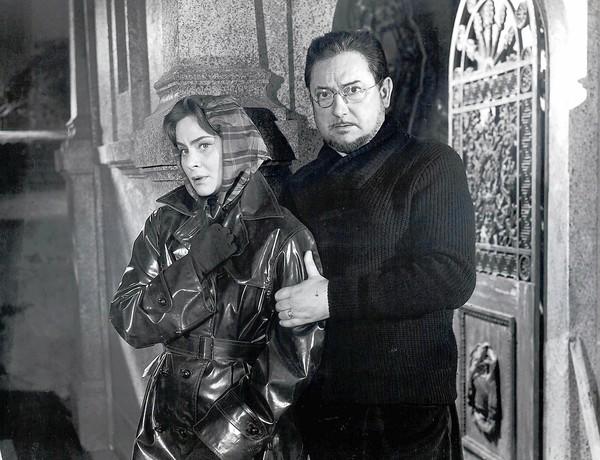
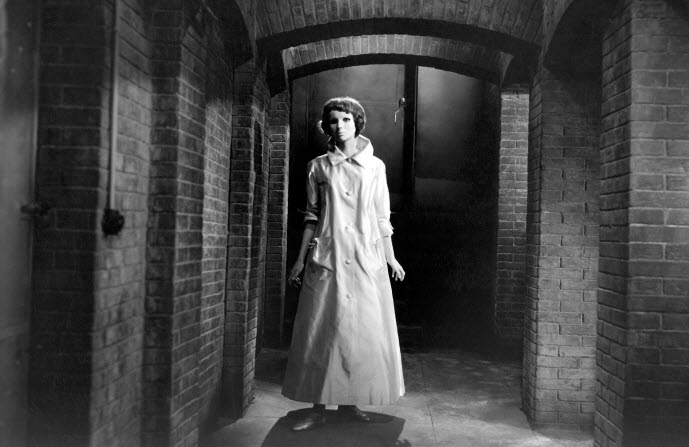
Still not being suspected at all due to his respectable social status, Dr. Génessier is already determined to try again along with his assistant, but Christiane is not so pleased to say the least. Usually wearing a fecklessly white mask covering her face, she is certainly afraid of how she looks at present, but she cannot help but feel quite suffocated as being constantly isolated inside the house, and we come to sense more of her growing guilt on what her father has been doing for her. Sure, the doctor does care a lot about his daughter, but Christiane becomes more and more horrified about his insane project, even though she has yearned to have a face to present in front of others out there someday.
When Dr. Génessier and Louise later kidnap and then work on another unfortunate young woman, the movie does not hesitate to go into those gruesome details of their work process. This unforgettable scene is thankfully shot in black and white film, so the result is relatively tame compared to the horror movie standards of our time, but it still looks and feels quite disturbing even at present. In fact, it is not surprising at all that the movie shocked or repulsed many audiences at the time of its initial theatrical release.
Franju was no stranger to inducing shock and repulsion from his audiences even before making this movie. His short documentary film “Blood of the Beasts” (1949), which is incidentally included in the Criterion DVD and Blu-ray edition, is still capable of shocking us quite hard with all those horrifyingly vivid moments captured from the slaughterhouses in Paris. Strikingly juxtaposed with the rather lyrical depiction of how the city keeps going outside those slaughterhouses, these dreadfully visceral moments are all the more disturbing and powerful, and the resulting impression will linger on your mind forever along with that undeniably brutal and inconvenient truth inside our life and civilization, even if you never want to watch this exceptional short documentary again.
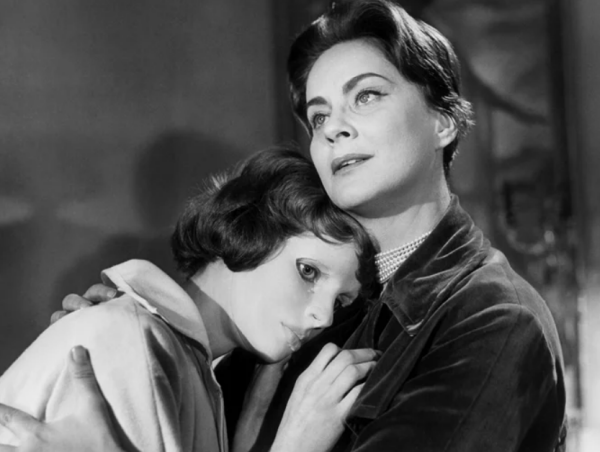
While it is relatively less disturbing in comparison, “Eyes Without a Face” slowly creeps into our mind via its clinically nightmarish atmosphere coupled with a lot of noirish visual touches to be observed here and there throughout the film. The cinematography by Eugen Schüfftan often feels unnerving in its stark contrast of light and shadow; the interior spaces of the doctor’s house are increasingly creepy and insidious along the story, and Christiane’s mask sometimes looks like a sort of second skin as becoming a part of her miserable existence.
I must point out that a subplot involved with the doctor’s young male protégé, who is incidentally Christiane’s boyfriend, is more or less than a mere plot device to maneuver the story toward the eventual finale. Nevertheless, the screenplay by Jean Redon, Claude Sautet, Pierre Gascar, and Boileau-Narcejac (This is the pen name of the French crime-writing duo of Pierre Boileau and Pierre Ayraud, who is also known as Thomas Narcejac. They are mainly known for writing several novels adapted into notable films including Henri-Georges Clouzot’s “Les Diaboliques” (1955) and, yes, Alfred Hitchcock’s “Vertigo” (1958)), which is based on the novel of the same name written by Redon, keeps focusing on the main characters as usual, and there is surrealistic poignancy in what happens after Christiane makes a sudden but understandable choice around the end of the film.
In conclusion, “Eyes Without a Face” is a modest but undeniably influential genre piece which will leave some indelible impression on you. I must confess that I felt rather distant to its story and characters at first, but then I was impressed more about its striking cinematic aspects, and I am certainly willing to revisit it for more appreciation and admiration.


 Seongyong's Private Place