
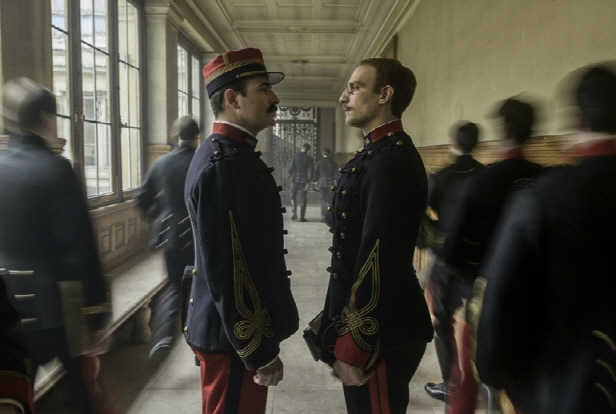
I must confess that it has been more than 10 years since the last time I watched and then reviewed a Roman Polanski film. At that time, I watched “Rosemary’s Baby” (1968) for writing an essay to be posted on the website of my late mentor Roger Ebert, and I willingly gave that great horror film 4 stars without any hesitation, though I was certainly well aware of why he came to run away to France not long after “Chinatown” (1974).
Around that point, I thought we could overlook Polanski’s serious sex crime at least for a while as admiring his best works including the two aforementioned movies, which are undeniably great and important in each own genre field. After all, can we possibly discuss about the neo-noir film era without mentioning “Chinatown”? And how can we possibly talk about occult horror or female body horror films without mentioning “Rosemary’s Baby”, which ironically becomes all the more relevant after the #MeToo movement?
As many of you remember, the #MeToo movement exposed many sexual predators in the global movie industry ranging from Harvey Weinstein to Woody Allen, and it also made us a lot more aware of what Polanski’s sex crime than ever. Yes, there was a time when we became a bit more forgiving and Polanski even won a surprise Best Director Oscar for “The Pianist” (2002), but he came to lose his Academy membership not long after the #MeToo movement began, and he has been a persona non grata just like Allen since that point (Come to think of it, it has also been several years since I watched a Woody Allen film for the last time).

When Polanski came to the Venice International Film Festival with “An Officer and a Spy” in late 2019, I and many others regard this news with understandable reservation. The main subject of the film is none other than the Dreyfuss Affair in France at the end of the 19th century, and I wondered whether this was Polanski’s blatant artistic response to #MeToo movement. Well, the film subsequently received the Grand Jury Prize and the FIPRESCI Prize at the Venice International Film Festival, and the following public controversy surrounding the film became all the more intense when it received the three awards including Best Director at the César Awards in early 2020.
After finally watching the film now (It has been available on a number of local streaming services in South Korean during last several years without getting any theatrical release, by the way), now I can tell you my opinion about it. Yes, this is a solid historical drama to be admired for many things including Polanski’s confident direction, but, folks, I still have some doubt on his intentions behind it.
Objectively, the movie can be regarded as the tale of a defiant pursuit of integrity as well as justice, because the center of the story is actually not Captain Alfred Dreyfuss (Louis Garrel, who looks rather dry and distant throughout the film) but Colonel Georges Picquart (Jean Dujardin, who looks much more subdued compared to his Oscar-winning performance in Michel Hazanavicius’ “The Artist” (2011)), who gets appointed as the new head of the secret service section of the French Army not long after Dreyfuss was found guilty of passing military secrets to the German government and then condemned to the imprisonment in the Devil’s Island. At first, Picquart is simply interested in handling the aftermath of the Dreyfuss affair as neatly as possible, but, what do you know, he eventually realizes that the French army actually caught the wrong guy and the real culprit remains free without any particular suspicion on him.
The movie makes some sharp points on how those high-ranking French military officers and generals were willing to frame Dreyfuss from the very beginning. They all cared only about protecting the reputation of their system as much as possible, and Dreyfuss, who is incidentally a man of Jewish heritage, was promptly targeted by them just because of their antisemitic prejudice. When Picquart begins to delve more into how thoroughly they messed up the case, they are certainly willing to stop him by any means necessary, and Picquart soon finds himself facing a lot of infuriating injustice just like Dreyfuss.
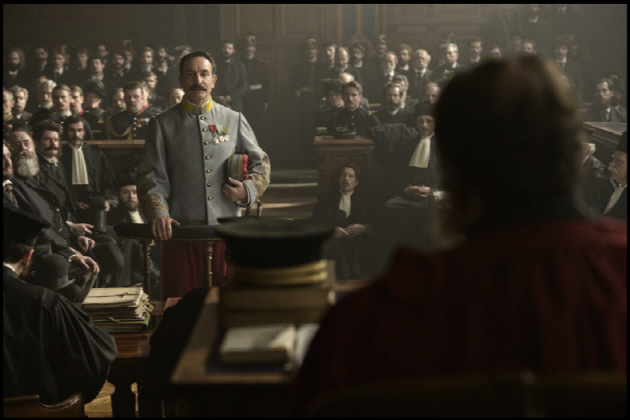
Fortunately, there are also a number of prominent public figures willingly showing considerable public support to not only Dreyfuss but also Picquart, and one of them is none other than Émile Zola, who, as dramatically depicted in second half of William Dieterle’s Oscar-winning film “The Life of Émile Zola” (1937), stirred a lot of people in France via his famous newspaper opinion headlined “J’Accuse…!” (This is incidentally the original French title of “An Officer and A Spy”, by the way). Even around this narrative point, the movie does not lose its calm and restrained attitude at all as steadily following Picquart’s increasingly daunting plight to the end, and we come to admire his bravery and integrity more around the end of the story.
However, can I praise Polanski for his competent handling of mood, storytelling, and performance here in this film? Despite being your average amateur reviewer, I do always value integrity and principle, and I can only say that I recommend it for being a good movie even though I must also be honest about my personal thoughts and feelings on Polanski as a human being. In my trivial opinion, he is both a great filmmaker and a deplorable person, and that is why we really should keep dealing with him as well as his works to the end.
So, will “An Officer and a Spy” be eventually remembered as something important but thematically problematic just like, say, Elia Kazan’s Oscar-winning film “On the Waterfront” (1954)? I cannot possibly answer for now, but maybe you should watch it for more talk and discussion among us, and that will probably help us arrive at the eventual verdict in the end.


 Seongyong's Private Place