
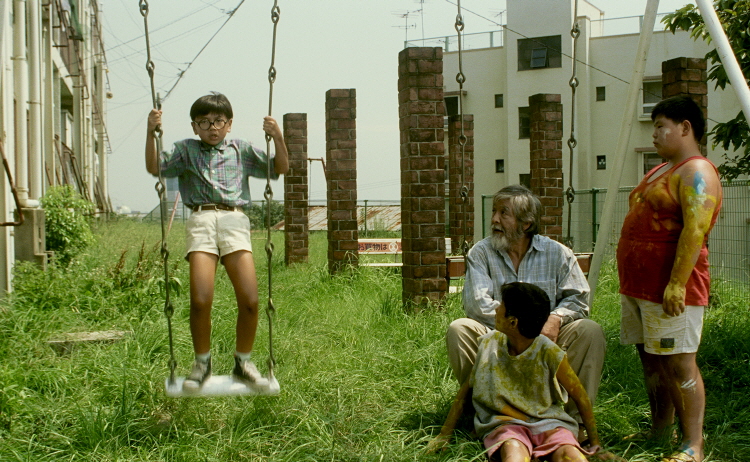
Shinji Sômai’s 1994 film “The Friends”, whose 4K restoration version was released in South Korean theaters yesterday, is gentle, humorous, and poignant in its unadorned coming-of-tale to remember. Calmly and sensitively following its three little young heroes’ eventful summertime, the movie goes much deeper into its main subjects along with them than expected, and we are eventually quite touched as reflecting more on how much they come to learn and then grow up around the end of the story.
At the beginning, we are introduced to three elementary school kids: Kiyama (Naoki Sakata), Kawabe (Yasutaka Oh), and Yamasita (Ken’ichi Makio). Because Yamasita, who is incidentally your average chubby boy, recently went to his grandmother’s funeral, Kawabe and Yamasita have been quite curious about death, and there is a morbidly amusing moment when Kawabe shows more of his curiosity about death while being quite reckless on the railing of an overpass (I sincerely hope that the three child performers of the film were protected enough during the shooting).
These three boys’ shared curiosity leads them to one particular old shabby house in their neighborhood. This house belongs to one reclusive old man who may die sooner or later, and Kawabe, who is often quite imaginative for a harrowing personal reason, suggests that they should monitor this old guy just for getting a chance to watch death someday. At first, they simply watch his house from a gap in the fence surrounding the house, and then, what do you know, they soon get themselves into his reclusive daily life more as becoming more curious about him.
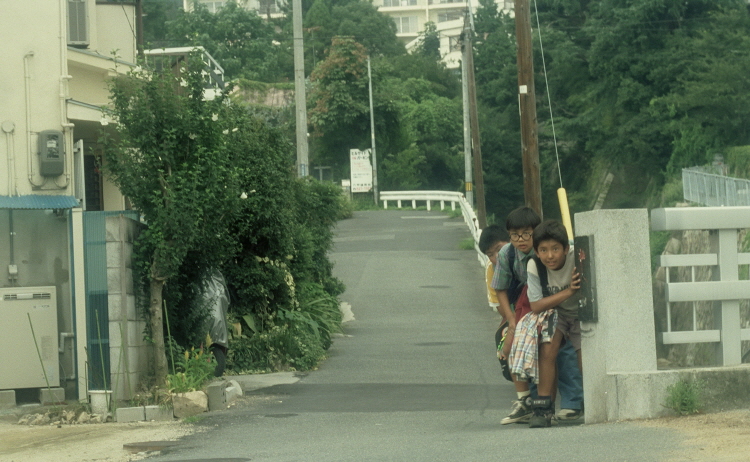
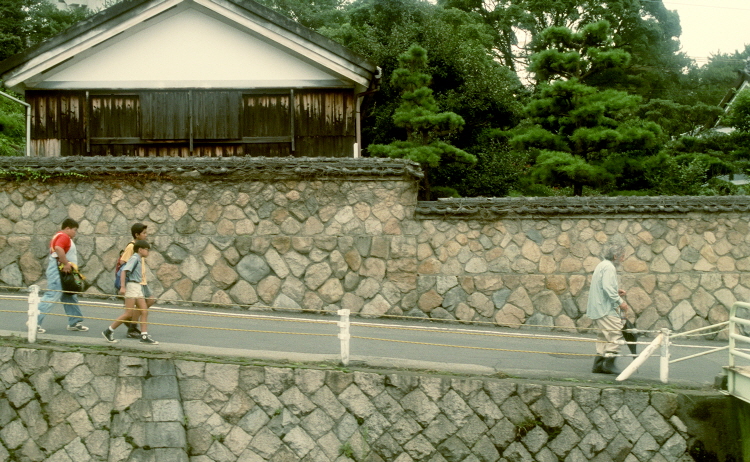
Of course, it does not take much time for the old man to notice the attention from these three boys. At first, he is just surprised and annoyed, and that makes the boys all the more focused on watching on the old man. At one point, they follow after him when he goes to somewhere in the neighborhood, and their silly act of following merely amuses us for a while, and then the movie surprises us as suddenly entering the realm of surrealism along with one of the boys. This may feel jarring at first, but it is so skillfully handled that we have no problem with accepting whatever is experienced by the boy’s very imaginative mind.
Anyway, as you have already guessed, the old man gradually comes to accept the boys into his residence, and the movie observes how things get changed in his little solitary environment thanks to the boys. First, he has them help him a bit on drying his laundry, and that is just the beginning of how the boys get themselves involved much more with the old man than before. They gladly clean up the foreground of his residence full of tall weeds for planting flower seeds there later, and they also assist him in a bit of renovation inside and outside his house.
It is not much of a spoiler to tell you that our little heroes come to learn a little more about their unlikely friend as caring a lot more about him than expected, but the screenplay by Yôzô Tanaka, which is based on the novel of the same name written by Kazumi Yumoto, takes its time as subtly developing its story and characters via mood and details. As the camera of cinematographer Noboru Shinoda patiently follows or focuses on the boys and the old man, we get to know more about them as well as their developing relationship, and there is an absolutely compelling scene where the old man phlegmatically reveals his longtime personal guilt in front of the boys in the middle of one dark and stormy night.

The following third act of the story depends on a little Dickensian coincidence, but what follows next is presented with a considerable amount of emotional power to engage us more than before. I will not go into details here, but I can tell you at least that the movie handles its expected melodramatic finale with a lot of sensitivity and thoughtfulness to admire, and I assure you that the poetically bittersweet quality of the last scene will linger on your mind for a while. Now I am reminded of that unforgettable quote from Errol Morris’ great documentary “Gates of Heaven” (1978): “Death is for the living and not for the dead.”
Sômai also draws the wonderful natural performances from his three young actors. They are often quite effortless in their interactions on the screen (You may smile a little when one of them cheerfully sings a song from Hayao Miyazaki’s great animation film “My Neighbor Totoro” (1988), by the way), and it is quite clear to see why Sômai has been admired so much by Hirokazu Kore-eda, who surely knows a lot about how to get good performances from child performers. While never overshadowing his much younger co-stars, Rentarô Mikuni is believable as a man slowly coming out of his shell at last thanks to his unexpected little friends, and Naho Toda and Ritsuko Nemoto are also effective as the two small but crucial supporting characters in the story.
In conclusion, “The Friends”, whose Japanese title is incidentally “Summer Garden (夏の庭)”, is another hidden gem in Sômai’s fascinating filmmaker career. Although it has been more than 20 years since he passed away in 2001, “Typhoon Club” (1985) and “Moving” (1993), which were already introduced to South Korean audiences before “The Friends”, do not look old at all, and these two films and “The Friends” surely deserve to be introduced to more audiences out there for more recognition on its rather overlooked maker. After watching these three interesting films from him, you will understand why Sômai has been respected a lot by Hirokazu and many other current Japanese filmmakers, and you may want to check out more of his filmography just like me.


 Seongyong's Private Place