
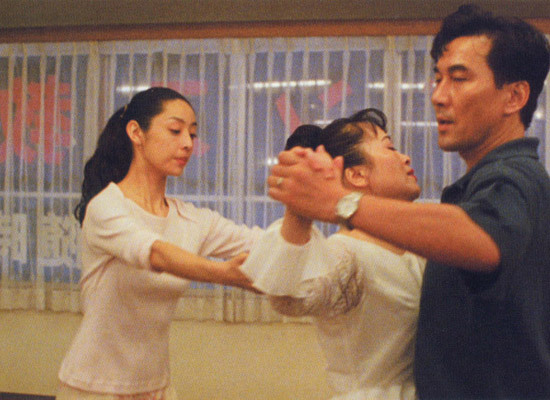
1996 Japanese film “Shall We Dance?” humorously and touchingly reminds us that we human beings often need a bit more than merely going through our life day by day. Leisurely following its plain middle-class hero’s accidental venture on dancing, the movie smoothly and cheerfully dances between comedy and drama, and we come to root more for not only its hero but several other characters around him.
Kōji Yakusho, who has been one of the best movie performers working in Japan during last three decades, plays Shohei Sugiyama, a fortysomething company accountant who suddenly finds himself feeling rather empty when he is going to accomplish almost everything for him and his dear family. Since his marriage, he diligently worked hard for providing a stable domestic life for the family, and they are now living in a fairly good suburban house, but he feels rather depressed as reflecting more on what may be next for his life.
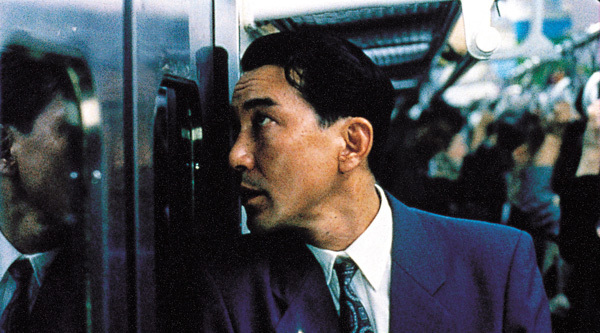
Shortly after another routine drinking evening with his fellow employees, Shohei goes back to his home by train, and then he notices something when the train stops at one particular station. There is a little dance studio in a nearby building, and his eyes are drawn to a young beautiful woman who later turns out to be one of the instructors working there. As he continues to watch her from the distance evening by evening, he feels something awakened inside him just like the hero of Sam Mendes’ Oscar-winning film “American Beauty” (1999), and he eventually takes the first forward step toward this woman as reluctantly walking inside that dance studio.
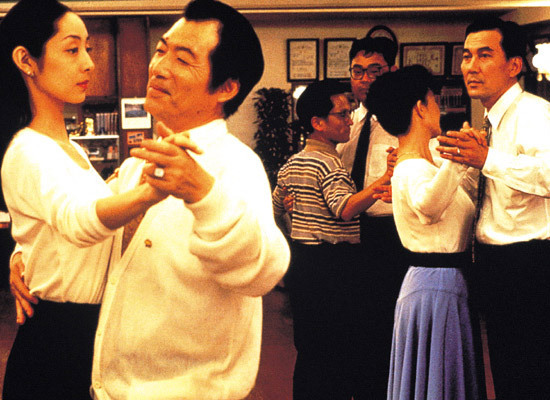
Not so surprisingly, that young lady, Mia Kishikawa (Tamiyo Kusakari), still seems beyond his reach, but Shohei decides to join the class for beginners along with two guys much more eager to learn how to dance. The movie certainly generates some good laughs from Shohei’s painfully awkward attempts to learn dance steps, but we also come to observe his gradual inner change ignited by this accidental lesson of his. As he practices and then makes some progress step by step, he cannot help but feel enlivened more and more, and, what do you know, he often finds himself looking forward to having another good time at the dance studio.
Of course, it does not take much time for Shohei’s wife and their adolescent daughter to notice how he feels a bit livelier than before. In contrast to her husband, Shohei’s wife knows what she wants to do next for her life once their common goal is almost accomplished, but she cannot help but feel confused and anxious as wondering more about whatever her husband is doing behind his back. In the end, she decides to hire a private investigator, and she soon comes to learn more about her husband’s little secret hobby.
Rather than hurrying itself to the expected ending after that narrative point, the screenplay by director/writer Masayuki Suo wisely takes its time for building up its main characters with details and nuances to observe. As continuing to focus on its hero’s inner growth along the story, the movie also pays attention to several other main characters around him, and you may be surprised a bit by the complex human aspects of Shohei’s relationship with Mai. Sure, he was quite infatuated with her from the very beginning, but he subsequently finds himself driven more by his growing passion toward dancing, and this actually touches Mai, who is later revealed to have her own serious emotional issues behind her frigidly haughty attitude.
In the meantime, the movie also generates some low-key dramatic tension from why Shohei does not want to tell anyone about his dance lesson. He is afraid that this may hurt his appearance in both his work and house, and he certainly sympathizes with one of his colleagues, who turns out to be a passionate dancer behind his meek appearance. Despite that horrendous wig for hiding himself a bit, this dude looks much more alive whenever he dances in the dance studio, and he willingly draws Shohei more into the world of dancing even though Shohei often hesitates as usual.

It is not much of a spoiler to tell you that Shohei is eventually pushed toward a big local dancing competition later in the story. While we surely get several expected moments of laugh and surprise during this climactic part, the movie stays focused on the story and characters as before, and that is why its rather overlong finale keeps holding our attention to the end. Around that narrative point, dancing in the film becomes a lot more meaningful than before, and you will gladly overlook the contrived aspects of the final scene.
The solid performances of its main cast members wonderfully carry the film on the whole. The movie was a breakthrough point for Yakusho’s movie acting career which has constantly impressed us for many years, and this movie and Kiyoshi Kurosawa’s creepy horror film “Cure” (1997) will definitely show you a lot of the considerable range of Yakusho’s acting talent. On the opposite, Tamiyo Kusakari complements her co-star well as subtly conveying to us her character’s human sides, and Naoto Takenaka and Eriko Watanabe frequently steal the show as the two most colorful characters in the story.
In conclusion, “Shall We Dance?”, whose title incidentally comes from that famous song from Rodgers and Hammerstein’s musical “The King and I”, is a lovely movie even though almost 20 years have passed since it came out. Yes, you can clearly see where its dance steps are heading from the start, but it will alternatively amuse and touch you a lot, and you may come to consider being more serious about whatever you are passionate about in private. After all, that is how our inconsequential life feels a bit joyful and meaningful to us at least for a while, isn’t it?


 Seongyong's Private Place