
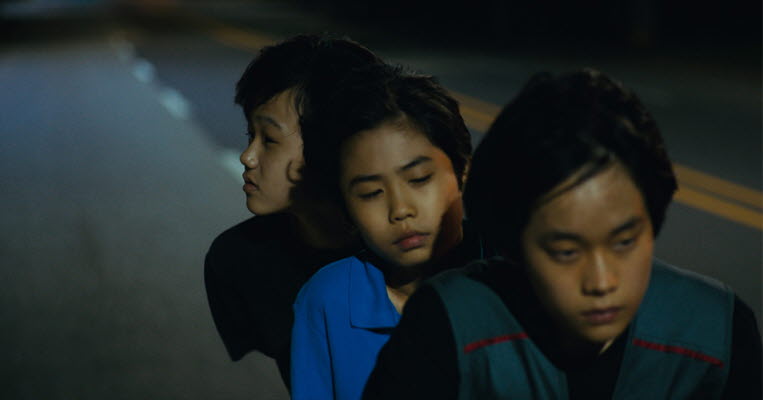
South Korean independent film “When This Summer is Over” is often disturbing for good reasons. Phlegmatically following how its plain young hero tumbles down into a number of crimes and misdemeanors thanks to his new “friends”, the movie gives us a sobering examination of toxic masculinity, and that often keeps us on the edge even when the story is approaching to its inevitable finale.
The story, which is set in a rural town which will be redeveloped sooner or later for urbanization, opens with the arrival of a 12-year-old boy named Gi-joon (Lee Jae-joon) and his mother. Very dedicated to her son’s future education and welfare, Gi-joon’s mother decided to move into this town in advance because its upcoming urbanization will affect not only its education system quality but also its real estate value, but Gi-joon is not so pleased about this environmental change because, well, the town looks quite boring without nothing much to do outside his new school and home.
And the first day in Gi-goon’s new school is not so promising to say the least. He comes along with his mother for completing his transfer process, and his new teacher is certainly ready to welcome him, but then he gets his new pair of sneakers stolen. While the teacher suspects that one of his class students stole Gi-joon’s sneakers, there is no incriminating evidence, and Gi-joon’s mother is not bothered that much, because she can surely afford to buy the new ones for her son as your average affluent middle-class mother.

Once he begins to study along with his new classmates, Gi-joon comes to befriend some of them including Seok-hoon (Jeong Joon), who is incidentally the prefect of their classroom. Seok-hoon often comes to Gi-joon’s new house for playing a video game together for a while, and Gi-joon’s mother does not mind this at all as long as her son does not cause any serious trouble in the school. After all, she is now quite busy as participating in a local protest along with many of her new neighbors just for getting a bit more benefit from the upcoming urbanization in their town.
Of course, a trouble soon comes when Gi-joon later gets himself associated with one of his classmates, who was the prime suspect of that theft incident. His name is Yeong-moon (Choi Hyun-jin), and we get to know more about how problematic he and his older brother Yeong-joon (Choi Woo-rok) are. Although they are technically orphans due to their parents’ absence, they defiantly refuse to receive any social service, and many of the town residents feel sorry for them even though Yeong-joon is clearly your typical juvenile delinquent.
And Gi-joon soon comes to witness what these two problematic brothers have been doing behind their back. Yeong-joon often extorts money from some of Gi-joon’s classmates, and, not so surprisingly, nobody in the class dares to mess with Yeong-moon. As Gi-joon befriends Yeong-moon more, Yeong-joon willingly has Gi-joon under his protection, and he savagely beats a student who punched Gi-joon in the face for a petty issue.
This unnerving scene is soon followed by more disturbing moments of violence, but the movie wisely avoids being unnecessarily gratuitous in the depiction of these violent moments. Most of the acts of violence in the film are not shown on the screen, but their virulent emotional effects on Gi-joon are palpably conveyed to us as the camera often focuses on his face, and we come to understand more of how he becomes more involved with Yeong-joon and Yeong-moon.

As our young hero commits more crimes and misdemeanors along the story, the level of tension is quietly increased under the competent direction of director/writer Jang Byung-ki, who previously made a feature film debut with “A Family Man” (2019). He and his crew members including cinematographer Choo Kyeong-yeob did a commendable job of establishing the mundane but realistic atmosphere of the rural background of the film, and that is why those restrained moments of violence in the movie feel quite intense and striking at times.
In addition, Jang’s screenplay also brings some human complexity to its story and characters. While Yeong-joon and Yeong-moon are surely the main source of bad influence upon Gi-joon, the movie also recognizes how vulnerable they are in one way or another – especially when they get punished hard by an older juvenile delinquent later in the story. In case of Gi-joon, he was not a totally innocent victim at all from the beginning, and that makes him all the conflicted when he eventually faces the consequences of his reckless actions.
Jang draws good performances from his main cast members. While Lee Jae-joon is convincing as his character willingly lets himself drawn more into the criminal world of Yeong-joon and Yeong-moon, several other young actors including Choi Hyun-jin, Choi Woo-rok, and Jeong Joon are well-cast in their respective supporting roles, and Ko Seo-hee holds her own small place well as Gi-joon’s increasingly concerned mother.
Overall, “When This Summer is Over” is quite uncomfortable to watch at times, but it will still hold your attention thanks to its deft handling of story and character. In my trivial opinion, this is one of more interesting South Korean films of this year, and you will be reminded of why the education on toxic masculinity is important for boys as well as girls.


 Seongyong's Private Place
Pingback: 10 movies of 2025 – and more: Part 3 | Seongyong's Private Place