

Dennis Dugan’s 1996 comedy film “Happy Gilmore” is a prime example of how schizophrenic many of those early comedy movies of its lead actor Adam Sandler feel even at present. Sandler always seems ready to go all the way with playing deeply unpleasant characters with violent and destructive temper, and he is very good at that, but this abrasive comic persona of his is usually limited or dulled by the half-hearted attempts to be ingratiating and likable to audiences.
Sandler probably knew well this inherent vice of his early comedy films, considering that they all written or produced by him, but he kept repeating himself just because “Happy Gilmore” and several subsequent comedy films of his including “The Wedding Singer” (1998) and “Big Daddy” (1999) were commercially successful on the whole. Fortunately, Paul Thomas Anderson, who is a longtime admirer of Sanders’s comic talent, demonstrated in “Punch-Drunk Love” (2002) that Sandler can be really funny and even quite poignant, but Sandler continued to make more dumb comedy movies, even while truly impressing us at times as shown from his stupefyingly intense performance in the Safdie Brothers’ “Uncut Gems” (2019).
Compared to Sandler’s superlative achievements in “Punch-Drunk Love” and “Uncut Gems”, what he did in “Happy Gilmore” is pretty much like a lumpy test drive on what he is naturally capable of. As a matter of fact, you can actually see a lot of Barry Egan or Howard Ratner from his titular character, and that is why it is often so depressing to see that the movie does not have enough wit or skill or guts to push its edgy hero for real mean and uncomfortable laughs.
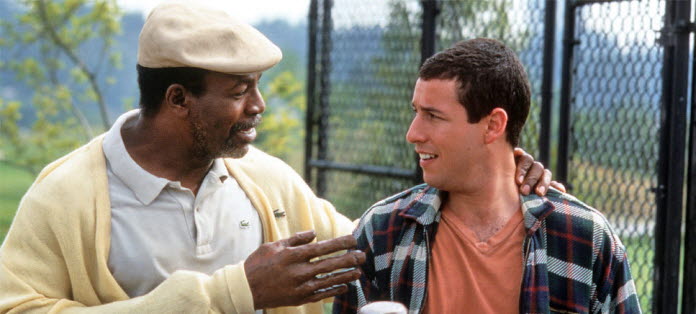
Anyway, let me talk a bit about how Sandler’s titular character made me wince more than once during the first 20 minutes of the film. On the surface, Happy Gilmore looks like a plain sweet loser to amuse you, but he often cannot control his serious temper problem, and many of the gags in the film come from how easily he is triggered to punch or hit anyone to annoy or insult him. Despite his longtime aspiration of being a professional ice hockey player someday, he is reminded again and again that he is not a very good ice hockey player from the beginning, and this certainly makes him quite angry more than once as shown from Sandler’s very first scene in the movie.
Nevertheless, Happy’s grandmother still sees the better sides of her dear grandson (Please don’t ask me how the hell that is possible), and he surely appreciates that, but there comes a big trouble for her on one day. Due to some serious tax problem, her old house and everything inside it get foreclosed by Internal Revenue Service, and the house will be put on an auction unless she and her grandson find any possible way to pay no less than $ 250,000 within 30 days.
After his grandmother has no choice but to go to a local facility for old people (Ben Stiller makes a cameo appearance as a vicious employee of that facility, by the way), Happy becomes quite devastated to say the least, but then there comes an unexpected opportunity when he discovers his unlikely potential in playing golf. Because he is pretty good at slapshot, his golf swing can actually drive a ball 400 yard (around 365 meter) at least, and his following golf hustlings get noticed by a retired professional golf player named Derick “Chubbs” Peterson (Late Carl Weathers, who fortunately manages to keep his dignity intact despite being required to many silly things throughout the film).
After getting some advice from Peterson, Happy participates in a local golf tournament, and he surely gets a lot of public attention right from the first day thanks to his powerful swings, though he remains to be a rather clumsy player and still shows a lot of temper problems. Nevertheless, he subsequently becomes more popular as playing in a series of the following golf tournaments, and he also learns a bit on how to make him a little more likable in public thanks to the public relations director of the professional golf tour who somehow finds herself quite attracted to Happy (Julie Bowen is sadly stuck in this fairly thankless supporting role, by the way).

Of course, like many of sports comedy films out there, the movie has a villainous opponent, who is determined to stop Happy’s earnest quest for earning $250,000 by any means necessary. That figure in question is an arrogant professional star golfer named Shooter McGavin (Christopher McDonald), and he is definitely not amused at all as Happy keeps drawing all the attentions away from what may be the highest point in his professional sports career.
Like Sandler, McDonald seems quite committed to go all the way as required by his role, but, again, the movie often does not support his game efforts well. His character’s several attempts of sabotage on Happy are so predictable that they look merely silly and annoying on the whole, and we are not so surprised even when, after deliberately heckled more than once, Happy comes to clash with a certain celebrity who happens to be playing with him on the spot. In case of the expected climactic part, it is riddled with not only countless clichés and but also a lot of the blatant promotion of a certain famous sandwich franchise company in US, and I absolutely agree with what my late mentor Roger Ebert observed in his 1.5-star review: “Halfway through the movie, I didn’t know what I wanted more: laughs, or mustard.”
So, is it still worthwhile to watch “Happy Gilmore” just for watching its recent sequel later or observing what was bound to emerge in Sandler’s much better films including “Punch-Drunk Love”? Yes, I was often quite bored or repulsed by its lame comedy during my viewing, but I also came to appreciate more of how far Anderson and the Safdie Brothers pushed Sandler’s genuine acting talent glimpsed a bit from the movie. Therefore, I guess there is some value in this deeply disagreeable comedy film and Sandler’s other equally ludicrous comedy films, and I hope that my 2-star review will help you decide on whether you will watch “Happy Gilmore” or not.


 Seongyong's Private Place