
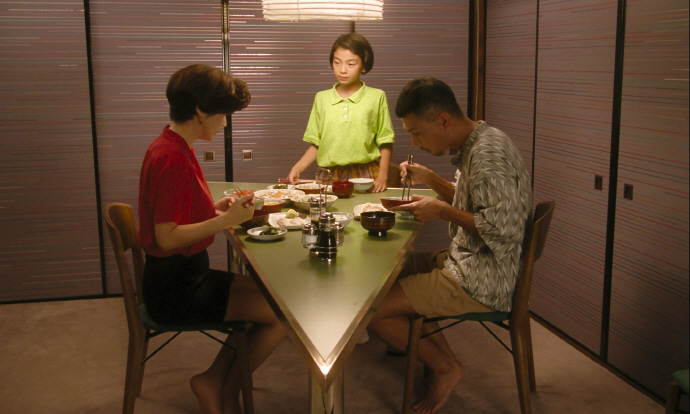
Shinji Sōmai’s 1993 film “Moving”, whose recent 4K restoration version is currently being shown in South Korean theaters, is about a 12-year-old girl trying to process a considerable domestic change in her daily life. At first, we are often amused by her bumpy emotional journey along the story, but we come to have more understanding and empathy on her ongoing inner struggles, and that is why it is poignant to observe how she comes to have a genuinely meaningful moment of maturation at the end of her journey.
The movie opens with a home dinner between Renko (Tomoko Tabata) and her parents. On the surface, everything seems fine and well as Renko tries to brighten up the mood among them, but it gradually becomes apparent to us that her parents, Kenichi (Kiichi Nakai) and Nazuna (Junko Sakurada), are quite estranged to each other. As a matter of fact, Renko’s parents are soon going to have a divorce, and we subsequently see Kenichi moving out of the family house along with a bunch of stuffs belonging to him.
Not totally understanding the personal reasons behind her parents’ divorce yet, Renko, who incidentally stays with her mother, acts as if nothing serious happened to her and her parents. While not telling anything about her parents’ divorce to her schoolmates, she attempts to maintain her relationship with her father as usual just because she likes him a bit more, but that is not welcomed much by her mother, who really wants to leave behind her unhappy married life.
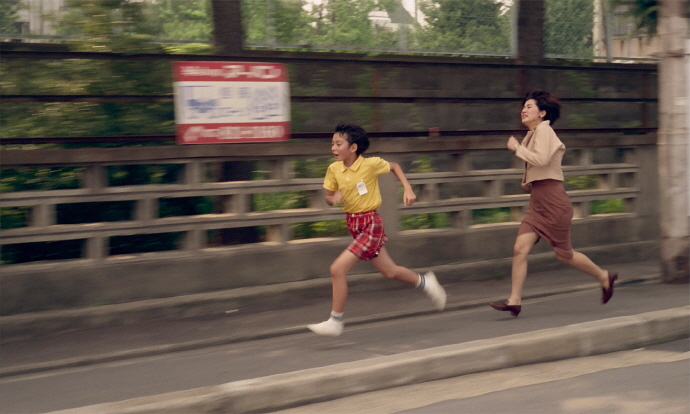
As our young heroine struggles to adjust herself to her changed domestic environment, the movie lets us sense more of her accumulating anxiety and frustration along the story. No matter how much she tries hard, it becomes all the clearer to us that her mother and father will never be together again, and the resulting conflict inside her eventually leads to several troubles in her elementary school. Needless to say, Nazuna is quite exasperated and frustrated about this problem, and Renko only becomes more rebellious while not appreciating much of her mother’s sincere efforts.
And she comes to learn more of how imperfect her parents are with each own human flaws. While Nazuna is often absent due to for being quite busy with her job, Kenichi turns out to be quite a lousy husband besides being still in the need of growing up more, and Renko inadvertently makes her parents show their worst sides to each other at one point later in the story.
After going through a fair share of anger, denial, and depression, Renko later concocts a little scheme as a part of what can be regarded as a sort of bargaining. She persuades her mother to go to a certain special place in their family life along with her, but, of course, her plan crumbles right from when they arrive at that place, and that consequently throws her into more conflict and confusion.
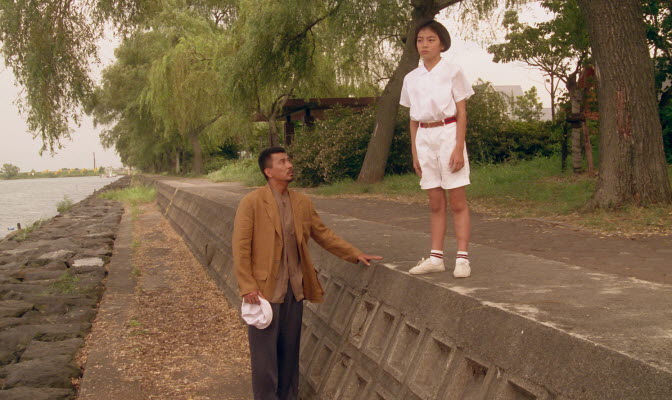
Even around that narrative point, the movie keeps maintaining its calm attitude, and then there come a series of somber but haunting human moments to remember. In case of an unexpectedly touching scene where Renko happens to receive the kindness of an old couple, she comes to learn from them a bit about how to accept loss, and the movie wisely does not spell out that small but valuable lesson of hers, while simply observing the gentle interactions between her and that old couple.
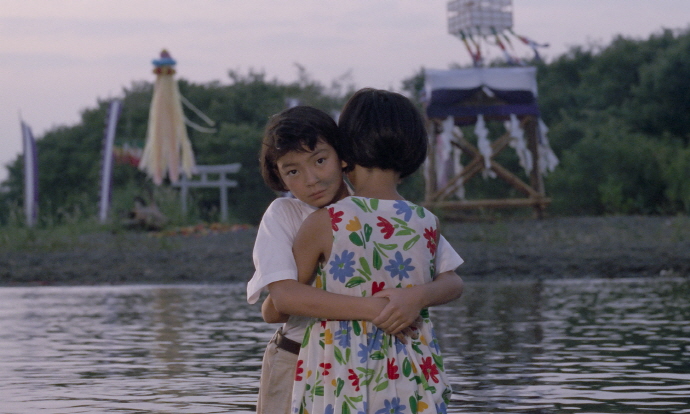
Around the finale, the mood becomes a bit dreamier as our young heroine aimlessly wanders around here and there in the middle of a big local festival, but the movie does not lose any of its emotional tension thanks to Sōmai’s skillful direction. As he and his crew members including cinematographer Toyomichi Kurita steadily carry the film via an ample amount of realism and verisimilitude on the screen, we become more absorbed in Renko’s conflicted mind, and the movie keeps us engaged as before – even when the story suddenly enters the realm of illusion along with its heroine.
The movie also depends a lot on the unforgettable lead performance of Tomoko Tabata, who incidentally began her acting career with this film. Effortlessly conveying to us her character’s difficult progress toward growth and acceptance, Tabata’s excellent performance holds the center to the end, and she is also supported well by Kiichi Nakai and Junko Sakurada. Nakai, whose first name was given by none other than Yasujirō Ozu (His actor father, Keiji Sada, appeared in Ozu’s several notable films including “An Autumn Afternoon (1962)”), makes his character somehow likable and understandable despite numerous flaws to observe, and Sakurada, who regrettably retired from acting not long after the movie came out, is equally convincing as her character goes through her own personal growth along the story.
In conclusion, “Moving” is a wonderful coming-of-age drama film from Sōmai, who deserves more recognition considering how much many of his works have been respected by many notable Japanese filmmakers including Hirokazu Kore-eda and Ryusuke Hamaguchi. Along with “Typhoon Club” (1985), which happened to be released in South Korean theaters in last year, the movie shows me that he is indeed one of the most important filmmakers in Japanese cinema, and I am certainly willing to get to know more about his career and achievement.


 Seongyong's Private Place