
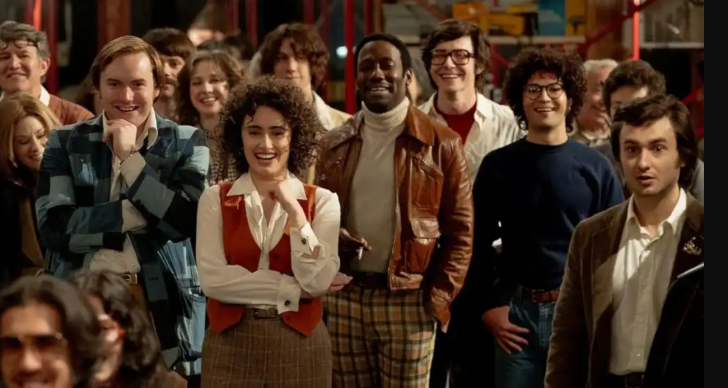
I do not know that much about its main subject, but I can tell you at least that Jason Reitman’s latest film “Saturday Night”, which is currently available on Netflix in South Korea, is a very typically crowded backstage tale. Mainly revolving around the premiere of one important American TV comedy sketch variety show in 1975, the movie throws and juggles a lot of stuffs in the air, but I doubt whether any of these supposedly interesting stuffs will linger on your mind after the very last shot of the film.
At the beginning, the movie, mostly set in NBC Studios in New York City during the late night of October 11th, 1975. introduces us to Lorne Michaels (Gabriel Labelle), a rather inexperienced but ambitious young TV producer quite determined to give a night to remember for the American TV audiences as well as him and many others around him. After managing to gather a bunch of young, talented, but relatively unknown comedians, he and his colleagues have prepared a lot for what these comedians are soon going to do on live TV during the next 90 minutes, and everyone is quite nervous because, well, there was nothing like that before in the American TV broadcasting history and they are certainly taking a big chance as entering a new territory.
Nevertheless, Michaels is ready to try anything for the successful premiere of “Saturday Night”, which would be later known as, yes, “Saturday Night Live”. Although it becomes more apparent later that NBC is simply using his nascent TV show as a bargaining chip for its ongoing contract negotiation with Johnny Carson, he is not daunted by that at all, and many of his colleagues including his wife/professional partner Rosie Shuster (Racheal Sennott) are also willing to try their best for their approaching big time on live TV.

Of course, things are not going that well for Michaels and his colleagues as their showtime is approaching second by second. While it is often hard and difficult to get their comedians including John Belushi (Matt Wood) under control, there comes one technical problem after another on the set of “Saturday Night”, and arranging all those planned comedy sketches into the 90 minutes given to them looks relatively easy compared to the accumulating troubles here and there around the set.
And Michaels gets all the more pressured by NBC, which is mainly represented by David Tebet (Willem Dafoe). At first, this supposedly benevolent NBC executive seems to be his biggest ally in NBC Studios, but he may eventually give the spot reserved for “Saturday Night” to Carson at the last minute if it ever looks not so promising to him at any chance.
While Micheals constantly struggles to get everything under control as much as possible, the screenplay by Reitman and his co-writer/co-producer Gil Kenan also presents a number of subplots popping up here and there around Micheals. While one of his main writers often keeps clashing with an NBC employee checking on any sensitive thing in his comedy sketches, Belushi turns out to be a bigger headache as refusing to sign on his contract, and his fellow comedian Chevy Chase (Cory Michael Smith) is no better than that. In case of Garrett Morris (Lamorne Morris), he becomes more aware that he is the only Black guy in the main cast of “Saturday Night”, and he seriously questions himself on whether “Saturday Night” is actually below his talent and potential.
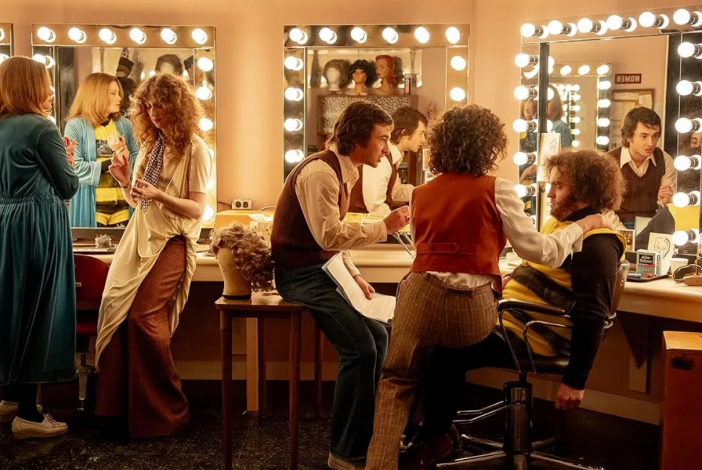
All these and many other elements in the story look fairly interesting regardless of how much the movie is actually close to its real-life story, but Reitman and Kenan’s screenplay only ends up scratching the surface as cramming too many things into its rather short running time (109 minutes). For example, a part involved with Milton Bearle (J. K. Simmons) is not so necessary in my humble opinion, and the movie does not delve enough into the private/professional relationship between Michaels and his wife. Around the last act, there eventually comes an expected moment when Micheals and many others really stick together for his ambitious vision at the last minute (Is this a spoiler?), but there is no surprise for us in the end, and the following reenactment of the very first minutes of “Saturday Night” feels merely obligatory on the whole.
Gabriel Labelle, who has been more notable thanks to his excellent performance in Stephen Spielberg’s “The Fabelmans” (2022), attempts to carry the movie with his earnest lead performance, but his efforts are often overshadowed by some of the more colorful performers in the bunch. Willem Dafoe, J.K. Simmons, and Tracy Letts are surely reliable as usual even though they are mostly required to fill their thin supporting parts with each own presence. In case of Cory Micheal Smith, Dylan O’Brien, Matt Wood, Matthew Rhys, and Nicholas Braun, they are fairly good, but we cannot help but become more of their attempts to imitate those legendary real-life figures played by them in the movie. While Rachel Sennott, who can be really funny as shown from her breakout performance in Emma Seligman’s “Shiva Baby” (2020), and Kim Matula are unfortunately wasted due to their under-developed parts, Lamorne Morris, who recently won an Emmy for his good supporting turn in the recent season of American TV drama series “Fargo”, manages to overcome his rather thankless role at times, and his best moment in the film comes from when his character gladly steps forward for making “Saturday Night” feel a little more exciting later in the story.
Overall, “Saturday Night” feels a bit too thin and scattershot as trying to present too many things at once, though it may make you reflect more on how its titular TV comedy sketch variety show has endured during last five decades. Yes, they did try to do something different at that time, and the rest is indeed history, but the movie is merely another backstage tale to my little dissatisfaction.


 Seongyong's Private Place