

As revisiting Hayao Miyazaki’s classic animation film “My Neighbor Totoro” (1988), I observed again how plainly simple it is in terms of story and characters. The story can be just described as a series of episodic childhood moments unfolded in a small rural village. Its main characters can be regarded as broad archetypes who often look very exaggerated in their emotional expression. Nevertheless, everything in the story including the titular mythic creature feels quite real, if not realistic, to me besides being quite charming and lovely to say the least.
And that probably makes the film the purest example of that distinctive style and mood shown from Miyazaki’s works, which have seldom disappointed me and other during last 46 years since his first animation feature film “The Castle of” Cagliostro (1979). His works distinguish themselves a lot via their vivid and meticulous cell animation which often evokes the texture of watercolor paintings, and they always fly high with a lot of wondrous imagination and compassionate humanistic touches. In short, this is something which cannot possibly be imitated by that abominable AI program which both disgusted and infuriated me and many others a few months ago.
After the cheerful main title which will instantly appeal to your inner child, the film, whose story is probably set in Japan around the 1950s considering its several notable period details, introduces us to Satsuki (voiced by Noriko Hidaka) and Mei (voiced by Chika Sakamoto), two little young girls who move to a little country village along with their father on one sunny day. Because their mother is currently in a nearby local hospital due to some unspecified illness, the girls have to be taken care of by their father or an old woman who is one of their new neighbors, and things seem all right for them as they enthusiastically look around here and there inside the house they are going to reside along with their father.
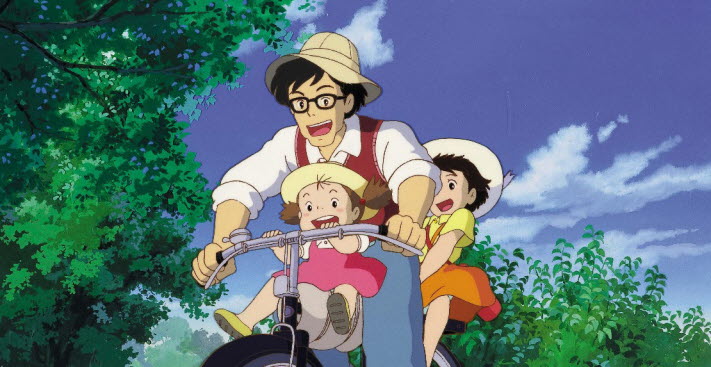
The girls are told later that the house, which looks like a juxtaposition between Western and Japanese cultural elements (This is one of the recurring aspects shown in many of Miyazaki’s works, by the way), is your average old haunted house, but that does not stop their enthusiasm at all. As a matter of fact, they happen to encounter something odd and curious when they check out the attic of the house, and that makes them all the more excited about their new place.
It is still refreshing even for an Asian audience like me to observe how the adult characters in the story casually accept what the girls think they see inside the house, instead of flatly disregarding their words. Their father, your typical intellectual who incidentally teaches at a big university in Tokyo, kindly tell his daughters that what they saw in the attic is supernatural entities called “dust bunnies”, and that old woman hired by him confirms his explanation without any objection.
While this is the girls’ first step into the realm of fantasy, the film patiently and sensitively establishes the daily mood and background of their ongoing summer days without hurrying itself at all. We see them and their father trying to get accustomed more to their new residence, and that leads to one little humorous moment when they feel a bit scared in the middle of their evening bath. We see Satsuki continuing her education at a local elementary school, and the situation becomes a bit awkward for her when her younger sister comes to the school for some emotional issue. In addition, there is also a funny subplot involved with a local boy who apparently likes Satsuki but, like many boys around their age, hesitates to show his feelings toward her.
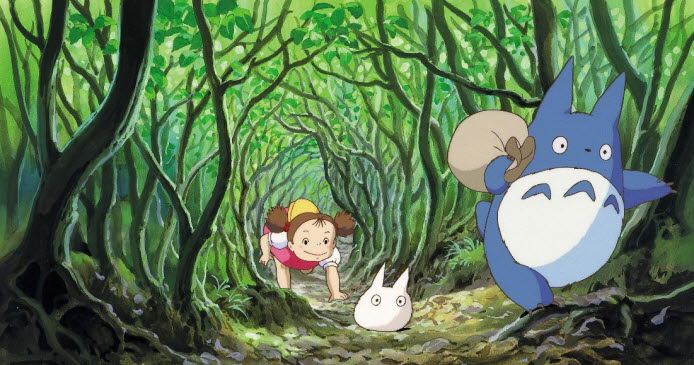
All these and other small moments in the film are presented via a lot of atmosphere and details to observe and appreciate. Many of seemingly inconsequential details ranging from an abandoned piece of trash in a little stream to the contents of the lunch boxes prepared by Satsuki are clearly drawn with a lot of care and skill, and they help us immerse more into Satsuki and Mei’s innocent viewpoint. Around the point where the titular mythic creature of the film appears, we are so fully engaged in their small world which always seems ready to evoke another awe and wonder for them that we willingly accept whatever they encounter along the story.
The titular mythic creature of the film, whose big, wide, friendly smile always somehow reminds me of Cheshire Cat, is certainly one of the most enduring animation characters of our time, and I am amazed again by how endearing it is even though it does not speak at all and the film also never tries to explain it at all. Is it just a piece of the girls’ shared imagination? Or do it and its several fellow creatures including what can be called “Catbus”, really actually inhabit around that big camphor tree in a Shinto shrine not so far from the girls’ house? The film leans a bit toward the second possibility during a little but sudden dramatic situation involved with the girls’ mother later in the story, but it still strikes the right balance between fantasy and reality even at that point, and its final shot is genuinely poignant without being unnecessarily melodramatic or sentimental.
On the whole, besides being one of the best works from Studio Ghibli, “My Neighbor Totoro” is still a great animation film to be enjoyed by both young and adult audiences out there for its sublime gentle qualities. Since I watched it for the first time in 2003, the film has never left my mind, and I assure you that you will revisit it from time to time just for cherishing its superlative beauty and wonder more and more.


 Seongyong's Private Place