
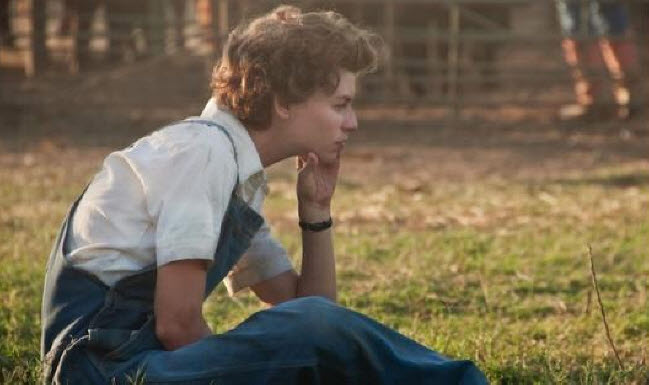
I have a personal soft spot for Mick Jackson’s 2010 HBO TV movie “Temple Grandin”, a deeply empathic drama about the remarkable life and career of Dr. Temple Grandin. Despite being on the autistic spectrum, Dr. Grandin became a respectable professional in animal science and psychology thanks to not only her considerable intelligence and determination but also a lot of support and help from many others around her including her caring mother, and the movie is often touching as letting us have more understanding on her autistic viewpoint.
The early part of the film focuses on how Grandin, played by Claire Danes, struggled a lot when she was about to study at the Arizona State University in the 1960s. Before starting her first semester in the university, she is going to spend some summertime at a rural ranch belonging to her aunt, and we observe how difficult it is for Grandin to adjust to a new environment despite her aunt’s sincere efforts.
Nevertheless, Grandin enjoys being around the animals in the ranch while also showing some brilliance thanks to her autistic brain, which usually thinks in pictures instead of words. For example, she devises a solution to the creaky problem of the front gate of the ranch, and the movie vividly shows us how she visually concocts that idea in her mind. As watching how the cattle in the ranch are handled, she also thinks of a special device to handle her occasional anxiety problem, and that certainly helps her adjust more to her new environment.

Not so surprisingly, Grandin feels quite anxious and overwhelmed right from her first day in the university despite her mother’s assurance. In addition, her awkward attitude and quirky personality certainly draw a lot of ridicule and ostracization from many schoolmates, and this only fuels her anxiety further to her frustration.
Nevertheless, Grandin does not give up at all because of how she was encouraged and supported a lot by her mother from the start. When she was notified that her daughter has autism, Grandin’s mother was quite devastated to say the least, but she refused to send her daughter to an institution, and she instead devoted a lot of herself to her daughter having a proper education for her future. Fortunately, she later found a right school for her daughter when Grandin became a teenager, and Grandin was further supported by a generous science teacher who really understood her and then encouraged her growing interest in science and engineering.
In the end, Grandin finds a way for being allowed to be simply herself in the university, and there is an amusing moment when she gets a new dormitory roommate, who is incidentally blind and has no problem with her quirkiness at all. Right from the beginning, they quickly bond with each other, and they also share their enthusiasm toward several popular TV drama series including “The Man from U.N.C.L.E.”.
Of course, there comes more challenges for Grandin when she subsequently finishes her undergraduate course and then embarks on the graduate course. When she is sent to a ranch along with several other students, she is soon ridiculed and then disregarded due to her odd behaviors as well as sexism, but, again, she is not daunted by this and other obstacles at all, and the mood becomes quite cheerful as her smart brain keeps finding the solutions for stepping forward.
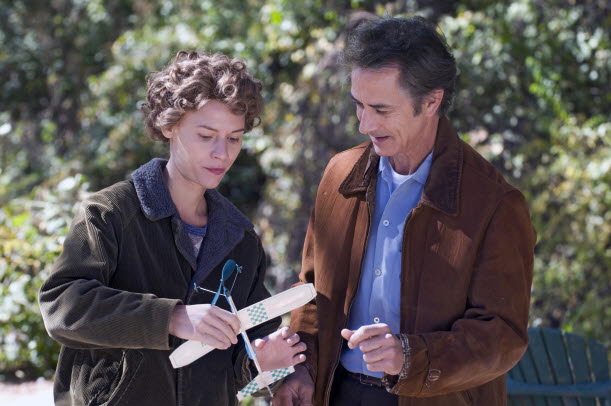
Around the narrative point where Grandin eventually designs how to handle cattle more efficiently and humanely, the movie, which is based on “Thinking in Pictures” by Grandin and “Emergence” by Grandin and her co-writer Margaret Scariano, immerses us more into her viewpoint. A number of visual tactics in the film including the frequent sudden insertion of images to reflect her rather jumpy mind may feel a bit too obvious at first, but they work well enough to give us more understanding on how her autistic mind works, and that is why we come to have more empathy on her human struggles along the story.
It surely helps that the movie is firmly anchored by Danes’ excellent performance, which rightfully won an Emmy at that time. While feeling quite showy and mannered on the surface, Danes also imbues her role with a lot of life and personality to observe, and she is particularly poignant when her character comes to have a little more intimate human interaction with her mother later in the story.
In case of several notable cast members in the film, they dutifully support Danes’ acting. While Julia Ormond has her own several good moments as Grandin’s devoted mother, Catherine O’Hara brings extra warmth as Grandin’s kind aunt, and David Strathairn, who won an Emmy like Danes and Ormond respectively did, is also terrific as effortlessly exuding wisdom and generosity.
On the whole, “Temple Grandin” is a very engaging human drama which will give you some enlightenment on autism, and it still comes close to me as it did 10 years ago. As a guy on the autistic spectrum, I had a fair share of personal struggles during last 42 years, and I was moved to tears again by the elevating finale of the movie. Despite all those problems associated with my autism, I was able to go forward and then open more doors to the world outside thanks to the support and encouragement from others around me including my parents, and I surely know and understand what Grandin feels around the end of the story. Yes, she is indeed different – but not less at all.


 Seongyong's Private Place