
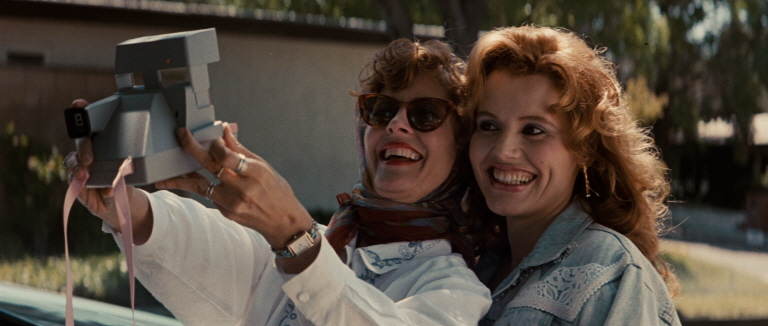
Ridley Scott’s 1991 film “Thelma & Louise”, which happens to be released in South Korean theaters in this week, remains fresh and vibrant besides being one of the best female drama films from the 1990s. While it looks like a typical mix of two different American genres on the surface, the movie deftly rolls its two unforgettable heroines along its narrative course, and the result is not only funny and exciting but also harrowing and poignant.
As revisiting the film with a bunch of audiences at last night at a local movie theater, I was impressed again by how the story unpredictably and lively bounces from one point to another as driven by the distinctive personalities of its two heroines. As they go through each own personal transformation along their bumpy (and criminal) journey, they are often surprised by themselves, and they feel all the more alive when they fatefully face the end of their journey.
In the beginning, the movie quickly establishes its two heroines’ little weekend plan. Thanks to the insistence of her waitress friend Louise Sawyer (Susan Sarandon), Thelma Dickinson (Geena Davis) decides to have her own good time away from her lousy husband, but she does not tell anything to her husband in advance because she knows too well that her husband, who is your average insensitive jerk, will not allow that at any chance.

Anyway, everything feels fine and all right as Thelma and Louise leave their little suburban neighborhood in Arkansas, and the mood becomes more cheerful when they decide to have some fun time at a local bar. Thelma is ready to have more fun as drinking and dancing more, but Louise is less eager to have a good time there in contrast to her friend – especially as watching how Thelma loses herself more due to more drinking and dancing.
And something very serious happens. While quite excited and drunken, Thelma is sexually assaulted by a guy who seemed nice to her at first, and she is fortunately saved by Louise at the last minute, but then Louise, who comes to the rescue with a gun brought from Thelma’s home, shoots that vile guy when his insulting words trigger something inside her. Naturally, both Louise and Thelma are quite scared and confused to say the least, and they hurriedly leave the scene because they fear that nobody will believe their words. As Louise points out, it is highly possible that people will think Thelma had it coming from the start, and you may be reminded of how many female survivors of sexual assault were disregarded or discredited for similar reasons before the #MeToo era.
Anyway, Louise soon decides to run away to Mexico, and Louise chooses to accompany Louise as her best friend. As they drive Louise’s car along the road to Mexico, Scott and his cinematographer Adrian Biddle, who was Oscar-nominated along with Scott and editor Thom Noble, vividly capture the wide and beautiful landscapes on the screen, and these lovely moments often accentuated how alone Thelma and Louise are in the middle of their escapade – and how free they also are as getting away from everything.
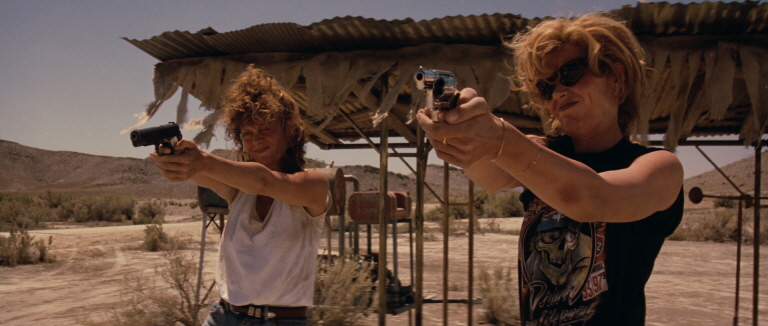
Needless to say, they are soon chased by the state police and FBI, and they also cause more legal troubles as things become more desperate for them later in the story, which becomes a cross between countless road movies and numerous American outlaw films such as “Bonnie and Clyde” (1967). The screenplay by Callie Khouri, which deservedly won an Oscar, skillfully drives its story and characters as doling out some unexpected moments to amuse or touch us. We are moved by how Louise and Thelma’s friendship is strengthened further by their plight, and we also cannot help but tickled by several humorous moments including the one involved with Thelma’s first act of crime, which incidentally made many audiences around me laugh together for a good reason.

Above all, the movie did a good job of letting us get to know more of its two heroines. Although it does not show much of their personal backgrounds, Thelma and Louise are fully established as the center of the story around the end of its first act, and their personal transformations along the plot are handled with a lot of care and sensitivity. As the heart and soul of the story, Geena Davis and Susan Sarandon, both of whom were nominated for Best Actress Oscar (They lost to Jodie Foster in “The Silence of the Lambs” (1991), by the way), wonderfully carry the film together with their rich and strong performances, and it is interesting observe how dynamically their characters interact with each other throughout the film. While Thelma comes to show a surprise amount of pluck and spirit later, Louise comes to show more vulnerability behind her hardened attitude, and some of the most touching moments in the film come from how they complement each other in one way or another.
In case of several notable cast members in the film, they dutifully support Sarandon and Davis without overshadowing them at all. While Harvey Keitel is a no-nonsense cop who turns out to be quite sympathetic to Louise and Thelma’s ongoing plight, Michael Madsen, who sadly passed away a few weeks ago, and Christopher McDonald are also solid as Louise’s boyfriend and Thelma’s husband, and you may be impressed by how Brad Pitt, who was just a young newcomer at that time, is already showing the potential for his approaching stardom.
On the whole, “Thelma & Louise” is still a terrific movie in addition to being one of the best works in Scott’s long and illustrious career. As late critic Roger Ebert correctly pointed out in his 1991 review, the movie stumbles a bit after undeniable dramatic impact of the very last shot (I think it would be more effective if it had a few seconds of silence before moving onto the end credits), but this is thankfully a fairly minor flaw compared to many strong elements of the film, and I am sure the movie will be remembered as a timeless classic as before.


 Seongyong's Private Place
I enjoyed your review. It was thorough and well-considered. Have you seen the documentary about Thelma & Louise which was the closing night film at a women’s festival is Seoul in 2019? It is called “Catching Sight of Thelma & Louise.”
SC: I am interested in checking out that film.