

South Korean independent film “Spring Night” is often frustrating for its dry and austere storytelling which does not add much on its barebone narrative. This is a simple story about two miserable people who somehow choose to live together, and the movie surely puts them into more misery and despair as expected, but it does not have much human interest to draw us more into their bleak human condition.
The movie begins with what can be regarded as a sort of Meet Cute moment between its two main characters. Yeong-kyeong (Han Ye-ri) and Soo-hwan (Kim Seol-jin) come across each other when they happen to attend the wedding of their acquaintances and the following drinking party, and Soo-hwan later shows a bit of kindness when Yeong-kyeong is too drunk to return to her current residence for herself.
After this rather awkward encounter, Soo-hwan comes to meet Yeong-kyeong again and again probably because he is smitten with her, and Yeong-kyeong does not mind this at all mainly because she has been quite lonely whenever she is not drinking. It becomes more apparent to us that she is your average alcoholic, and she soon confides to Soo-hwan a lot about her very unhappy life. When her married life crumbled some time ago, she lost her kid as well as her job, and her resulting bitter regret has driven her more into alcoholism.
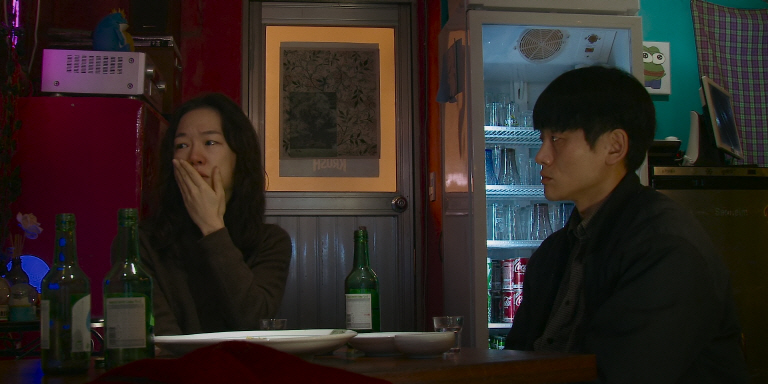
In case of Soo-hwan, he has also had a fair share of misery. He once ran a metal factory, but then his business became bankrupt, and he came to lose much more thanks to his ex-wife. Now he is suffering a serious medical condition, but he cannot get insured due to his poor economic status, and that prompts Yeong-kyeong to give him a seemingly practical offer. Considering that she still has some money and an apartment belonging to her, she may be able to help him to some degree once she becomes his new wife on the paper, and Soo-hwan eventually accepts her offer.
The middle act of the story shows how Yeong-kyeong and Soo-hwan try to get accustomed to their new situation. Once she sells his apartment, Yeong-kyeong and Soo-hwan move together to a nursing home where he will get some medical treatment. Yeong-kyeong is already ready to stand by him, and we later see a big bed delivered into their little private room in the nursing home.
Everything seems to be fine and well for Yeong-kyeong and Soo-hwan on the surface, but it soon turns out that Yeong-kyeong is still struggling with her alcoholism. At first, she is just content with a bottle of soju hidden inside her luggage bag, but then, of course, she comes to crave for more booze once the bottle is empty, and she eventually decides to go outside for getting more booze, though the head of the nursing home clearly sees through her when she requests a permit for being outside for a couple of days.
Soo-hwan certainly knows well why Yeong-kyeong wants to go outside, but he does not stop her at all while caring more about her. Even though she is not exactly punctual about her return, he patiently waits for her as long as possible, and that makes Yeong-kyeong feel more guilty about her worsening alcoholism. The more she drinks, the more she cannot help herself over her addiction problem, and this eventually jeopardizes her and Soo-hwan’s current status to a serious degree.

Around that narrative point, we are supposed to care more about their increasingly miserable human condition, but the movie adamantly sticks to its detached attitude, and we come to observe them from the distance without much care or interest. They are indeed sad and miserable characters, but they are only defined by their misery and unhappiness without much inner life or personality. The screenplay by director/editor Kang Mi-ja and her co-writer Lee Ji-sang, who also served as the co-cinematographer of the film, often seems to be spinning its wheels in terms of character development, and that is the main reason why a brief moment of insight into Yeong-kyeong’s tortured mind feels rather superficial.
At least, the movie works to some degree as the showcase of its two lead performers. Han Ye-ri, who recently became more notable thanks to Lee Isaac Chung’s Oscar-winning film “Minari” (2020), has enough presence and talent to fill her cardboard role, and her fairly good efforts here in this film, which make a big contrast with her lightweight comic performance in Kim Jong-kwan’s “Worst Woman” (2016), deserves a better story and character in my inconsequential opinion. On the opposite, Kim Seol-jin is stuck with a thankless job of looking quiet and passive, but he mostly acquits himself well on the whole, while subtly complementing his co-actor’s showier acting.
Overall, “Spring Night”, which is incidentally the second feature film from Kang after “Let the Blue River Run” (2008), can be admired for how uncompromisingly austere it is in terms of mood, performance, and storytelling, but it did not engage me enough for recommendation. Although this is not a bad movie at all and Kang is clearly a competent filmmaker, I must confess that my mind struggled to process how it is about during its rather short running time (67 minutes), and I only came to wish that I will have more satisfaction from whatever may come next from Kang.


 Seongyong's Private Place