

I must confess that I had a rather complicated history with Paul Haggis’ 2004 film “Crash”. When it won several Oscars including the one for Best Picture right before getting released in South Korean theaters in early 2006, I was disappointed because I rooted for “Brokeback Mountain” (2005) or “Munich” (2005). When I finally watched the movie a few weeks later, I was quite annoyed with the early part of the film as becoming more convinced that the Academy voters indeed made a wrong choice, but, what do you know, my heart was knocked down more than once by the rest of the film, and I came to have some understanding on why my late mentor/friend Roger Ebert picked it as the best film of 2005.
Even though I still believe that “Brokeback Mountain” or “Munich” should have won the Best Picture Oscar instead, I also think “Crash” is not exactly the worst Best Picture Oscar winners during last 25 years (That dishonor should go to “Green Book” (2018), by the way), but, as revisiting it again at last night, I could not help but reminded of how much I and the world have changed since it came out 20 years ago. There was some hope and optimism with Barack Obama entered the White House a few years later, but then there came that Donald J. Trump, whose sheer cruelty and stupidity have exposed and then fueled the truly ugly sides of American racism. Considering what has happened during last 10 years thank to that bastard and his equally racist cronies, the main message of “Crash”, which is basically “Can we just get along well with each other?”, seems quite naïve to me at times now.
Nonetheless, the movie still works in terms of story and characters. Once it quickly establishes various stereotype characters during its first act, the screenplay written by Haggis and his co-writer Bobby Moresco catches us off guard more than once via unexpected dramatic moments, and we come to regard its many main characters with more complicated feelings. Yes, some of them are quite unpleasant to say the least, and that is one of the main reasons why I became so annoyed during my first viewing, but then I came to have some understanding and empathy on them even though I still did not like them much.
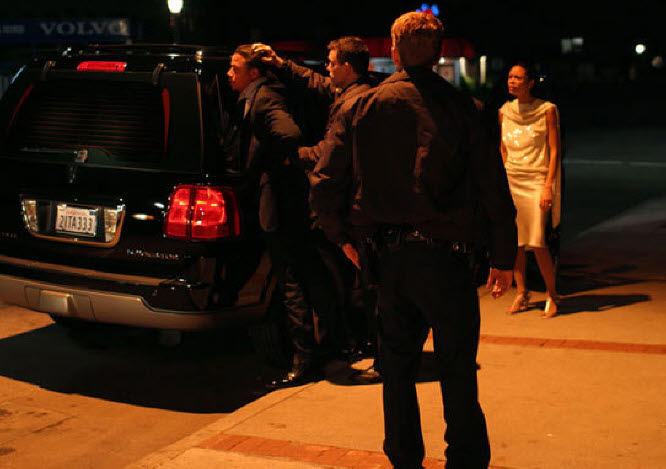
Like “Short Cuts” (1993) and “Magnolia” (1999), the movie draws our interest as juggling a bunch of many different characters who turn out to be connected with each other in one way or another as they are going through another day in LA. After the brief prologue scene involved with two detectives who happened to have a car accident right before arriving at a crime scene, the movie moves onto an unfortunate incident between a couple of young black man and a certain white couple, and then we see how that incident indirectly causes a very disturbing happening between a couple of patrolling cops and one black couple.
These and many other characters in the film frequently show each own racism as clashing a lot with each other during its first act, and I must say that this part still gets on my nerve as before. In my humble opinion, the movie tries a little hard on making the point on how we are often not so free from prejudice and bigotry in each own way, and this makes the film look like a mere educational film for school kids at times.
However, its supposedly broad main characters turn out to be a bit more complex than expected as the movie keeps rolling them along its interconnected narratives. For example, one of those two patrolling cops is apparently your average racist, but then there comes a surprisingly powerful emotional moment as he comes across someone who does not want to see him again at all. In case of the other cop, who is your typical rookie cop, he does not approve much of his partner’s racist behavior, but then there comes a tragic moment of irony later in the film, which always reminds me of what John Huston’s character says in “Chinatown” (1974): “You see, Mr. Gittes, most people never have to face the fact that at the right time and the right place, they’re capable of ANYTHING.”

One of the most poignant moments in the film come from the subplot involved with a Latino locksmith. While he may look like your average Latino thug on the surface, he actually turns out to be a caring family man genuinely concerned about his little daughter’s welfare in their rather tough neighborhood, and their little private conversation scene is all the more touching, considering how it leads to another powerful moment later in the story.
Around the last act, the movie loses some of its narrative momentum, but it is still supported well by its strong ensemble performance from its numerous cast members, which is incidentally the best thing in the film. While Don Cheadle humbly holds the center as a detective who must make some hard choice for his problematic family, Sandra Bullock, Brendan Fraser, Jennifer Esposito, Terrence Howard, William Fichtner, Shaun Toub, Loretta Devine, Michael Peña, Ludacris, Ryan Phillippe, and Larenz Tate have each own moment to shine, and Matt Dillon and Thandiwe Newton are particularly excellent in their respective parts. I still remember when I was quite overwhelmed by the painfully human reaction of Newton’s character to Dillon’s character during that dramatic moment, and this actually sensitized me to a considerable degree as a movie reviewer. Yes, Dillon’s character did the right thing for saving her during that scene, but he does not feel redeemed at all as reflected by a brief moment of his later in the film, and I think he will remember more of her pain and anger.
Overall, “Crash” does not age that well compared to its main Oscar competitor, but I think it is still a good film whose several strong elements compensate enough for a number of weak ones including its rather condescending presentation of its Asian characters. I initially gave it 3.5 stars out of four as a young moviegoer, but now I give it 3 stars as a seasoned one with more experience and knowledge, and I will let you decide your opinion on this rather flawed but engaging movie.


 Seongyong's Private Place