

Ang Lee’s 2005 film “Brokeback Mountain” has endured the test of time pretty well during last 20 years to my little surprise. While I regarded it as a major breakthrough in several aspects at that time, I also wondered whether it would get eventually aged as opening the door for its numerous juniors to come, but, what do you know, it still works as a classic tale of star-crossed romance with a lot of sincerity and sensitivity.
The early part of the movie, which is set in a rural area of Wyoming, 1963, begins with the first encounter between two different young men: Ennis Del Mar (Heath Ledger) and Jack Twist (Jake Gyllenhaal). They happen to be hired by some cranky rancher to take care of a big herd of sheep on Brokeback Mountain during next several months alone by themselves, and the movie observes how difficult and demanding their job is as they begin their first days on the mountain.
And we get to know these two lads bit by bit. Ennis is quite taciturn while usually focusing on doing his job day by day, but Jack is relatively more flexible about their work while being often quite open about whatever he feels or thinks right now. As a matter of fact, we gradually sense something being developed between Jack and Ennis, as the camera often lingers a bit more on how Jack looks at Ennis.
In the end, Ennis comes to open himself a bit more to Jack, because, well, there is no one else to talk with besides his partner right now. Both of them come to see more of how lonely they have been in one way or another, and then there eventually comes a fateful moment when they find themselves quite attracted to each other. As observing how they instantly follow their sexual urge once they feel more of their mutual attraction, I was reminded of how I did not hesitate at all in my first sexual experience with a boy around my age in the middle of one night in early 1997. I certainly felt afraid, but I wanted to do that, and I and he immediately followed our urge without thinking anything else.
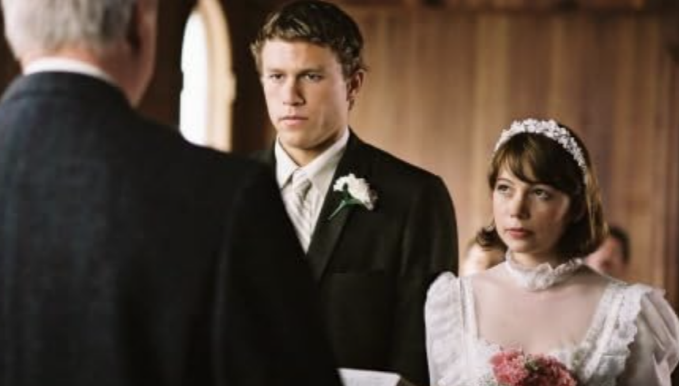
We subsequently told ourselves that we were not gays, like Jack and Ennis did after their first sex, but we continued our little secret relationship for a while, and that is why I am always a bit amused as observing how Ennis and Jack become more attracted to each other along the story. They surely want to look away from what they cannot totally understand or accept, but they also cannot help but follow what their hearts want, and the movie handles their clumsy but unadorned romance with tender thoughtfulness.
Some time later, Jack and Ennis come to part ways as their work is eventually over, but they cannot forget each other even after they respectively get married. While Ennis marries his longtime girlfriend Alma (Michelle Williams), Jack marries Lureen (Anne Hathaway), the daughter of some rich businessman in Texas. Both of them try to be happy with their respective married lives, but they only find themselves becoming more distant from their spouses, and Ennis does not hesitate at all when Jack tries to reach him later.
While being always happy to be with Jack during their “fishing trips”, Ennis still hesitates to go further because he is still not so comfortable with his homosexuality as haunted by one traumatic childhood incident involved with a murdered gay man. This tendency of his is continued even after he divorces Alma, and this certainly frustrates Jack, who really wants to have a real honest life with his lover someday.
The screenplay by Larry McMurtry, who is no stranger to loneliness considering his several acclaimed novels such as “Lonesome Dove” and “The Last Picture Show”, and Diana Osana, which is based on the short story of the same name by Annie Proulx, handles several inherently melodramatic moments during the second half of the movie with considerable empathy and honesty. While we come to know and understand its two heroes more than before, we also come to have some sympathy toward their respective spouses, who have to deal with a fair share of emotional issues due to their increasingly distant husbands.
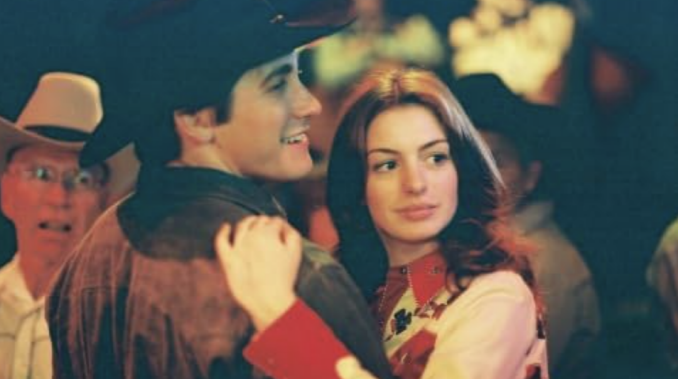
Lee’s handling of the story and characters seems quite plain and transparent on the surface, but his deft direction makes us pay more attention to small but crucial emotional moments, and he and his crew members including cinematographer Rodrigo Prieto did a stellar job of filling the screen with an ample amount of mood and details to observe. As Prieto’s camera vividly and crisply captures the remote landscapes surrounding Ennis and Jack, we are more reminded more of how lonely they are – and how desperately they need each other. The sparse score by Gustavo Santaolalla, who won an Oscar for this film (The movie also won Best Director and Best Adapted Screenplay Oscar, by the way), effectively reflects the tentative yearning inside Jack and Ennis, and its best moment comes from when Ennis becomes a bit more honest about his feelings around the end of the story.
The movie was a major breakthrough for its four main cast members. While Heath Ledger, who would give us another memorable performance in “Dark Knight” (2008) right before his unfortunate death, is touching in his subtle embodiment of Ennis’ conflicting emotions, Jake Gyllenhaal ably complements his co-star, and Michelle Williams and Anne Hathaway do more than holding each own place around the story. Williams is particularly good when her character is quite confused and devastated after unexpectedly discovering Ennis’ big secret, and Hathaway has a brief but important moment when her character has a short phone conversation with Ennis later in the story. Randy Quaid, Linda Cardellini, and Anna Farris are also effective in their small supporting roles, and you may be amused by the brief appearances of David Harbour and Kate Mara, both of whom were starting their respective careers at that time.
While it may look a bit tame compared to many subsequent LGBTQ+ films ranging from “Carol” (2015) to “All of Us Strangers” (2023), “Brokeback Mountain” is still a powerful love story both universe and specific, and it also remains one of the best works from Lee, whose filmmaking career is as diverse as that of, say, Sidney Lumet. It does not seem so easy to find any common ground among “Sense and Sensibility” (1995), “Crouching Tiger, Hidden Dragon” (2000), “Hulk” (2003), “Lust, Caution” (2007), and “Life of Pi” (2012), but it is clear that he is a master filmmaker who always pays attention to story and characters first, and it is a shame that he has been rather quiet since the critical and commercial failure of his last two films “Billy Lynn’s Long Halftime Walk” (2016) and “Gemini Man” (2019). At least, he gave us a number of excellent movies besides “Brokeback Mountain”, and he certainly deserves our admiration as before.


 Seongyong's Private Place