

“Kneecap”, which was selected as the Irish entry to Best International Film Oscar in last year, is a typical rapper movie with some local flavor. While it has a substantial amount of irreverent wit and bouncy energy to hold our attention, the movie feels rather flawed at times due to some plot contrivance and thin characterization, and that is rather disappointing considering its interesting main subject.
The movie is a fictional story loosely based on Kneecap, a real-life Irish hip-hop trio from Belfast, Northern Ireland. I have no idea on how much the movie is actually based on their real-life story, but the members of Kneecap, Liam Óg Ó hAnnaidh, Naoise Ó Cairealláin, and JJ Ó Dochartaigh, play themselves in the film besides writing the story with director/screenplay writer Rich Peppiatt, and I guess they bring a lot of themselves to the film in more than one way.
At the beginning, the story, which is set in Belfast around the 2010s, depicts how things are not so good for Liam and Naoise. two wild local lads who have not thought much about their future as throwing themselves into a lot of fun and drug. When they were little boys, Naoise’s father, played by Michael Fassbender, often reminded that they tried to speak Irish more as being prouder of their heritage, but he eventually left Naoise and her mother for evading the police due to his political activities during that time, and this certainly hurts both Naoise and his mother, who has never left their house since that point.
When Liam and Naoise are going through another hedonistic night of drug and music along with many other young people during one evening, the police ambush them all, and Liam is arrested while Naoise manages to escape. At the police station, Liam pretends that he does not know English at all, and that is how JJ, who incidentally works as a music teacher at some local school, is brought to the police station for functioning as a translator instead of his activist wife.

During the interrogation, JJ takes away Liam’s little notebook as asked by Liam, and that notebook contains something to interest JJ. After reading several song lyrics written in Irish, JJ attempts to juxtapose one of them with one of a piece of beat music created by himself, and, what do you know, the result is good enough to prompt him to do more. After subsequently meeting Liam and Naoise, they decide to make more hip-hop songs together in JJ’s little private space, and they also do a lot of drug just for more fun and excitement for themselves
Their first public performance, which is held at a little local pub, is not so successful to say the least, but, of course, someone eventually shoots their modest performance, and their music soon goes viral on the Internet in addition to causing the unexpected controversy in Belfast. As JJ’s wife and many other local activists and people demand that Irish should be recognized as a public language, the music and lyrics of Kneecap certainly draw more attention due to the sensitive contents, and that makes JJ quite conflicted – even while hiding his identity in public because he may lose his job because of his little musical activity.
In case of Liam and Naoise, they also find themselves facing a big problem as their popularity grows more and more day by day. A local republican paramilitary group is not so pleased about Kneecap because Kneecap causes a lot of trouble via not only its wild rap songs but also drug, and they are certainly ready to suppress Kneecap as much as possible just like the local police.
Around that narrative, we should care more about the main characters of the film, but the movie does not seem to have much thought and point on the serious aspects of their reckless musical activities. Sure, their music can bring some life and attention to their local language for the younger generation, but, as reflected by the rather disapproving stance of JJ’s wife, it can also be regarded as the thoughtless vandalism on Irish, and, not so surprisingly, Naoise’s father is not so amused by what his son is doing.
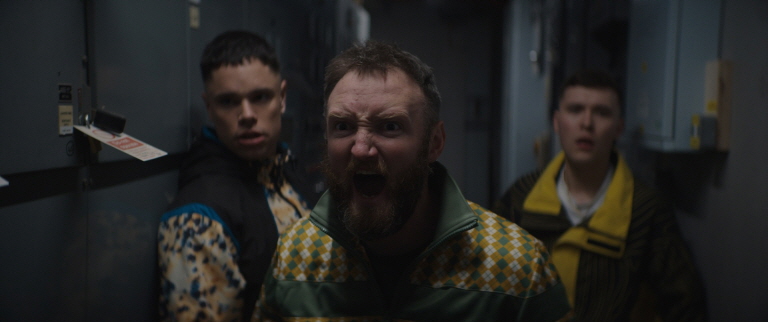
During the last act, the movie leans more on plot contrivance, but it is still supported well by its fairly good soundtrack. When everything culminates to what is going to be a major public breakthrough for Kneecap, Peppiatt and his crew members including cinematographer Ryan Kernaghan pull all the stops as demanded, and the result is fun and exciting as expected.
Regardless of how much their performances in the film are actually overlapped with their real lives, the three lead actors of the film are engaging in their unadorned acting, and the chemistry among them is always palpable whenever they perform together on the screen. In case of several supporting performers around them, Josie Walker, Fionnuala Flaherty, Jessica Reynolds, and Simone Kirby are rather under-utilized due to their underwritten characters, and the same thing can be said about Fassbender, who simply fills his thankless role as much as possible.
In conclusion, “Kneecap”, which received the NEXT Audience Award when it was premiered at the Sundance Film Festival early in last year, could be more improved in terms of story and character, and, after observing what is shown during its end credits, I wonder now whether their story would be more interesting if it were presented via a documentary instead. Sure, I had some fun during my viewing, but, folks, the movie could delve into its main subject more in my trivial opinion.


 Seongyong's Private Place