
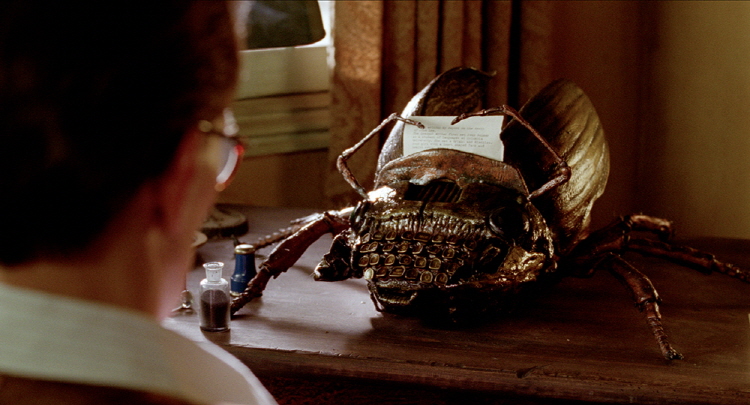
David Cronenberg’s 1991 film “Naked Lunch”, which happens to come to South Korean theaters shortly after the local theatrical release of Luca Guadagnino’s “Queer” (2024), tackles on an impossible task, and the result is alternatively interesting and baffling. Loosely based on William S. Burroughs’ controversial novel of the same name and his own messy (and dopey) life, the movie attempts to present a despairing hell of addiction driven by a stream of drugged conscience, and you may admire its bold cinematic experience even while often feeling repulsed or disoriented a lot during your viewing.
The early part of the film effectively sets its dryly petrified tone right from the beginning. It is 1953, New York City, and William Lee (Peter Weller), who is virtually a fictional version of Burroughs himself, has earned his meager living as a bug exterminator, but things have not gone particularly that well for him and his wife Joan (Judy Davis). It turns out that he frequently runs out of bug powder during his worktime, and, what do you know, both he and his wife, who happen to be addicts still far from clean and sober, are seriously addicted to bug powder (Don’t ask me how the hell that toxic substance can make them high).
When his mind does not crave for another dose of drug, Lee often spends time with his two fellow Beat Generation writer friends, who are apparently the fictional version of Jack Kerouac and Allen Ginsberg. They talk and discuss a lot about writing, but Lee’s mind seems mostly disaffected and disinterested, and he finds himself more and more addicted to the bug powder – even after he attempts to get some medical help from a shady local doctor introduced to him later by one of his colleagues.
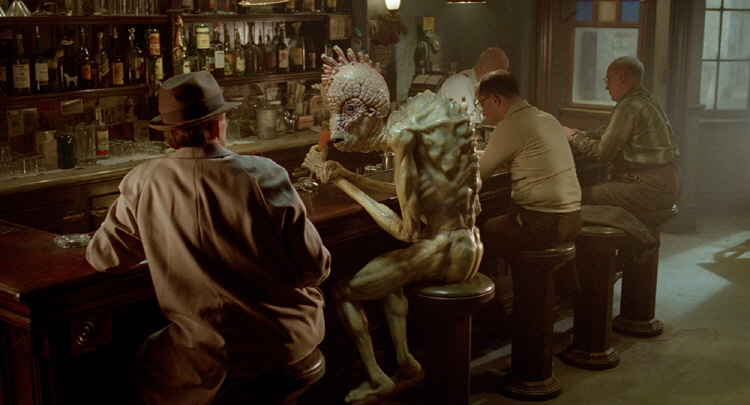
In the end, there comes a shocking tragic incident which did happen in Burroughs’ real life. While quite high and dopey due to their latest moment of drug abuse, Lee attempts what he and his wife call “William Tell Game”, and this accidentally leads to his wife’s unfortunate death, which consequently turns his life upside down. Around that point, Lee is so addicted to the bug powder and some other substances that he begins to experience one hallucination after another, and one of them features a big bug talking to him via a big rear orifice which does look more like a sphincter on big screen due to some little hairy details.
Now you may sense that Lee is not only a junkie but also a conflicted gay dude not so comfortable with his sexuality as reflected by the morbidly sexual aspects observed from some of his crazy hallucinations in the film. As depending more and more on his substances of choice, Lee’s mind eventually enters a place called “Interzone”, and this supposedly imaginary exotic place, which often looks like a secondhand version of Casablanca, Morocco, is packed with handsome local gay lads as well as a bunch of odd people who come and then go around Lee as fueling his anxiety and paranoid more and more.
One of these strange figures, who is also a writer just like him, has a wife who exactly looks like Lee’s wife and is also played by Davis. Lee naturally gets attracted to this woman who seems relatively sharper than his dead wife, and the movie later gives us a very strange moment of writing and sex as they try a bit on a kinky Arabic typewriter belonging to her husband.

Around that narrative point, I kept scratching my head again as wondering more about Lee’s actual state of mind, but I admire Cronenberg’s uncompromising exploration on what makes Lee (and Burroughs) tick. Because of Burroughs’ deliberately random writing style coupled with a lot of morbid and freakish sexualization beyond NC-17 rating, the faithful movie adaptation of his novel is nonsense from the start, so Cronenberg chooses to go for the collage of the fragments of the novel and Burroughs’ life instead, and you will appreciate that more if you are familiar with his life and writing career. Thanks to cinematographer Peter Suschitzky, the overall atmosphere of the film is deliberately drab and dispirited with a palpable sense of misery, fear, and despair beneath the surface, and that is further accentuated by the ominous score by Howard Shore, who closely collaborated with legendary jazz musician Ornette Coleman for injecting some free jazz style to the film.
The main cast members flawlessly tune their performance to the detached overall tone of the movie. Peter Weller ably embodies the pathetically hollow state of his character’s mind, and it is clear that he studied a lot of that distinctive appearance and speech pattern of Burroughs, who was incidentally still alive when the movie was made. On the opposite, Judy Davis, who came to show the considerable range of her immense talent via this film and the Coen Brothers’ “Barton Fink” (1991) in the same year, is terrific in her dual performance, and several notable performers including Ian Holm, Julian Sands, and Roy Scheider are also solid as some of those odd denizens of Interzone.
On the whole, “Naked Lunch” is often interesting for its mood, detail, and performance, but I must warn you that it can also be a little too weird and distant for some of you. I do not think it is one of Cronenberg’s best works, but, like many of Cronenberg’s cult films such as “Videodrome” (1982), it will definitely make you quite uncomfortable and baffled, and you will probably never forget all those weird stuffs in the movie.


 Seongyong's Private Place