

Steven Spielberg’s 1998 film “Saving Private Ryan”, which happens to be re-released in South Korean on this Wednesday, definitely earns its own place in the pantheon of war movies via its stupefyingly stunning opening battle sequence, but it is much more than that. This is a seemingly modest but undeniably powerful drama about nobility, brutality, vulnerability, and humanity, and its somber but indelible human qualities do not age at all just like a number of impressive battle sequences in the film.
After the brief prologue scene, the movie goes straight into in the middle of the Normandy Landings on June 6th, 1944. While this big military operation of the Allied Forces was quite successful enough to change the course of the World War II on the whole, hundreds of soldiers were killed right from when they arrive at the beach of Normandy, and the movie often overwhelms us with its horrifyingly realistic depiction of chaos, violence, and death as steadily following Captain John H. Miller (Tom Hanks) and many other American soldiers around him. Yes, there had already been many movies showing that war is indeed hell, but Spielberg and his crew members including editor Michael Kahn and cinematographer Janusz Kamiński, both of who deservedly won an Oscar for this film, pushed the envelope for more visceral verisimilitude, and the commercial/artistic success of the movie opened the door for its numerous juniors ranging from Ridley Scott’s “Black Hawk Down” (2001) to Mel Gibson’s “Hacksaw Ridge” (2016).
Not long after Captain Miller and several soldiers under his command manage to survive and then win their big battle in the end, they receive an unexpected assignment. One mother living in some rural area of Iowa, US happened to lose three of her four enlisted sons within a short time, and the Chief of Staff of the US Army eventually decides that one remaining son, Private James Francis Ryan (Matt Damon), must be safely returned to his mother right now. However, Private Ryan was already sent to somewhere around Normandy along with many other soldiers of his division, and it is Captain Miller’s job to locate and then retrieve him as soon as possible.

As Captain Miller and several soldiers selected by him for this little but supposedly important mission move from one dangerous region after another for finding Private Ryan, some of his men naturally come to have questions and doubts on whether their mission is really necessary from the beginning. Yes, they are simply following the order as demanded, and they are supposed to do the morally right thing for Private Ryan’s dear mother, but putting no less than 8 men into a lot of danger just saving one person does not make sense much to them – especially whenever they face more of how risky their mission can be.
Along their perilous journey, the movie expectedly gives us one battle sequence after another, and these battle sequences are skillfully handled under the masterful direction of Spielberg, who incidentally won his second Best Director Oscar for this film (The movie lost to John Madden’s “Shakespeare in Love” (1998) in case of Best Picture Oscar, by the way). Each of them is intense and compelling in one way or another, and the restrained score by Spielberg’s another usual collaborator John Williams wisely steps back completely, while mostly focusing more on the enormous human cost of war reflected by their bitter aftermath.
Between these striking battle sequences, Spielberg and his screenplay writer Robert Rodat gradually and thoughtfully develop several main characters in the story, and these characters’ little personal moments are balanced well between humor and drama. Yes, they do merely look like familiar archetypes expected from your average war drama flick at first, but they come to show their personality and humanity along the story bit by bit, and that is why we come to pay more attention to what is being at stake for them as they go through one peril after another.
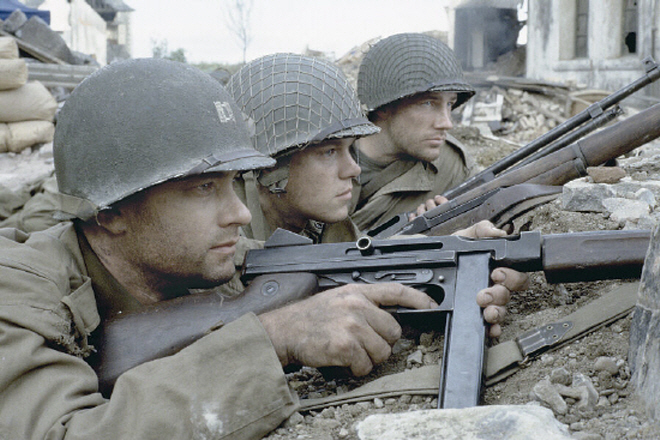
And we also come to know and admire more of Captain Miller’s quiet but aching human aspects. Tom Hank is surely no stranger to playing a man of decency and integrity just like James Stewart, but his earnest low-key performance here in this film, which received an Oscar nomination, is one of the best moments in his career. Even when his rather taciturn character does not seem to signify much on the surface, we clearly sense a plain good man dutifully trying to do his best for not only accomplishing his mission but also surviving the war, and Hanks ably exerts a gentle but strong leadership over the other main cast members around him.
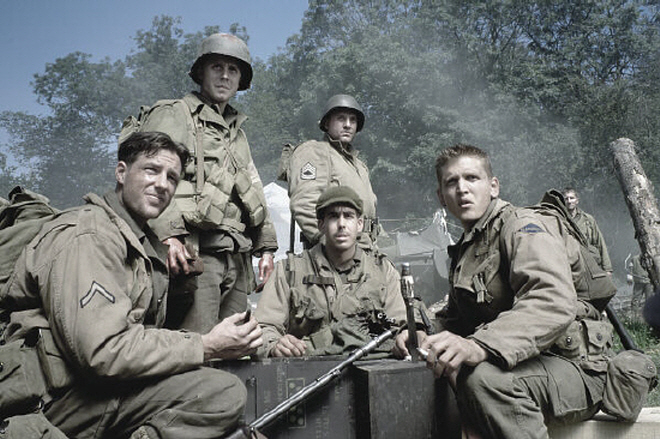
As revisiting the film yesterday, I was particularly impressed by how a bunch of recognizable performers are effectively cast in their respective supporting roles. Tom Sizemore, Edward Burns, Jeremy Davies, Vin Diesel, Adam Goldberg, Barry Pepper, and Giovanni Ribisi are believable along with Hanks as one solid bunch, and Matt Damon, who just rose to his emerging stardom after winning a Best Screenplay Oscar for Gus van Sant’s “Good Will Hunting” (1997) along with his best friend Ben Affleck, is an almost perfect casting choice. In addition, you may also notice Ted Danson, Harve Presnell, Nathan Fillion, Bryan Cranston, and Paul Giamatti appearing in small but crucial supporting parts, and it is fun to see how Giamatti, who eventually became one of the best character actors working in Hollywood, showed considerable potential even at that point (He also appeared in Peter Weir’s “The Truman Show” (1998) in the same year, by the way).
On the whole, “Saving Private Ryan” is one of the best films from Spielberg besides remaining as an excellent war drama film to be admired and appreciated. Besides recognizing the huge human sacrifice behind the biggest war in the 20th century, the movie also makes a humble but poignant human answer to the central question of the story, and, considering how our world may be entering another grim time of brutality and inhumanity right now, that is something we should always remember regardless of whatever will happen to us and our world next.


 Seongyong's Private Place