
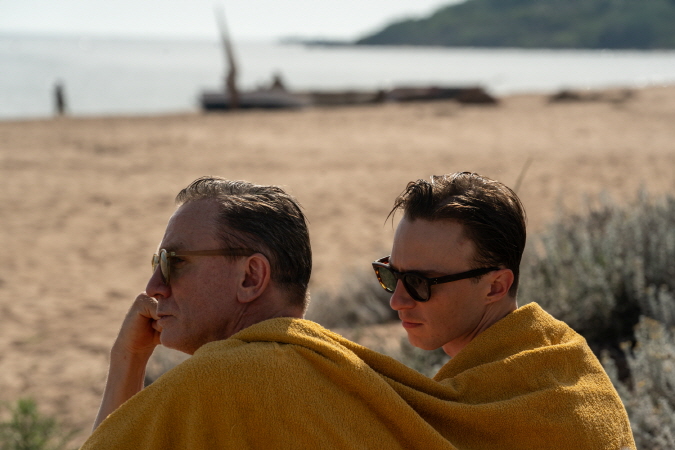
Luca Guadagnino’s latest film “Queer”, which came out not long after his previous film “Challengers” in the same year, often frustrated and baffled me. While this is another distinctive work of Guadagnino which is packed with an ample amount of mood and details, the movie is sometimes too languid and distant to engage me on the whole, and I got rather bored even when it belatedly interested me to some degree around its last act.
The movie is based on the novella of the same name by William S. Burroughs, a Beat Generation writer mainly known for his wild dopey works such as “Naked Lunch”, which was also adapted into a feature film by David Cronenberg in 1991. I still vividly remember when I came across the 1991 film via a cable TV movie channel at one late night in 2001, and, even though I am not so sure whether I love it or not, it was fairly interesting as a loony and weird mix of fiction and Burroughs’ messy personal life.
Like that film, “Queer” has a hero who is a fictional version of Burroughs. William Lee (Daniel Craig) is an American expatriate staying in Mexico City in the early 1950s, and the early part of the movie is mainly about how aimlessly he spends one day after another unless his mind focuses on drug or sex. There are always local young guys bound to attract his attention at local bars, and we later see him having a sex with one of those local lads in a shabby hotel.
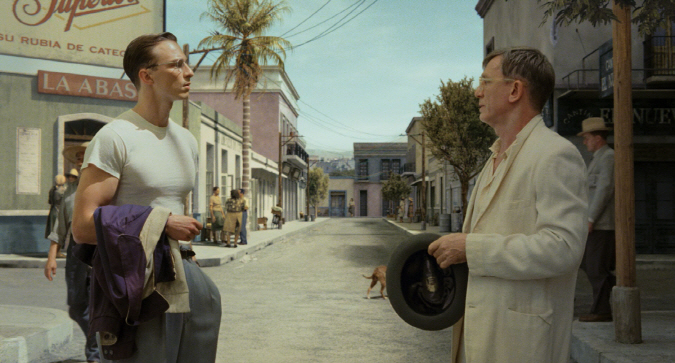
On one day, Lee comes to notice one handsome American lad which instantly draws his attention. This young American in question is Eugene Allerton (Drew Starkey), and, regardless of whether Allerton is really gay or not, Lee finds himself more attracted to him, and Allerton seems to be aware of this, even though he does not signify that much while usually flirting with some young woman right in front of Lee.
Eventually, there comes a point where Lee finally gets his wish, and we are accordingly served with an obligatory sex scene as expected, but, not so surprisingly, Lee finds himself still lonely and miserable as usual. Although he simply demands Allerton to hang around with him as much as he can, Allerton remains beyond his reach at times without making any genuine emotional connection between them, and this certainly annoys and frustrates Lee. Sure, he knows too well that Allerton is the one holding the power over their relationship, and he certainly tries to live with that, but, not so surprisingly, this makes him all the more discontented than before.
As a consequence, Lee comes to depend more on his drugs of choice, and then he becomes interested in using a certain South American natural drug, which may open his mind and will also probably help him connect more with Allerton. Although Allerton is not so willing at first, he agrees to accompany Lee when Lee decides to travel to somewhere in Ecuador, and the change of scenery seems to make Lee a bit better, though his drug addiction problem soon turns out to be more troublesome than expected.
Around that narrative point, we are supposed to be more engaged in Lee’s despair and frustration, but the screenplay by Justin Kuritzkes, who previously collaborated with Guadagnino in “Challengers”, does not delve that deep into its two main characters. Lee remains as a merely pathetic figure going down further toward the bottom of addiction just like Burroughs did in real life, and we never get to know anything about Allerton, who frequently looks like being beyond Lee’s reach as well as ours. In the other word, he is more or less than a distant object of desire like that pretty boy who captures the heart of the artist hero of Luchino Visconti’s “Death in Venice” (1971).

At least, Guadagnino and his crew members including cinematographer Sayombhu Mukdeeprom, who did a first-rate job in “Challengers”, decorate the screen with a lot of stylish elements to be appreciated. The first half of the movie is filled with a palpably languid sense of ennui and anxiety, and Daniel Craig, who is already moving onto the next phase of his career after his last James Bond film, and several other main cast members including Jason Schwartzman, who is rather unrecognizable due to his chubbier appearance here in this film, look believable as the unhappy inhabitants of their little hedonistic world. Although he does not have much to do except looking handsome and distant at first, Drew Starkey manages to fill his character to some degree, and his performance gets a little more interesting when his character goes into a remote Ecuadorian jungle area along with Lee later in the story.
With the delightfully hammy supporting turn by Leslie Manville, who plays a loony American botanist who may help Lee get that South American natural drug in question, the movie becomes more energized than before, but it is still too late in my trivial opinion. A series of following hallucinogenic moments may not impress you that much if you have seen “Naked Lunch”, and the last scene does not have enough emotional ground to be genuinely poignant from the beginning.
Overall, “Queer” is the first time Guadagnino disappoints me, and that is a shame because he has seldom disappointed me since “I Am Love” (2009), which was incidentally one of the best films I saw in 2010. At this point, he is already preparing to release a new movie a few months later, and I sincerely wish I will be more entertained.


 Seongyong's Private Place