

It is ironic that Jean-Luc Godard’s 1965 film “Alpaville”, whose 4K remastered version is being shown in South Korea at this point, is quite dry, distant, and abstract to the end without much feeling to sense. While the story itself seems to emphasize the importance of human emotion and spirit, this is another clinically cerebral exercise in style and genre from Godard, and I become more aware of its glaring flaws while admiring its striking style and mood enough for recommendation.
I must confess that “Alpaville” is one of the few films which actually made me quite drowsy more than once. When I watched it for the first time in 2002, I somehow fell asleep in the middle of the film, and that happened again when I revisited it a few years later. This time, I fortunately did not become drowsy, probably because everything felt bigger and louder as I watched it along with a few audiences in a fairly big screening room,
Oh, yes, just like some of Godard’s works, the movie draws our attention with its striking presentation of images and sounds right from the beginning, and it goes on and on. While we are served with plenty of philosophical/political statements, there are also a lot of other stuffs thrown to us here and there, and these stylish moments surely show us how much the movie is conscious of itself – or full of itself, shall we say.
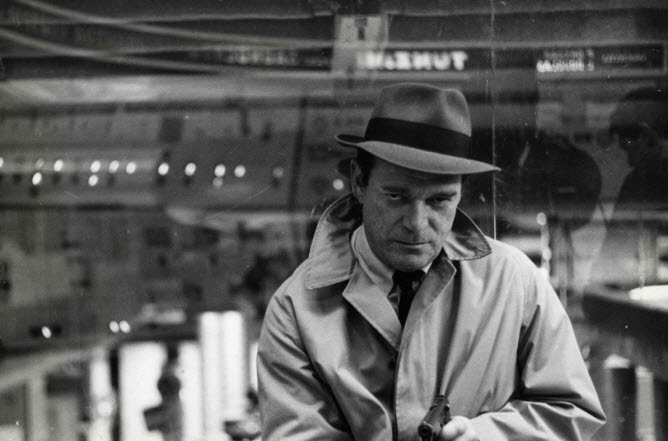
The story is set in a futuristic world called “Alphaville”, which is supposed to located somewhere in the space outside the Earth. The people of Alphaville have been thoroughly dominated and controlled by an omnipresent supercomputer which is virtually your average AI computer just like HAL 9000 in Stanley Kubrick’s “2001: A Space Odyssey” (1968), and they are not allowed to show or have any kind of emotion while only following the cold and emotionless logic of their technology.
The movie opens with the arrival of Lemy Caution (Eddie Constantine), an undercover agent who incidentally disguises himself as a journalist. Right from his arrival at a nice big hotel located in the middle of Alphaville, Caution, who is your typical film noir tough guy, is baffled a lot by the behaviors of the denizens of Alphaville, and there is an absurd moment when he adamantly refuses the service from a female hotel employee who is willing to provide sex if that is necessary.
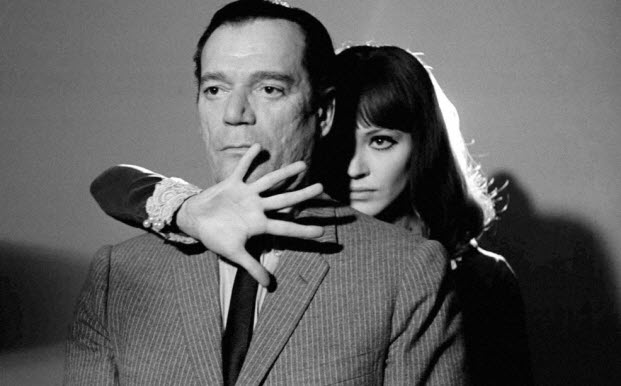
As Caution works on his secret mission, we get to know more about the absurd aspects of Alphaville via Natacha von Braun (Anna Karina, who divorced Godard around the time when the movie was released in 1965), a young beautiful woman who turns out to be the daughter of a certain important scientist working behind that supercomputer. At one point later in the story, she takes Caution to a special government ceremony where a group of subversives are executed just for being emotional, and that is one of the most chilling moments in the film.
Around that narrative point, Caution comes to face that supercomputer as expected. As the supercomputer asks him a series of supposedly important questions, we notice several microphones moving above his head more than once, and you may wonder what the hell the point of this actually is. Don’t ask me, because I can only tell you that Godard probably wants us to be more conscious of how the movie is about.
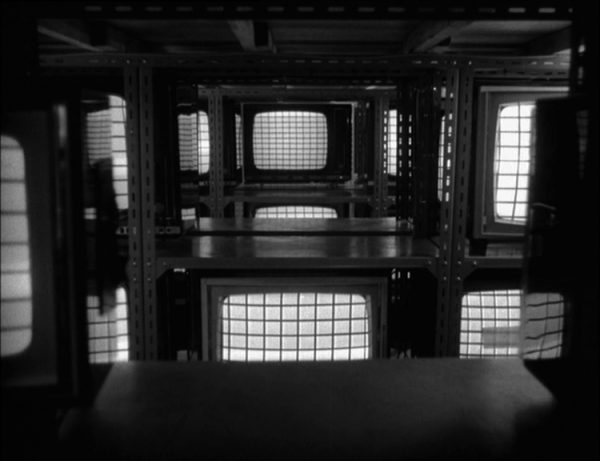
And the movie will always keep you alerted about how it is about. As going back and forth between the words of Caution and that supercomputer, it frequently inserts a number of various images and signs for no apparent reason, and it will continue to disorient you as before, but you may appreciate how Godard and his frequent cinematographer Raoul Coutard establish the distinctively alien mood and background on the screen. They deliberately shot the streets and alleys of Paris in extreme high contrast, and the overall result is often quite striking with the dryly ominous ambience surrounding the main characters in the film. Sure, you may be occasionally amused by some tacky details including those big and ungainly computer machines, but you become more intrigued as getting more immersed in its odd futuristic world.
However, I also must tell you that it is still hard and difficult to care more about the story and characters. For example, Caution is supposed to be a man more emotional than others around him, but he simply comes to us as a callous dude often wielding blatant sexism and misogyny along with the movie, which reminds me again of that unmistakable gender limit of many European white filmmakers during the 1960s. As far as I can see from the film, most of female figures in the film including Natasha are sexually objectified in one way or another throughout the story, and I would not be surprised at all if they all turned out to be female robots instead of real human beings. Furthermore, Eddie Constantine and Anna Karina do not generate much feeling between them although their characters are supposed to be gradually attracted to each other along the story, and that is the main reason why the last scene is not as emotionally effective as intended.
In conclusion, “Alphaville” is worthwhile to watch for its intriguing style and mood, but I still feel rather ambivalent about it for the reasons mentioned above. Yes, any serious moviegoer needs to watch a Godard film at movie theater at least once, but I would select “Breathless” (1959) or “Vivre sa vie” (1962) instead, and I sincerely advise you to be fully aware of what and how the movie is about in advance.


 Seongyong's Private Place