
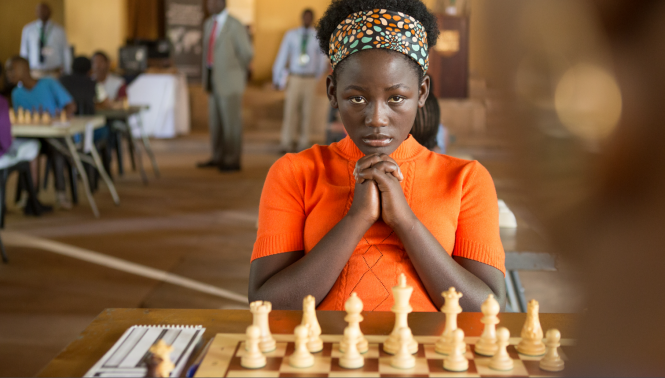
Mira Nair’s 2016 film “Queen of Katwe”, which is currently available on Disney+ presents a remarkable story about one extraordinary female chess player in Uganda. She was born in a slum neighborhood of Kampala, Uganda, but she and several other neighborhood kids came to find their unexpected talent and potential thanks to their dedicated chess coach, and, as touchingly shown at the end of the film, that did change their lives a lot.
The story mainly revolves around a 10-year-old girl named Phiona Mutesi (Madina Nalwanga), and the early part of the film focuses on how things have been difficult and desperate for her and her family. After losing her husband and eldest child some years ago, Phiona’s mother Nakku Harriet (Lupita Nyong’o) has struggled a lot with the following economic hardship, and Phiona and her younger brother often have to sell maize on the streets of Katwe, a slum neighborhood outside Kampala, along with their mother for supporting their family as much possible.
Meanwhile, the movie also pays attention to Robert Katende (David Oyelowo), a young man who has worked as a soccer coach at a local youth center as trying to get hired as an engineer someday. On one day, he decides to start a little chess club for those poor kids in Katwe because 1) he sincerely wants the kids to go for more intelligence and confidence 2) he happens to have considerable knowledge on chess. Although the first day of his chess club is not that promising, the kids gradually show more interest in chess, and this draws the interest of Phiona when she comes to the chess club along with her younger brother.

While she does not even know how to read, Katende willingly lets Phiona into the chess club, and we see how she gets to know the rules of chess game bit by bit and then begins to surprise everyone around her. Within a short period of time, she becomes the most prominent chess player in the group, and Katende is willing to support not only her but also several other considerably talented kids as much as he can. Although there is not any available money for allowing his talented kids to participate in a big local junior chess tournament, he manages to get the money in the end, and, of course, Phiona and her fellow chess players prove themselves more at that tournament.
However, the movie never overlooks that there is still the harsh reality for Phiona and her family whenever she is not playing chess – especially when they get much poorer due to an unexpected incident. As things become all the more desperate for her and her family, Phiona naturally comes to wonder whether chess can really help her and her life, but she keeps getting supported by her coach as well as her mother, who does not know that much about chess but is always ready to do anything for her children’s welfare.
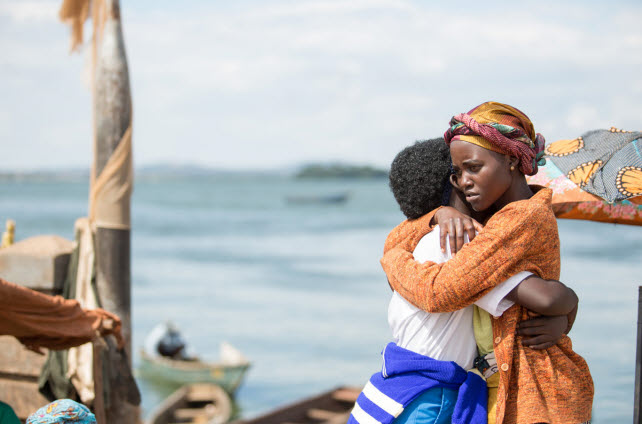
Clearly recognizing the complex aspects of its young heroine’s situation, the screenplay by William Wheeler, which is based on the nonfiction book of the same named by Tim Crothers, patiently builds up the story and characters along its engaging narrative. Yes, there eventually comes a point where our young heroine comes to have some painful lesson about life and chess, but this and several expected moments in the film are handled with enough thoughtfulness and sensitivity, and we come to root more for not only her but also several supporting characters around her. There is a little touching moment when Katende shows more of his goodwill and sincerity to Phiona as a man who also had a fair share of childhood hardship, and then we get a poignant scene when her mother eventually decides to make some sacrifice for helping Phiona more.

In case of several chess game scenes in the film, they do not reach to what is so electrifyingly shown in recent Netflix miniseries “The Queen’s Gambit” as having less detail and excitement in comparison, but the movie stays focused on character and drama as before, while occasionally showing some humor via Phiona’s fellow chess players. They may be less skillful than her, but they are bright and colorful kids nonetheless, and that is another reason why the obligatory epilogue part of the film feels so inspiring.
Above all, the movie is anchored well by the unadorned natural performance by young performer Madina Nalwanga. Although she did have any previous acting experience before, Nalwanga did a commendable job of imbuing her role with enough spirit and pluck besides holding her own place well between her two much more experienced co-starts, and several other young cast members in the film are equally splendid in their respective supporting parts. In case of David Oyelowo, who incidentally became more notable after his substantial supporting performance in Kevin Macdonald’s Oscar-winning film “The Last King of Scotland” (2006), Lupita Nyong’o, their understated actings ably embody their characters’ decency and dignity. and they are particularly wonderful when their characters come to have a serious conversation on Phiona’s future at one point in the middle of the story.
On the whole, “Queen of Katwe” is recommendable for its solid storytelling and good performances to watch, though it is less impressive than director Mira Nair’s previous acclaimed works such as “Salaam Bombay!” (1988) and “The Namesake” (2006). It is really a shame that she has been relatively quiet during last several years since “Queen of Katwe” came out, and I sincerely hope that she will soon be back in action.


 Seongyong's Private Place