

“Young Woman and the Sea”, which is currently available on Disney+, is a biographic film about one remarkable woman who showed that women can do anything as much as men. While her extraordinary achievement certainly deserves to be known more to us, the movie is unfortunately rather plain and clichéd in comparison, and that is a shame considering the commendable efforts from its lead actress.
Daisy Ridley, who seems ready to go further than the recent Star Wars trilogy, plays Gertrude “Trudy” Ederle, an American competition swimmer who became the first woman to swim across the English Channel in 1926. The early part of the film focuses on her childhood years in New York City during the 1910s, and we see how young Ederle became interested in swimming just because her older sister was allowed to learn swimming under their no-nonsense mother’s insistence. Although she has to be careful about losing hearing after suffering a severe case of measles, young Ederle enjoys swimming more and more, and she and her older sister eventually join a local Woman’s Swimming Association later.
Under their trainer who comes to recognize Ederle’s potential and passion, Ederle keeps going further during next several years. In the end, she comes to participate in the 1924 Paris Olympics, but her older sister, who has been content with her younger sister swimming better than her in many competitions, cannot go just because there is only one spot available.

Anyway, Ederle and several other members of the US women’s team are supervised by a German trainer named Jabez Wolffe (Christopher Eccleston) during their trip to the 1924 Paris Olympics, and we see how much they are disregarded and discriminated by their mean trainer. While those American male athletes are allowed to do routine training on the ship everyday, Ederle and the other American female athletes are not allowed to do that in contrast, and Wolffe does not pay much attention to their training or welfare while more concerned about his seasickness.
As a result, Ederle shows a worse result than expected at the 1924 Paris Olympics, and she feels all the more daunted when her older sister subsequently chooses to follow their conservative parents’ wish and then marry some German immigrant guy to help their father’s butchery business. However, after seeing that she has been a role model for many young girls out there, she becomes determined to find any possible way for swimming more and then getting recognized more, and she soon sets herself against a very demanding challenge: swimming across the English Channel.
From that narrative point, the screenplay by Jeff Nathanson, which is based on Glenn Stout’s nonfiction book of the same name, takes a more predictable course. After succeeding in getting full sponsorship, Ederle begins to prepare along with Wolffe just because he happens to be assigned to her as a guy who attempted to swim the channel more than once, and, not so surprisingly, they do not get along that well with each other from the beginning. The movie even suggests that Wolffe deliberately sabotaged Ederle’s first attempt to swim across the channel, but I must tell you that this is entirely fictional as far as I learned from Wikipedia later.
The last act of the movie focuses on Ederle’s second attempt, which is assisted by Bill Burgess (Stephen Graham), who was the second guy who successfully swam across the channel. Despite looking crude and coarse on the surface, Burgess turns out to be a much better trainer for her than Wolffe, and her family show full support as usual.
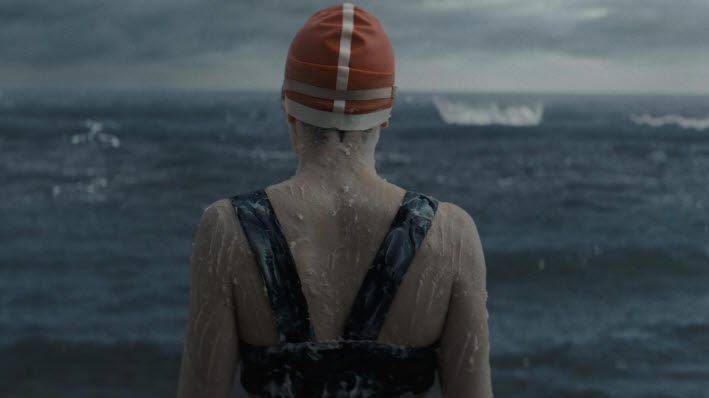
What follows next is a series of grueling obstacles Ederle has to face as trying to swim across the channel for the second time. Besides her accumulating physical exhaustion, she must endure the cold water temperature and unpredictable current changes of the channel, and she also has to be careful about those jellyfish in the sea.
Now some of you are probably reminded of recent Oscar-nominated Netflix film “Nyad” (2023), which is about a real-life competitive swimmer swimming against a similar challenge. Although the climatic part of “Young Woman and the Sea” looks fairly realistic under the competent direction of director Joachim Rønning, this still looks less palpable and impressive compared to “Nyad”, and the movie also is deficient in terms of story and characters. While Ederle is presented as your average clean-cut heroine, many supporting characters around her are more or less than stereotypes, and this often makes the film less engaging in my humble opinion.
At least, Ridley and the other main cast members in the movie try as much as they can. While her earnest performance carries the film to the end, Christopher Eccleston Tilda Cobham-Hervey, Kim Bodnia, Jeanette Hain, Glenn Fleshler, and Sian Clifford dutifully fill their respective spots around her, and the special mention goes to Stephen Graham, who brings some spirit and personality to the story as well as his character.
On the whole, “Young Woman and the Sea” does not impress me enough for recommendation, but it made me want to know about its admirable real-life heroine at least. As shown at the end of the story, Ederle continued to live the life of a trailblazer during the rest of her life, and her life and achievements certainly deserve something better than this passable biography film.


 Seongyong's Private Place
And it’s a neat title. Having been a swimming teacher for many years, I’d be curious to see this, and Nyad, but I’m afraid I’m strictly a cinemagoer. The one swimming biopic I did catch was Esther Williams in Million Dollar Mermaid, which was in the Seoul Women’s Film Festival several years ago.
SC: I should check out that film some day…