
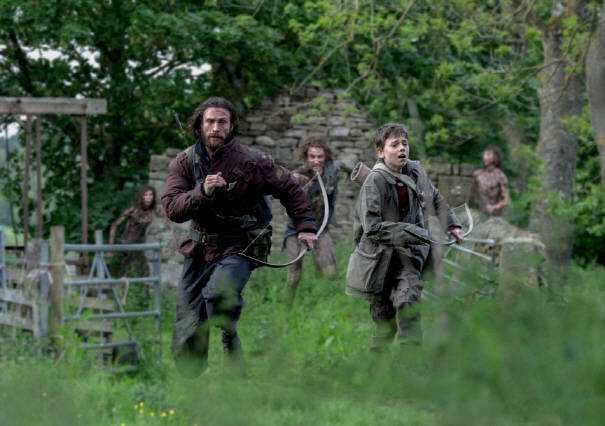
Danny Boyle’s latest film “28 Years Later” reminds me again that he is a filmmaker who has rarely repeated himself. Yes, he is back in that post-apocalyptic world explored in “28 Days Later” (2002), and we are surely served with a number of gory and bloody moments involved with those raging zombies, but, to my little surprise, the movie turns out to be more thoughtful and meditative than expected.
At the beginning, the movie quickly establishes how things have been grim and hopeless in Britain and Ireland since what happened at the beginning of “28 Days Later”. After a highly infectious virus nicknamed the “Rage virus” was spread from a medical research center in London, Britain and Ireland were eventually quarantined, and the remaining survivors have been stuck there during next 28 years while nearly isolated from the outside world.
The early part of the film is mainly set in an island where a bunch of survivors have peacefully lived together for many years. Except for a tidal causeway to the mainland, the island has been totally and safely separated from the mainland filled with lots of infected people, and the movie observes a bit of how the survivors in the island go through another day of their shabby life as doing their respective tasks.
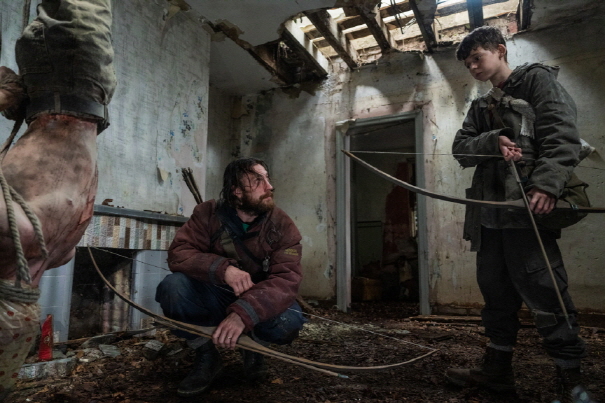
One of them is a guy named Jamie (Aaron Taylor-Johnson), a scavenger who has lived with his ailing wife Isla (Jodie Comer) and their 12-year-old son Spike (Alfie Williams). He is going to supervise a coming-of-age initiation to be done by his son in the mainland, and Spike seems to be ready for that, though he is more concerned about how his mother has become sicker day by day for some unspecified medical problem.
Once Spike and his father enter the mainland with their bows and arrows, we get to know more about how dangerous the mainland is despite looking quiet and peaceful on the surface. There are still a lot of infected people here and there in the mainland, and some of them are more dangerous due to having more strength due to that virus. Not long after Spike manages to kill one infected person as required, he and his father find themselves chased by one of those more dangerous infected people, and that leads to one of the most intense moments in the film.
After learning about a certain mysterious survivor who may be a doctor, Spike naturally becomes interested in bringing his mother to that figure who lives somewhere in the mainland, and the second half of the film follows his following impulsive journey along with his mother. Again, Spike is reminded of how he is not totally prepared for dealing with those infected people out there, but he tries as much as possible nonetheless, and his mother turns out to be more helpful than expected even though her medical condition keeps getting worse as before.
As their perilous journey is continued, the screenplay by co-producer Alex Garland, who also wrote the screenplay for “28 Days Later” and then impressed us more as directing several feature films including “Ex Machina” (2014) and “Civil War” (2024), takes some time for more character development. While we certainly get several scary scenes involved with those infected people, the movie stays focused on the relationship between Spike and his mother, and we come to sense more of the strong emotional bond between them.
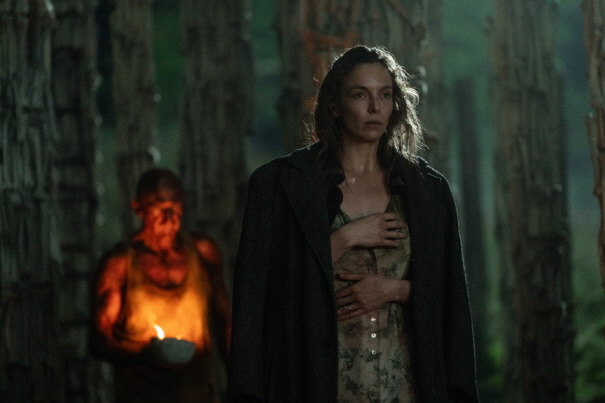
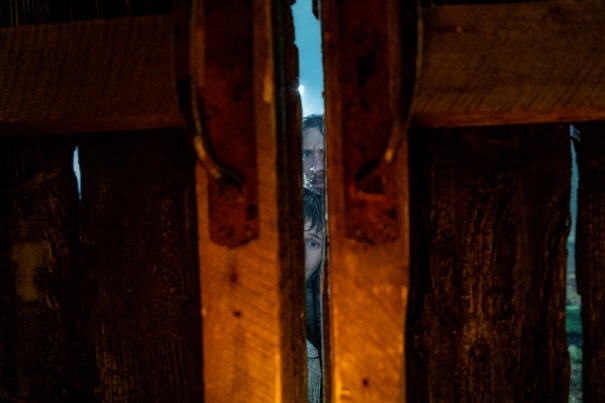
In addition, the movie constantly emphasizes how everything looks alien and unsettling to its main characters in one way or another. The cinematography by Anthony Dod Mantle, who won an Oscar for Boyle’s previous film “Slumdog Millionaire” (2008), often conveys to us the anxious mood surrounding the main characters, and that is why a few brief but surprisingly tender moments later in the film are quite effective. The editing by Jon Harris feels rather distracting at first due to frequent jump cuts throughout the film, but this jumpy editing style somehow works along with the increasing dread and anxiety along the story, and that is accentuated further by the intentionally jarring score by Young Fathers.
The main cast members of the film are terrific on the whole. While Jodie Comer and Aaron Taylor-Johnson dutifully hold the ground, young performer Alfie Williams is convincing in his character’s gradual growth and maturation along the story, and Jack O’Connell and Edvin Ryding are well-cast in their substantial crucial supporting parts. In case of Ralph Fiennes, he has some juicy fun with that mysterious character who will surely remind you a bit of Colonel Kurts in “Apocalypse Now” (1979), and he is particularly wonderful when his character gently handles an important moment between Spike and his mother later in the story.
Overall, “28 Years Later” is relatively more somber compared to the sheer intensity of “28 Days Later”, and that may let you down a little, but it will engage you with its good mood, storytelling, and performance instead. As reflected by its final scene, there will be the following sequel in the next year, and, considering how “28 Years Later” demonstrates more potential and interest in its familiar genre territory, I think we can have some expectation on whatever may come next after this solid installment.


 Seongyong's Private Place
Pingback: 10 movies of 2025 – and more: Part 2 | Seongyong's Private Place